QUESTION IMAGE
Question
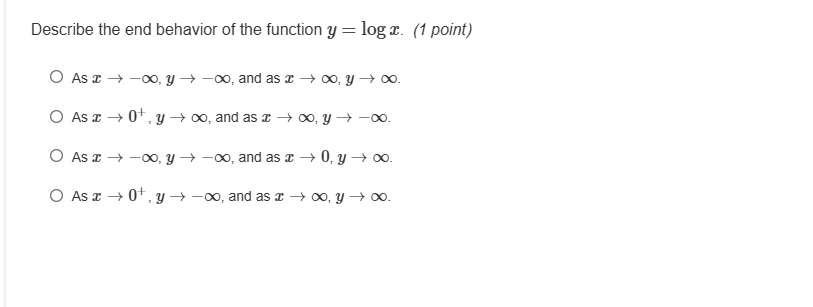
describe the end behavior of the function $y = \log x$. (1 point) \bigcirc as $x \to -\infty$, $y \to -\infty$, and as $x \to \infty$, $y \to \infty$. \bigcirc as $x \to 0^+$, $y \to \infty$, and as $x \to \infty$, $y \to -\infty$. \bigcirc as $x \to -\infty$, $y \to -\infty$, and as $x \to 0$, $y \to \infty$. \bigcirc as $x \to 0^+$, $y \to -\infty$, and as $x \to \infty$, $y \to \infty$.
The function \( y = \log x \) (assuming base 10 or natural logarithm, the domain is \( x>0 \)). As \( x \) approaches \( 0 \) from the right (\( x \to 0^+ \)), the logarithm function has a vertical asymptote and \( y \) approaches \( -\infty \) (since log of a number very close to 0 is a large negative number). As \( x \) approaches \( +\infty \), the logarithm function increases without bound, so \( y \to \infty \). Now let's analyze each option:
- First option: The domain of \( \log x \) does not include \( x \to -\infty \) (since log is only defined for \( x>0 \)), so this is wrong.
- Second option: As \( x \to \infty \), \( \log x \) should go to \( \infty \), not \( -\infty \), so this is wrong.
- Third option: \( \log x \) is not defined for \( x \to -\infty \), and as \( x \to 0 \), \( y \to -\infty \) (not \( \infty \)), so this is wrong.
- Fourth option: Correctly describes the end - behavior as \( x \to 0^+ \) ( \( y \to -\infty \)) and as \( x \to \infty \) ( \( y \to \infty \)).

Snap & solve any problem in the app
Get step-by-step solutions on Sovi AI
Photo-based solutions with guided steps
Explore more problems and detailed explanations
D. As \( x \to 0^{+} \), \( y \to -\infty \), and as \( x \to \infty \), \( y \to \infty \) (assuming the options are labeled A, B, C, D in order as given in the problem)