QUESTION IMAGE
Question
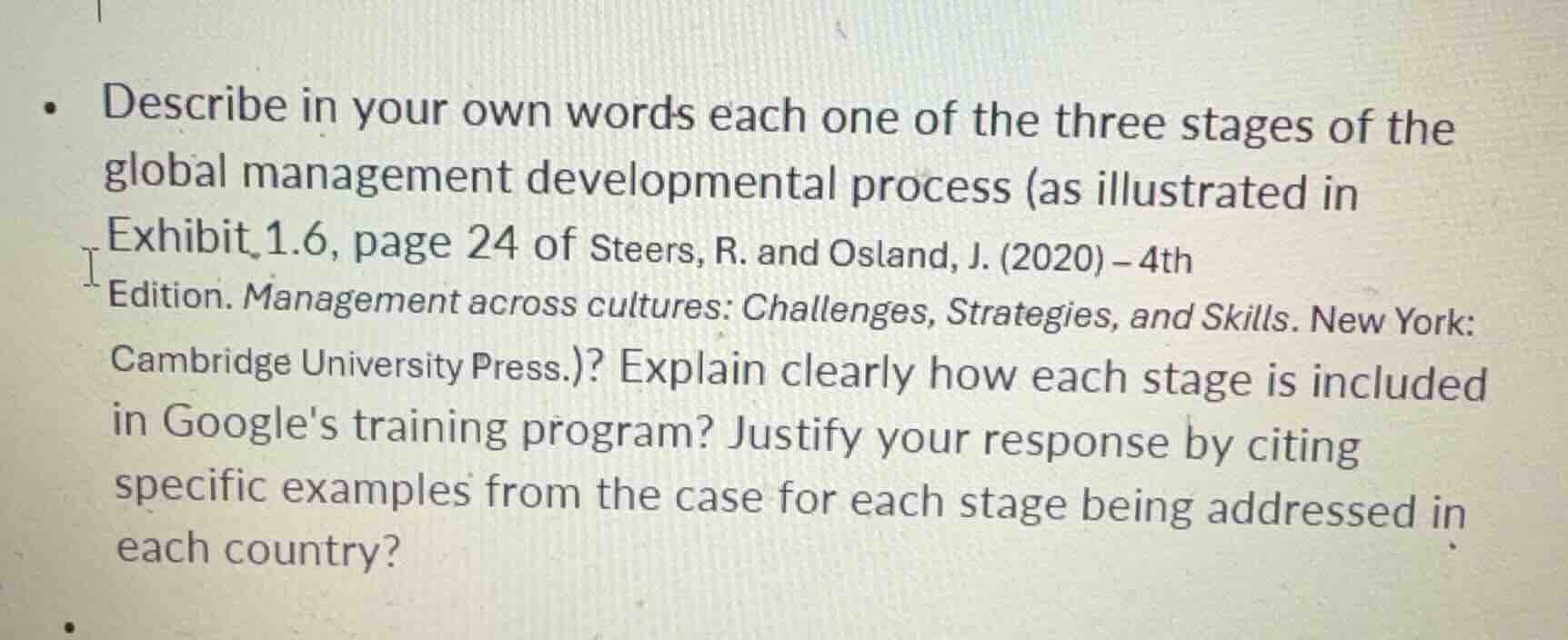
describe in your own words each one of the three stages of the global management developmental process (as illustrated in exhibit 1.6, page 24 of steers, r. and osland, j. (2020) – 4th edition. management across cultures: challenges, strategies, and skills. new york: cambridge university press.)? explain clearly how each stage is included in googles training program? justify your response by citing specific examples from the case for each stage being addressed in each country?
To answer this, we first recall the three stages of the global management developmental process from the referenced text (Steers & Osland, 2020):
1. Pre - departure Stage
This stage focuses on preparing managers for international assignments. It includes training on cultural awareness, language (if needed), understanding the business context of the host country, and basic logistical preparation (e.g., visa, housing).
2. On - assignment Stage
During the assignment, managers adapt to the host country’s work environment, culture, and business practices. They build relationships with local colleagues, clients, and stakeholders, and implement strategies while navigating cultural differences in communication, decision - making, and work norms.
3. Post - assignment Stage
After the international assignment, managers reintegrate into their home - country organization. They share their international experiences (e.g., new skills, cultural insights, global business knowledge) with the organization, and the organization leverages these learnings for future global initiatives.
Applying to Google’s Training Program (Hypothetical/Generalized, as Case Details Aren’t Provided Here)
Pre - departure:
- Google likely provides cultural immersion training for managers going to countries like India or Japan. For example, training on Indian business etiquette (e.g., hierarchy in meetings, gift - giving norms) or Japanese communication styles (e.g., indirect communication, respect for seniority). Language training (e.g., basic Mandarin for China - bound managers) might also be included.
- They may brief managers on local regulatory environments (e.g., data privacy laws in the EU for managers going to European offices).
On - assignment:
- In a country like Brazil, Google managers might participate in on - the - job coaching to adapt to Brazilian work culture (e.g., flexible work timings, relationship - based business). They could collaborate with local teams to understand consumer behavior (e.g., how Brazilians use Google services differently) and adjust product strategies accordingly.
- In Singapore, managers might be part of cross - cultural project teams, learning to work with colleagues from diverse Asian cultures (e.g., Singaporean, Malaysian, Chinese) and integrating regional insights into Google’s APAC strategy.
Post - assignment:
- A manager returning from a South Korean assignment might present at internal workshops, sharing how Korean users’ preference for mobile - first search influenced product design. Google could then use this insight to refine its mobile search algorithms globally.
- The organization might create “global knowledge repositories” where post - assignment managers document best practices (e.g., successful cross - cultural negotiation tactics in the Middle East) for future use.
Justification with Country - Specific Examples (Generalized)
- Pre - departure (e.g., for a US - based manager going to Germany):
Google would train on German business culture (punctuality, formal communication in meetings) and legal requirements (e.g., German labor laws). This ensures the manager is prepared to work in a structured, rule - based German business environment.
- On - assignment (e.g., in France):
The manager adapts to French work - life balance norms (shorter workweeks, longer lunch breaks) while collaborating with local teams on Google’s AI research initiatives. They learn to navigate French corporate hierarchy and decision - making processes (e.g., more top - down in some Frenc…

Snap & solve any problem in the app
Get step-by-step solutions on Sovi AI
Photo-based solutions with guided steps
Explore more problems and detailed explanations
To answer this, we first recall the three stages of the global management developmental process from the referenced text (Steers & Osland, 2020):
1. Pre - departure Stage
This stage focuses on preparing managers for international assignments. It includes training on cultural awareness, language (if needed), understanding the business context of the host country, and basic logistical preparation (e.g., visa, housing).
2. On - assignment Stage
During the assignment, managers adapt to the host country’s work environment, culture, and business practices. They build relationships with local colleagues, clients, and stakeholders, and implement strategies while navigating cultural differences in communication, decision - making, and work norms.
3. Post - assignment Stage
After the international assignment, managers reintegrate into their home - country organization. They share their international experiences (e.g., new skills, cultural insights, global business knowledge) with the organization, and the organization leverages these learnings for future global initiatives.
Applying to Google’s Training Program (Hypothetical/Generalized, as Case Details Aren’t Provided Here)
Pre - departure:
- Google likely provides cultural immersion training for managers going to countries like India or Japan. For example, training on Indian business etiquette (e.g., hierarchy in meetings, gift - giving norms) or Japanese communication styles (e.g., indirect communication, respect for seniority). Language training (e.g., basic Mandarin for China - bound managers) might also be included.
- They may brief managers on local regulatory environments (e.g., data privacy laws in the EU for managers going to European offices).
On - assignment:
- In a country like Brazil, Google managers might participate in on - the - job coaching to adapt to Brazilian work culture (e.g., flexible work timings, relationship - based business). They could collaborate with local teams to understand consumer behavior (e.g., how Brazilians use Google services differently) and adjust product strategies accordingly.
- In Singapore, managers might be part of cross - cultural project teams, learning to work with colleagues from diverse Asian cultures (e.g., Singaporean, Malaysian, Chinese) and integrating regional insights into Google’s APAC strategy.
Post - assignment:
- A manager returning from a South Korean assignment might present at internal workshops, sharing how Korean users’ preference for mobile - first search influenced product design. Google could then use this insight to refine its mobile search algorithms globally.
- The organization might create “global knowledge repositories” where post - assignment managers document best practices (e.g., successful cross - cultural negotiation tactics in the Middle East) for future use.
Justification with Country - Specific Examples (Generalized)
- Pre - departure (e.g., for a US - based manager going to Germany):
Google would train on German business culture (punctuality, formal communication in meetings) and legal requirements (e.g., German labor laws). This ensures the manager is prepared to work in a structured, rule - based German business environment.
- On - assignment (e.g., in France):
The manager adapts to French work - life balance norms (shorter workweeks, longer lunch breaks) while collaborating with local teams on Google’s AI research initiatives. They learn to navigate French corporate hierarchy and decision - making processes (e.g., more top - down in some French firms) to drive projects.
- Post - assignment (e.g., returning from Canada):
The manager shares insights on Canadian tech startup ecosystems (e.g., how Google can partner with Canadian AI startups). Google then uses this to strengthen its innovation partnerships in North America.
If specific case details were provided (e.g., from a Google case study), we would tailor examples to match the actual initiatives (e.g., Google’s “Noogler” training for new hires, but adapted for international managers).
Note
Since the original question references a “case” (which isn’t provided here), the above examples are generalized. To fully justify, one would need to analyze the specific Google case (e.g., from a business school case study) and map each stage to the case’s details (e.g., how Google trained managers for a specific international expansion).
Final Answer (Structure for the Question)
To fully answer, you would:
- Define each stage (pre - departure, on - assignment, post - assignment) based on the text.
- For each stage, explain Google’s training (using the case’s examples, e.g., if the case is about Google’s India expansion, use India - specific examples).
- Justify by citing how each stage’s activities (e.g., pre - departure cultural training, on - assignment local collaboration, post - assignment knowledge sharing) align with Google’s practices in different countries.
(If the case had specific details, the answer would be more precise. As the case isn’t provided, this is a framework to follow.)