QUESTION IMAGE
Question
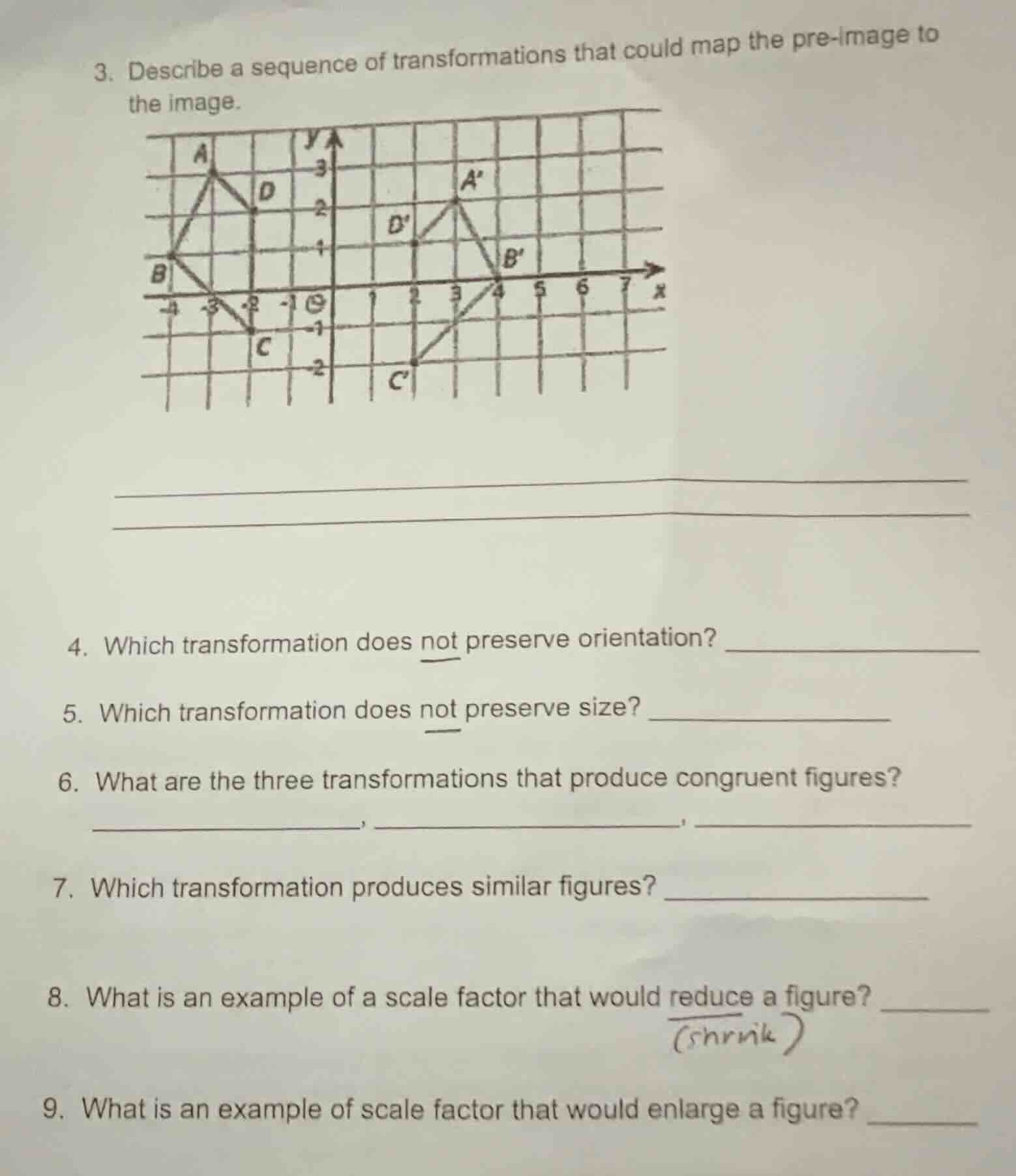
- describe a sequence of transformations that could map the pre - image to the image.
- which transformation does not preserve orientation?
- which transformation does not preserve size?
- what are the three transformations that produce congruent figures?
- which transformation produces similar figures?
- what is an example of a scale factor that would reduce a figure?
- what is an example of scale factor that would enlarge a figure?
Question 3
Step1: Identify Translation Direction
First, observe the horizontal shift. The pre - image (original figure) and the image (transformed figure) can be shifted horizontally. Let's take a point, say \(A(-3,3)\) and \(A'(3,2)\). Wait, maybe a better approach: first, check the horizontal and vertical shifts. Alternatively, we can consider a translation and then a reflection or other transformations. Let's look at the coordinates:
Pre - image points: \(A(-3,3)\), \(B(-4,1)\), \(C(-2,-1)\), \(D(-2,2)\)
Image points: \(A'(3,2)\), \(B'(4,0)\), \(C'(2,-2)\), \(D'(2,1)\)
First, let's do a horizontal translation. The x - coordinate of \(A\) is \(-3\) and of \(A'\) is \(3\). The difference is \(3-(-3)=6\), so a horizontal translation of \(6\) units to the right. Then, the y - coordinate of \(A\) is \(3\) and of \(A'\) is \(2\), so a vertical translation of \(1\) unit down.
Alternatively, we can also consider a reflection, but the translation seems more straightforward.
So one possible sequence: Translate the pre - image 6 units to the right and 1 unit down.
(Another way: We can also check for reflection. If we reflect over the line \(x = 0\) (y - axis), the x - coordinates change sign. For point \(A(-3,3)\), reflection over y - axis gives \((3,3)\), then translate 1 unit down to get \((3,2)\) which is \(A'\). Let's check \(B(-4,1)\): reflection over y - axis is \((4,1)\), translate 1 unit down to \((4,0)\) which is \(B'\). \(C(-2,-1)\): reflection over y - axis is \((2,-1)\), translate 1 unit down to \((2,-2)\) which is \(C'\). \(D(-2,2)\): reflection over y - axis is \((2,2)\), translate 1 unit down to \((2,1)\) which is \(D'\). So another sequence: Reflect the pre - image over the y - axis and then translate 1 unit down.
Orientation in transformations: Rotation and translation preserve orientation (the order of points, clockwise or counter - clockwise, remains the same). Reflection (a flip over a line) changes the orientation. For example, if you have a triangle with vertices in clockwise order, after a reflection, the order becomes counter - clockwise (or vice - versa). Dilation preserves orientation (since it just scales the figure). So the transformation that does not preserve orientation is reflection.
Transformations: Translation, reflection, and rotation are rigid transformations (isometries) that preserve size (lengths, angles, area, etc.). Dilation is a transformation that changes the size of the figure. In dilation, we scale the figure by a scale factor \(k\). If \(k
eq1\), the size of the figure (e.g., side lengths, area) changes. So the transformation that does not preserve size is dilation.

Snap & solve any problem in the app
Get step-by-step solutions on Sovi AI
Photo-based solutions with guided steps
Explore more problems and detailed explanations
One possible sequence is: Reflect the pre - image over the y - axis and then translate 1 unit down (or translate 6 units to the right and 1 unit down, or other valid sequences of transformations like translation and then reflection etc.)