QUESTION IMAGE
Question
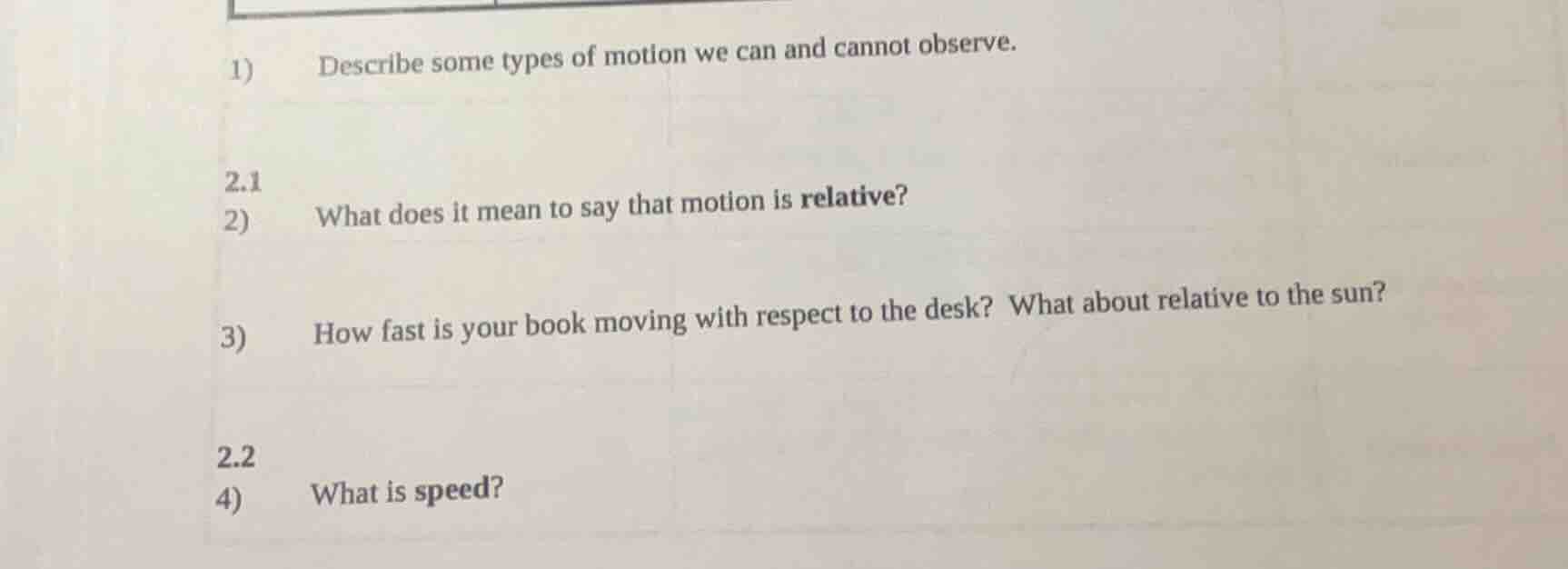
- describe some types of motion we can and cannot observe.
2.1
- what does it mean to say that motion is relative?
- how fast is your book moving with respect to the desk? what about relative to the sun?
2.2
- what is speed?
Brief Explanations
- For observable motion: These are movements we can directly see or detect with basic senses. Unobservable motion is too small, slow, or fast for human perception without tools.
- Motion being relative means an object's movement is only defined compared to another chosen reference point.
- The book's speed depends entirely on the reference frame; the desk is a stationary local frame, while the sun is a moving cosmic frame.
- Speed is a core kinematic quantity that measures how quickly an object covers distance.

Snap & solve any problem in the app
Get step-by-step solutions on Sovi AI
Photo-based solutions with guided steps
Explore more problems and detailed explanations
- Observable motion examples:
- Translational motion: A car driving down a road, a person walking.
- Rotational motion: A spinning ceiling fan, a turning bicycle wheel.
Unobservable motion examples:
- Atomic/subatomic motion: Vibrations of atoms in a solid, movement of electrons around an atomic nucleus.
- Very slow motion: Continental drift (tectonic plates moving a few centimeters per year).
- It means that an object's state of motion (moving or stationary) can only be defined by comparing it to a chosen reference point; there is no absolute "stationary" frame of reference.
- Relative to the desk: The book has a speed of 0 m/s (it is stationary if resting on the desk).
Relative to the sun: The book moves at ~30 km/s, matching Earth's orbital speed around the sun.
- Speed is a scalar quantity that measures the rate at which an object covers a distance, calculated as the distance traveled divided by the time taken.