QUESTION IMAGE
Question
describing the simulation of a geometric probability distribution
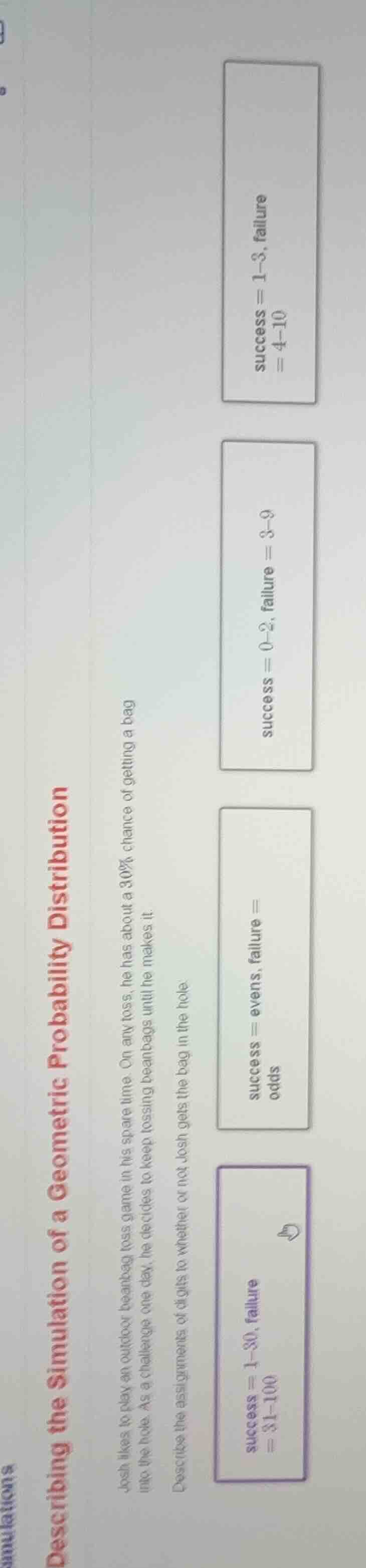
josh likes to play an outdoor beanbag toss game in his spare time. on any toss, he has about a 30% chance of getting a bag into the hole. as a challenge one day, he decides to keep tossing beanbags until he makes it.
describe the assignments of digits to whether or not josh gets the bag in the hole
odds
success = evens, failure =
success = 0–2, failure = 3–9
success = 1–3, failure = 4–10
Step1: Understand the success probability
Josh has a 30% chance of success (getting the bag in the hole), so the probability of success \( p = 0.3 \) and failure \( q=1 - 0.3=0.7 \). We need to find which digit assignment represents success with probability 0.3.
Step2: Analyze each option
- Option 1: success = evens, failure = odds. Probability of evens (2,4,6,8,10) in 1 - 10 is \( \frac{5}{10}=0.5 \), not 0.3.
- Option 2: success = 0 - 2, failure = 3 - 9. But digits are likely 1 - 10 (since it's a simulation with digits 1 - 10 maybe). If 0 - 2 is considered, but if digits are 1 - 10, 1 - 3 (3 digits) for success: probability \( \frac{3}{10} = 0.3 \), failure 4 - 10 (7 digits) \( \frac{7}{10}=0.7 \). Wait, the third option: success = 1 - 3, failure = 4 - 10. Number of success digits: 3 (1,2,3), total digits 10. Probability of success \( \frac{3}{10}=0.3 \), failure \( \frac{7}{10}=0.7 \), which matches \( p = 0.3,q = 0.7 \). The fourth option: success = 1 - 80, failure = 81 - 100? No, the context is a digit - based simulation, likely 1 - 10. So the correct assignment is success = 1 - 3, failure = 4 - 10.

Snap & solve any problem in the app
Get step-by-step solutions on Sovi AI
Photo-based solutions with guided steps
Explore more problems and detailed explanations
success = 1 - 3, failure = 4 - 10