QUESTION IMAGE
Question
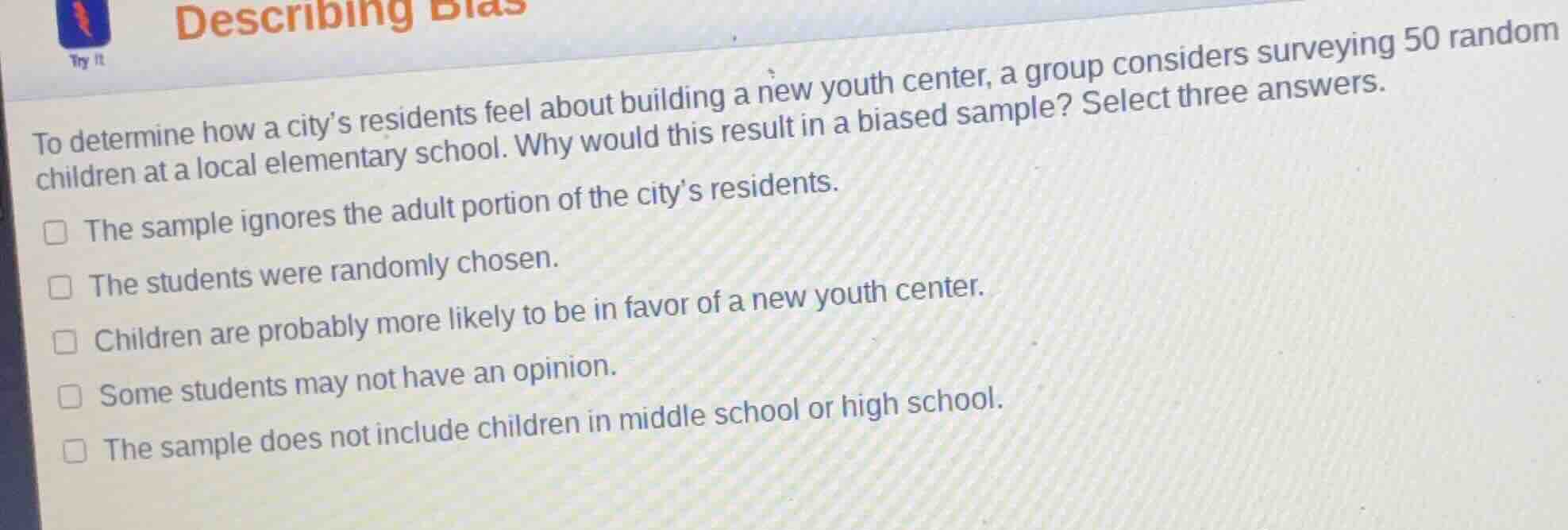
to determine how a city’s residents feel about building a new youth center, a group considers surveying 50 random children at a local elementary school. why would this result in a biased sample? select three answers. the sample ignores the adult portion of the city’s residents. the students were randomly chosen. children are probably more likely to be in favor of a new youth center. some students may not have an opinion. the sample does not include children in middle school or high school.
Brief Explanations
- A biased sample fails to represent the full population; adults are a key part of the city's residents, so excluding them creates bias.
- Children have a direct personal benefit from a youth center, so their opinions are likely skewed positively, not reflecting the broader population's views.
- The sample only includes elementary school children, excluding older children (middle/high school) who are also part of the relevant population for a youth center, limiting representativeness.

Snap & solve any problem in the app
Get step-by-step solutions on Sovi AI
Photo-based solutions with guided steps
Explore more problems and detailed explanations
- The sample ignores the adult portion of the city's residents.
- Children are probably more likely to be in favor of a new youth center.
- The sample does not include children in middle school or high school.