QUESTION IMAGE
Question
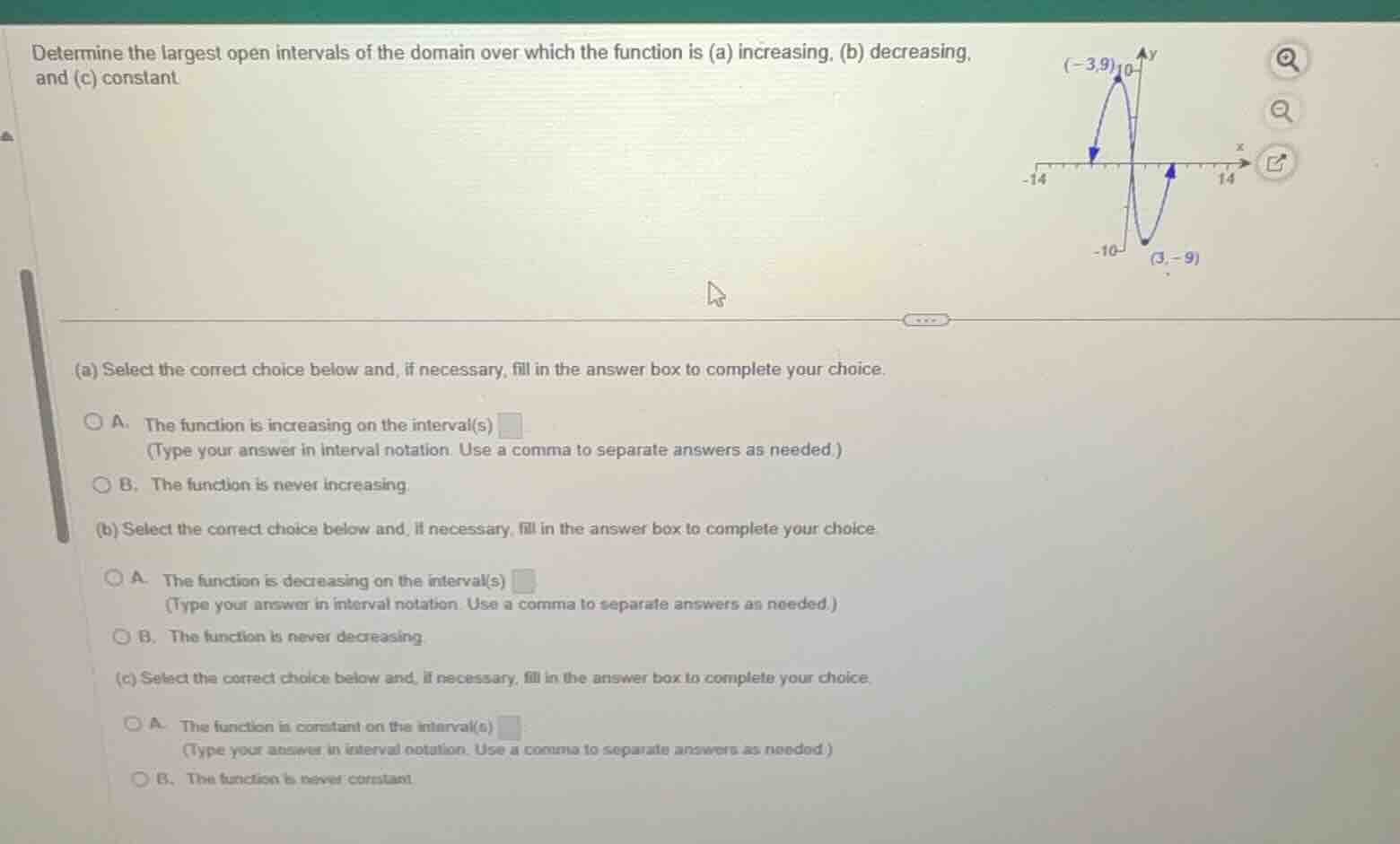
determine the largest open intervals of the domain over which the function is (a) increasing, (b) decreasing, and (c) constant
(a) select the correct choice below and, if necessary, fill in the answer box to complete your choice.
a. the function is increasing on the interval(s)
(type your answer in interval notation. use a comma to separate answers as needed.)
b. the function is never increasing.
(b) select the correct choice below and, if necessary, fill in the answer box to complete your choice.
a. the function is decreasing on the interval(s)
(type your answer in interval notation. use a comma to separate answers as needed.)
b. the function is never decreasing
(c) select the correct choice below and, if necessary, fill in the answer box to complete your choice.
a. the function is constant on the interval(s)
(type your answer in interval notation. use a comma to separate answers as needed.)
b. the function is never constant.
Step1: Identify increasing interval
A function increases when as $x$ increases, $y$ increases. Looking at the graph, from $x=3$ to $x=\infty$, the $y$-values rise as $x$ increases. Also, from $x=-\infty$ to $x=-3$, $y$ rises as $x$ increases? No, correction: from $x=-\infty$ to $x=-3$, $y$ goes from lower to 9, wait no, the arrow on left goes to $(-3,9)$ so as $x$ moves to -3 from left, $y$ increases. Then from $x=3$ to $\infty$, $y$ increases from -9 upwards. Wait no, no: when $x$ moves from $-\infty$ to $-3$, the function goes to higher $y$ (increasing). When $x$ moves from $3$ to $\infty$, function goes to higher $y$ (increasing). Wait no, no, let's check the graph: the peak is at $(-3,9)$, trough at $(3,-9)$. So when moving from left to right: from $-\infty$ to $-3$, $y$ increases to 9 (so interval $(-\infty, -3)$? No, wait no: when $x$ increases towards -3, $y$ increases. Then from $-3$ to $3$, $y$ decreases from 9 to -9. Then from $3$ to $\infty$, $y$ increases from -9 upwards.
So increasing intervals are $(-\infty, -3)$ and $(3, \infty)$.
Step2: Identify decreasing interval
A function decreases when as $x$ increases, $y$ decreases. This happens between $x=-3$ and $x=3$: as $x$ goes from -3 to 3, $y$ falls from 9 to -9. So interval $(-3, 3)$.
Step3: Identify constant interval
A constant function has $y$ unchanged as $x$ changes. The graph has no flat segments, so no constant intervals.

Snap & solve any problem in the app
Get step-by-step solutions on Sovi AI
Photo-based solutions with guided steps
Explore more problems and detailed explanations
(a) A. The function is increasing on the interval(s) $(-\infty, -3), (3, \infty)$
(b) A. The function is decreasing on the interval(s) $(-3, 3)$
(c) B. The function is never constant.