QUESTION IMAGE
Question
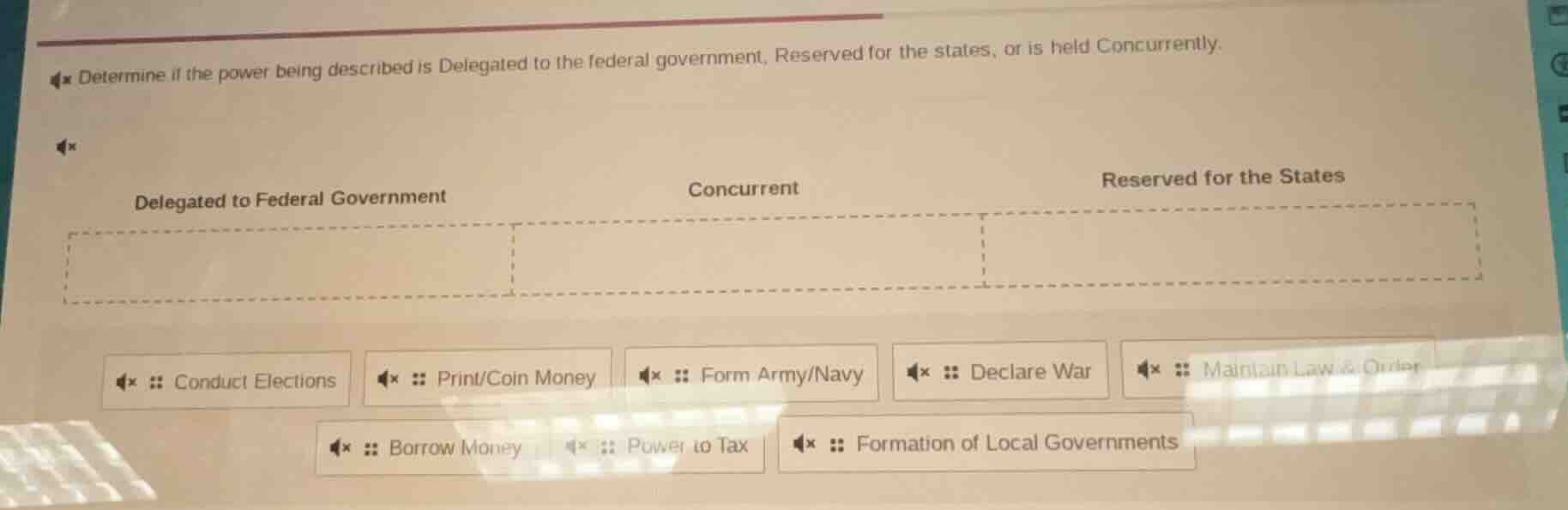
determine if the power being described is delegated to the federal government, reserved for the states, or is held concurrently.
delegated to federal government concurrent reserved for the states
conduct elections print/coin money form army/navy declare war maintain law & order
borrow money power to tax formation of local governments
Response
To solve this, we analyze each power based on U.S. government power distribution:
Delegated to Federal Government (Exclusive powers of federal gov):
- Print/Coin Money: Only federal government can coin/print money (Constitution, Art. I, Sec. 8).
- Form Army/Navy: Federal government has authority to raise and maintain armed forces (Art. I, Sec. 8).
- Declare War: Only federal government can declare war (Art. I, Sec. 8).
Concurrent (Powers shared by federal and state govs):
- Borrow Money: Both federal and state governments can borrow money (e.g., state bonds, federal debt).
- Power to Tax: Both levels of government can impose taxes (e.g., federal income tax, state sales tax).
Reserved for the States (Powers not delegated to federal, reserved by 10th Amendment):
- Conduct Elections: States administer elections (e.g., voter registration, polling places) (10th Amendment, state sovereignty over elections).
- Maintain Law & Order: States handle local law enforcement (e.g., police, state courts) (10th Amendment, local governance).
- Formation of Local Governments: States create and regulate local governments (e.g., cities, counties) (10th Amendment, state control over sub - state entities).
Final Categorization:
- Delegated to Federal Government: Print/Coin Money, Form Army/Navy, Declare War
- Concurrent: Borrow Money, Power to Tax
- Reserved for the States: Conduct Elections, Maintain Law & Order, Formation of Local Governments
If you need to drag and drop:
- Drag "Print/Coin Money", "Form Army/Navy", "Declare War" to "Delegated to Federal Government".
- Drag "Borrow Money", "Power to Tax" to "Concurrent".
- Drag "Conduct Elections", "Maintain Law & Order", "Formation of Local Governments" to "Reserved for the States".

Snap & solve any problem in the app
Get step-by-step solutions on Sovi AI
Photo-based solutions with guided steps
Explore more problems and detailed explanations
To solve this, we analyze each power based on U.S. government power distribution:
Delegated to Federal Government (Exclusive powers of federal gov):
- Print/Coin Money: Only federal government can coin/print money (Constitution, Art. I, Sec. 8).
- Form Army/Navy: Federal government has authority to raise and maintain armed forces (Art. I, Sec. 8).
- Declare War: Only federal government can declare war (Art. I, Sec. 8).
Concurrent (Powers shared by federal and state govs):
- Borrow Money: Both federal and state governments can borrow money (e.g., state bonds, federal debt).
- Power to Tax: Both levels of government can impose taxes (e.g., federal income tax, state sales tax).
Reserved for the States (Powers not delegated to federal, reserved by 10th Amendment):
- Conduct Elections: States administer elections (e.g., voter registration, polling places) (10th Amendment, state sovereignty over elections).
- Maintain Law & Order: States handle local law enforcement (e.g., police, state courts) (10th Amendment, local governance).
- Formation of Local Governments: States create and regulate local governments (e.g., cities, counties) (10th Amendment, state control over sub - state entities).
Final Categorization:
- Delegated to Federal Government: Print/Coin Money, Form Army/Navy, Declare War
- Concurrent: Borrow Money, Power to Tax
- Reserved for the States: Conduct Elections, Maintain Law & Order, Formation of Local Governments
If you need to drag and drop:
- Drag "Print/Coin Money", "Form Army/Navy", "Declare War" to "Delegated to Federal Government".
- Drag "Borrow Money", "Power to Tax" to "Concurrent".
- Drag "Conduct Elections", "Maintain Law & Order", "Formation of Local Governments" to "Reserved for the States".