QUESTION IMAGE
Question
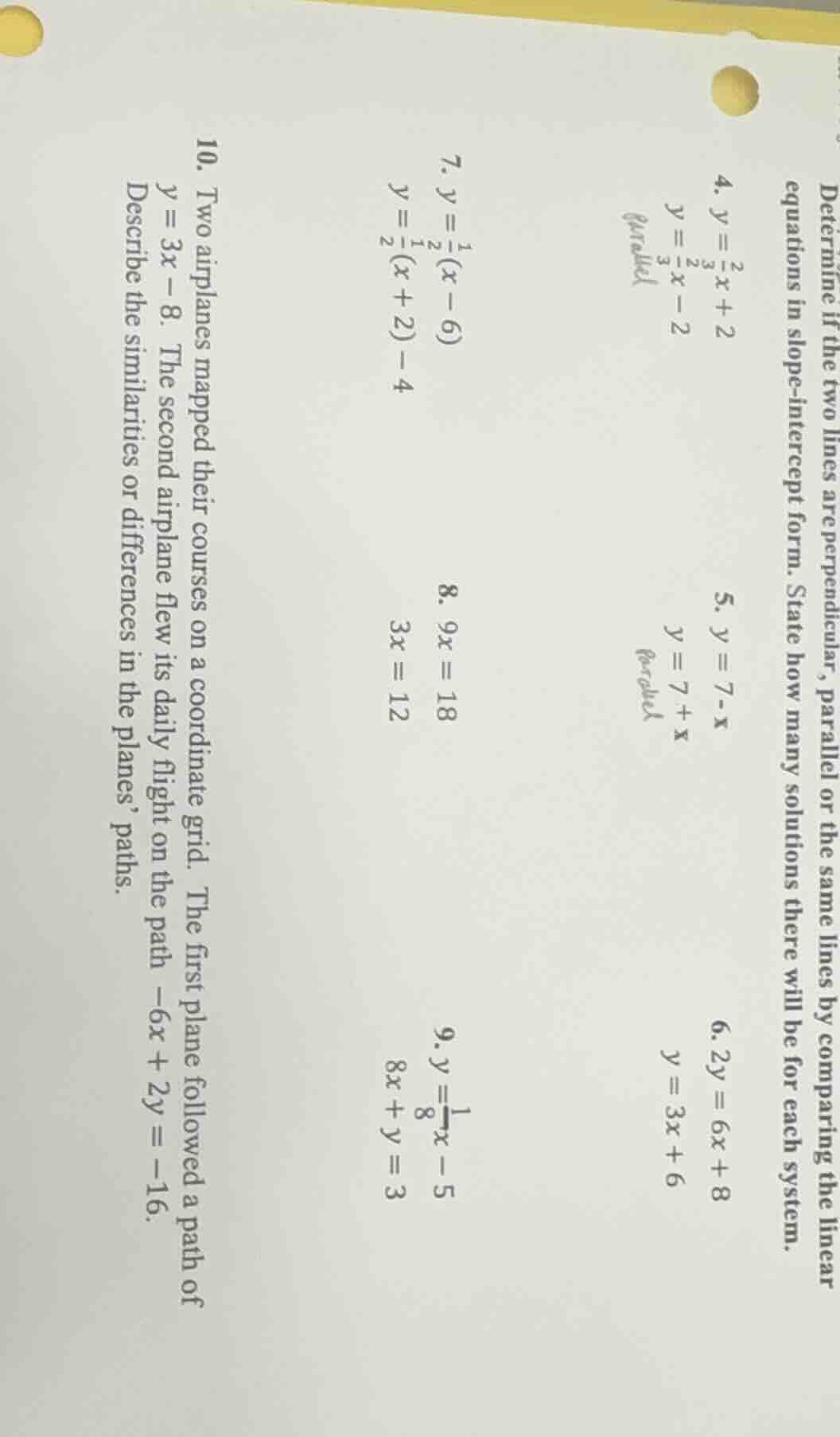
determine if the two lines are perpendicular, parallel or the same lines by comparing the linear equations in slope - intercept form. state how many solutions there will be for each system.
- $y = \frac{2}{3}x + 2$
$y = \frac{2}{3}x - 2$
- $y = 7 - x$
$y = 7 + x$
- $2y = 6x + 8$
$y = 3x + 6$
- $y = \frac{1}{2}(x - 6)$
$y = \frac{1}{2}(x + 2) - 4$
- $9x = 18$
$3x = 12$
- $y = \frac{1}{8}x - 5$
$8x + y = 3$
- two airplanes mapped their courses on a coordinate grid. the first plane followed a path of $y = 3x - 8$. the second airplane flew its daily flight on the path $- 6x + 2y = - 16$. describe the similarities or differences in the planes’ paths.
Problem 10: Analyzing the Planes' Paths
To determine the relationship between the two lines (paths of the airplanes), we first need to convert both equations to slope - intercept form ($y = mx + b$, where $m$ is the slope and $b$ is the y - intercept) and then compare their slopes and y - intercepts.
Step 1: Convert the first plane's equation to slope - intercept form
The first plane's path is given by the equation $y = 3x-8$. This is already in slope - intercept form. So, for this line, the slope $m_1=3$ and the y - intercept $b_1 = - 8$.
Step 2: Convert the second plane's equation to slope - intercept form
The second plane's path is given by the equation $-6x + 2y=-16$.
We want to solve for $y$. First, add $6x$ to both sides of the equation:
$2y=6x - 16$
Then, divide every term in the equation by 2:
$y=\frac{6x}{2}-\frac{16}{2}$
$y = 3x-8$
Step 3: Compare the two equations
Now, the second plane's equation in slope - intercept form is also $y = 3x - 8$, which is identical to the first plane's equation.
When two linear equations represent the same line, it means that the two lines are coincident (they lie on top of each other). For a system of linear equations representing the paths of the two planes, if the two lines are coincident, there are infinitely many solutions (the planes will be on the same path for all values of $x$ and $y$ that satisfy the equation, meaning they will follow the exact same path).
Problem 4: Determining the Relationship between the Lines
The two lines are $y=\frac{2}{3}x + 2$ and $y=\frac{2}{3}x-2$.
Step 1: Identify the slopes and y - intercepts
For a linear equation in the form $y=mx + b$, $m$ is the slope and $b$ is the y - intercept.
For the first line $y=\frac{2}{3}x + 2$, the slope $m_1=\frac{2}{3}$ and the y - intercept $b_1 = 2$.
For the second line $y=\frac{2}{3}x-2$, the slope $m_2=\frac{2}{3}$ and the y - intercept $b_2=-2$.
Step 2: Compare the slopes and y - intercepts
Since $m_1=m_2$ (both slopes are $\frac{2}{3}$) and $b_1
eq b_2$ (2 $
eq - 2$), the two lines are parallel.
For a system of linear equations with two parallel lines (that are not coincident), there are no solutions because the lines never intersect.
Problem 5: Determining the Relationship between the Lines
The two lines are $y = 7 - x$ and $y=7 + x$.
Step 1: Rewrite the equations in slope - intercept form
Rewrite $y = 7 - x$ as $y=-x + 7$, so the slope $m_1=-1$ and the y - intercept $b_1 = 7$.
Rewrite $y=7 + x$ as $y=x + 7$, so the slope $m_2 = 1$.
Step 2: Check the product of the slopes
To determine if two lines are perpendicular, we check if the product of their slopes is $- 1$.
Calculate $m_1\times m_2=(-1)\times1=-1$.
Since the product of the slopes is $-1$, the two lines are perpendicular.
For a system of linear equations with two perpendicular lines, there is exactly one solution (the lines intersect at exactly one point).
Problem 6: Determining the Relationship between the Lines
The two lines are $2y=6x + 8$ and $y = 3x+6$.
Step 1: Convert the first equation to slope - intercept form
Divide each term in $2y=6x + 8$ by 2:
$y=\frac{6x}{2}+\frac{8}{2}$
$y = 3x + 4$
Step 2: Identify the slopes and y - intercepts
For the first line $y = 3x + 4$, the slope $m_1=3$ and the y - intercept $b_1 = 4$.
For the second line $y=3x + 6$, the slope $m_2=3$ and the y - intercept $b_2 = 6$.
Step 3: Compare the slopes and y - intercepts
Since $m_1=m_2$ (both slopes are 3) and $b_1
eq b_2$ (4 $
eq6$), the two lines are parallel.
For a system of linear equations wi…

Snap & solve any problem in the app
Get step-by-step solutions on Sovi AI
Photo-based solutions with guided steps
Explore more problems and detailed explanations
Problem 10: Analyzing the Planes' Paths
To determine the relationship between the two lines (paths of the airplanes), we first need to convert both equations to slope - intercept form ($y = mx + b$, where $m$ is the slope and $b$ is the y - intercept) and then compare their slopes and y - intercepts.
Step 1: Convert the first plane's equation to slope - intercept form
The first plane's path is given by the equation $y = 3x-8$. This is already in slope - intercept form. So, for this line, the slope $m_1=3$ and the y - intercept $b_1 = - 8$.
Step 2: Convert the second plane's equation to slope - intercept form
The second plane's path is given by the equation $-6x + 2y=-16$.
We want to solve for $y$. First, add $6x$ to both sides of the equation:
$2y=6x - 16$
Then, divide every term in the equation by 2:
$y=\frac{6x}{2}-\frac{16}{2}$
$y = 3x-8$
Step 3: Compare the two equations
Now, the second plane's equation in slope - intercept form is also $y = 3x - 8$, which is identical to the first plane's equation.
When two linear equations represent the same line, it means that the two lines are coincident (they lie on top of each other). For a system of linear equations representing the paths of the two planes, if the two lines are coincident, there are infinitely many solutions (the planes will be on the same path for all values of $x$ and $y$ that satisfy the equation, meaning they will follow the exact same path).
Problem 4: Determining the Relationship between the Lines
The two lines are $y=\frac{2}{3}x + 2$ and $y=\frac{2}{3}x-2$.
Step 1: Identify the slopes and y - intercepts
For a linear equation in the form $y=mx + b$, $m$ is the slope and $b$ is the y - intercept.
For the first line $y=\frac{2}{3}x + 2$, the slope $m_1=\frac{2}{3}$ and the y - intercept $b_1 = 2$.
For the second line $y=\frac{2}{3}x-2$, the slope $m_2=\frac{2}{3}$ and the y - intercept $b_2=-2$.
Step 2: Compare the slopes and y - intercepts
Since $m_1=m_2$ (both slopes are $\frac{2}{3}$) and $b_1
eq b_2$ (2 $
eq - 2$), the two lines are parallel.
For a system of linear equations with two parallel lines (that are not coincident), there are no solutions because the lines never intersect.
Problem 5: Determining the Relationship between the Lines
The two lines are $y = 7 - x$ and $y=7 + x$.
Step 1: Rewrite the equations in slope - intercept form
Rewrite $y = 7 - x$ as $y=-x + 7$, so the slope $m_1=-1$ and the y - intercept $b_1 = 7$.
Rewrite $y=7 + x$ as $y=x + 7$, so the slope $m_2 = 1$.
Step 2: Check the product of the slopes
To determine if two lines are perpendicular, we check if the product of their slopes is $- 1$.
Calculate $m_1\times m_2=(-1)\times1=-1$.
Since the product of the slopes is $-1$, the two lines are perpendicular.
For a system of linear equations with two perpendicular lines, there is exactly one solution (the lines intersect at exactly one point).
Problem 6: Determining the Relationship between the Lines
The two lines are $2y=6x + 8$ and $y = 3x+6$.
Step 1: Convert the first equation to slope - intercept form
Divide each term in $2y=6x + 8$ by 2:
$y=\frac{6x}{2}+\frac{8}{2}$
$y = 3x + 4$
Step 2: Identify the slopes and y - intercepts
For the first line $y = 3x + 4$, the slope $m_1=3$ and the y - intercept $b_1 = 4$.
For the second line $y=3x + 6$, the slope $m_2=3$ and the y - intercept $b_2 = 6$.
Step 3: Compare the slopes and y - intercepts
Since $m_1=m_2$ (both slopes are 3) and $b_1
eq b_2$ (4 $
eq6$), the two lines are parallel.
For a system of linear equations with two parallel lines (that are not coincident), there are no solutions because the lines never intersect.
Problem 7: Determining the Relationship between the Lines
The two lines are $y=\frac{1}{2}(x - 6)$ and $y=\frac{1}{2}(x + 2)-4$.
Step 1: Expand the equations
Expand $y=\frac{1}{2}(x - 6)$:
$y=\frac{1}{2}x-3$, so the slope $m_1=\frac{1}{2}$ and the y - intercept $b_1=-3$.
Expand $y=\frac{1}{2}(x + 2)-4$:
$y=\frac{1}{2}x + 1-4=\frac{1}{2}x-3$, so the slope $m_2=\frac{1}{2}$ and the y - intercept $b_2=-3$.
Step 2: Compare the equations
Since both the slopes and the y - intercepts are equal ($m_1 = m_2=\frac{1}{2}$ and $b_1=b_2=-3$), the two lines are coincident (they are the same line).
For a system of linear equations with two coincident lines, there are infinitely many solutions because every point on one line is also on the other line.
Problem 8: Determining the Relationship between the Lines
The two lines are $9x = 18$ and $3x=12$.
Step 1: Solve for $x$ in each equation
For $9x = 18$, divide both sides by 9: $x = 2$. This is a vertical line (parallel to the y - axis) passing through $x = 2$.
For $3x=12$, divide both sides by 3: $x = 4$. This is a vertical line (parallel to the y - axis) passing through $x = 4$.
Step 2: Determine the relationship
Since both lines are vertical and have different $x$ - intercepts ($x = 2$ and $x = 4$), the lines are parallel.
For a system of linear equations representing two parallel vertical lines, there are no solutions because the lines never intersect.
Problem 9: Determining the Relationship between the Lines
The two lines are $y=\frac{1}{8}x-5$ and $8x + y=3$.
Step 1: Convert the second equation to slope - intercept form
Solve $8x + y=3$ for $y$: $y=-8x + 3$.
So, the slope of the first line $m_1=\frac{1}{8}$ and the slope of the second line $m_2=-8$.
Step 2: Check the product of the slopes
Calculate $m_1\times m_2=\frac{1}{8}\times(-8)=-1$.
Since the product of the slopes is $-1$, the two lines are perpendicular.
For a system of linear equations with two perpendicular lines, there is exactly one solution (the lines intersect at exactly one point).