QUESTION IMAGE
Question
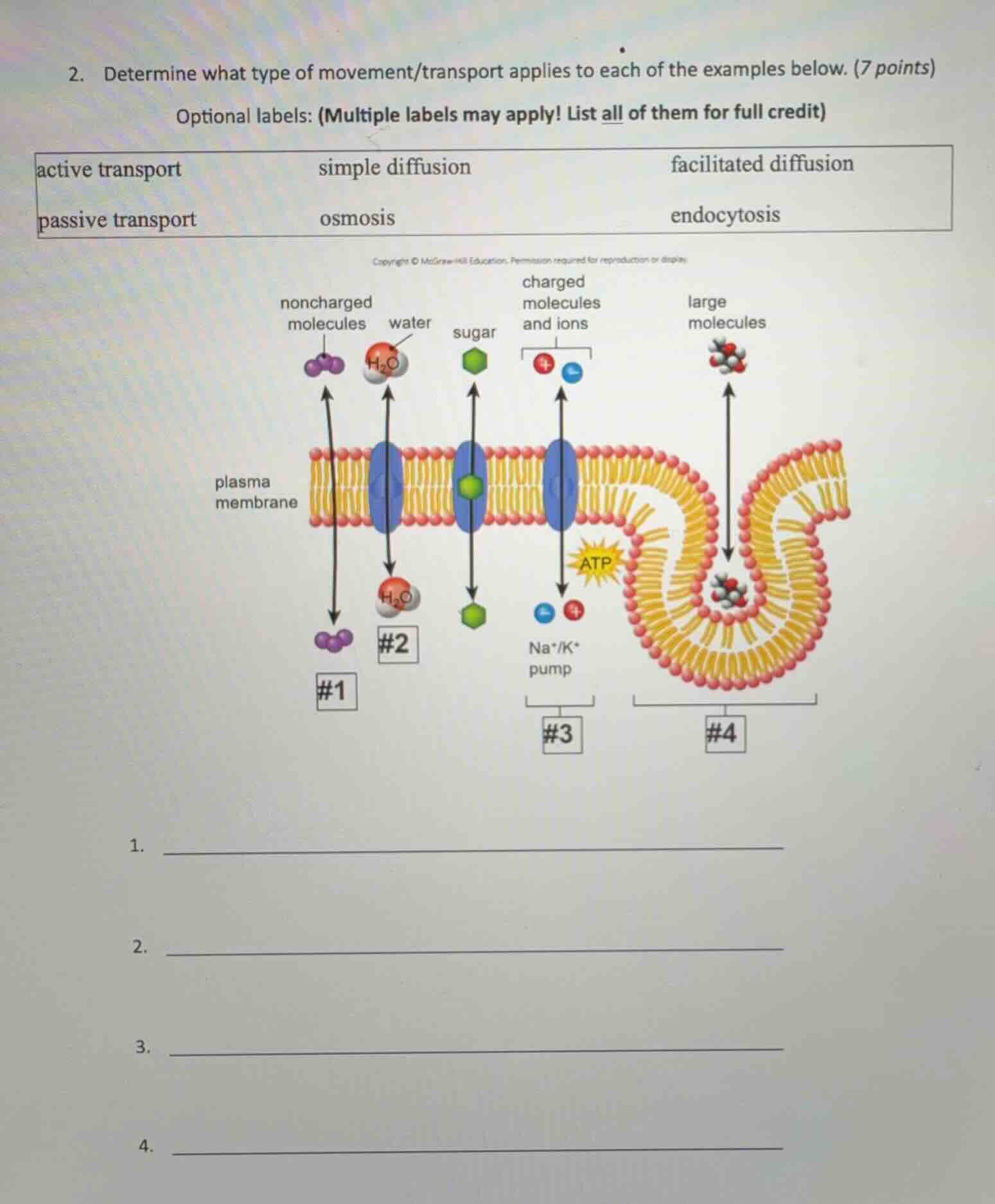
- determine what type of movement/transport applies to each of the examples below. (7 points)
optional labels: (multiple labels may apply! list all of them for full credit)
active transport\tsimple diffusion\tfacilitated diffusion
passive transport\tosmosis\tendocytosis
copyright © mcgraw-hill education. permission required for reproduction or display
plasma membrane
noncharged molecules
water $ce{h_{2}o}$
sugar
charged molecules and ions
large molecules
$ce{na^{+}/k^{+}}$ pump
atp
#1
#2
#3
#4
1.
2.
3.
4.
Brief Explanations
- Noncharged molecules move directly through the phospholipid bilayer without proteins or energy, which is simple diffusion, a type of passive transport.
- Water moves through an integral protein channel down its gradient; this is osmosis, a subset of facilitated diffusion and passive transport.
- The Na⁺/K⁺ pump uses ATP to move charged ions against their gradient, which is active transport.
- Large molecules are engulfed by the plasma membrane, requiring energy, which is endocytosis (a type of active transport).

Snap & solve any problem in the app
Get step-by-step solutions on Sovi AI
Photo-based solutions with guided steps
Explore more problems and detailed explanations
- simple diffusion, passive transport
- osmosis, facilitated diffusion, passive transport
- active transport
- endocytosis, active transport