QUESTION IMAGE
Question
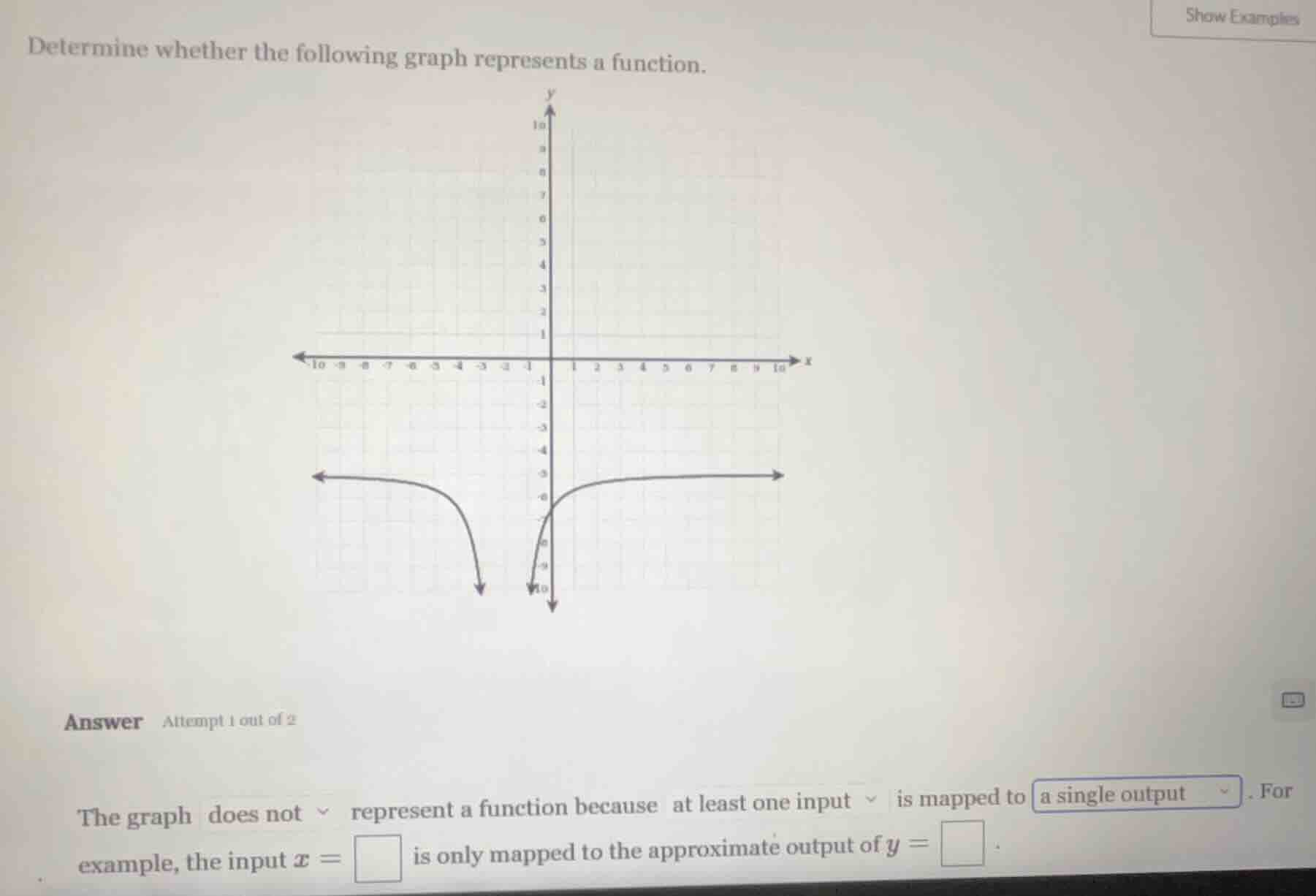
determine whether the following graph represents a function.
answer attempt 1 out of 2
the graph does not represent a function because at least one input is mapped to a single output. for example, the input ( x = square ) is only mapped to the approximate output of ( y = square ).
Step1: Recall the vertical line test
A graph represents a function if every vertical line intersects the graph at most once. This means each \( x \)-value (input) has at most one \( y \)-value (output).
Step2: Analyze the given graph
Looking at the graph, when we consider the vertical line at \( x = 0 \) (the y - axis), we can see that there are multiple points (outputs) for the input \( x = 0 \). Wait, but the initial statement in the problem's answer attempt has a mistake. Wait, no, let's re - examine. Wait, the graph as described (with two curves near the y - axis) – actually, when we apply the vertical line test, if a vertical line intersects the graph more than once, it's not a function. Let's take \( x = 0 \). The vertical line \( x = 0 \) will intersect the graph at more than one point. So for the input \( x = 0 \), there are multiple outputs. But the original problem's answer attempt has a wrong dropdown selection (it says "a single output" which is incorrect). But to answer the blanks: Let's find an \( x \)-value where the vertical line intersects the graph more than once. Let's take \( x = 0 \). The approximate \( y \)-values? Wait, no, maybe the graph is such that at \( x = 0 \), there are two points? Wait, maybe the graph is like a relation where for \( x = 0 \), there are multiple \( y \)-values. Wait, the correct reasoning is: A graph is a function if each \( x \) has exactly one \( y \). If at \( x = 0 \), we have two (or more) \( y \)-values, then it's not a function. Let's assume that at \( x = 0 \), the graph has two points, say \( y=-6 \) and another? Wait, maybe the graph is drawn such that at \( x = 0 \), there are two intersections. So the input \( x = 0 \) is mapped to more than one output (so the initial dropdown "a single output" is wrong, it should be "more than one output"). But to fill the blanks: Let's take \( x = 0 \). The approximate \( y \)-value? Wait, maybe the graph has a point at \( x = 0,y=-6 \) and another? Wait, perhaps the intended answer is \( x = 0 \), and let's say one of the \( y \)-values is - 6 (or whatever the graph shows). But let's correct the reasoning first.
The correct reasoning: The vertical line test: if any vertical line intersects the graph more than once, it's not a function. So for the graph, when we draw a vertical line (e.g., \( x = 0 \)), it intersects the graph at more than one point. So the graph does not represent a function because at least one input (e.g., \( x = 0 \)) is mapped to more than one output. For example, the input \( x = 0 \) is mapped to (let's say) \( y=-6 \) and another \( y \)-value. But maybe the graph is such that at \( x = 0 \), there are two points. So filling the blanks: \( x = 0 \), and let's say one of the \( y \)-values is - 6 (depending on the graph's scale).

Snap & solve any problem in the app
Get step-by-step solutions on Sovi AI
Photo-based solutions with guided steps
Explore more problems and detailed explanations
The graph does not represent a function because at least one input is mapped to more than one output. For example, the input \( x=\boldsymbol{0} \) is mapped to (among others) the approximate output of \( y = \boldsymbol{-6} \) (the second blank can have other values too, but \( x = 0 \) is a common input to test here).
(Note: The initial dropdown in the problem's answer attempt for "is mapped to" was incorrect; it should be "more than one output" instead of "a single output".)