QUESTION IMAGE
Question
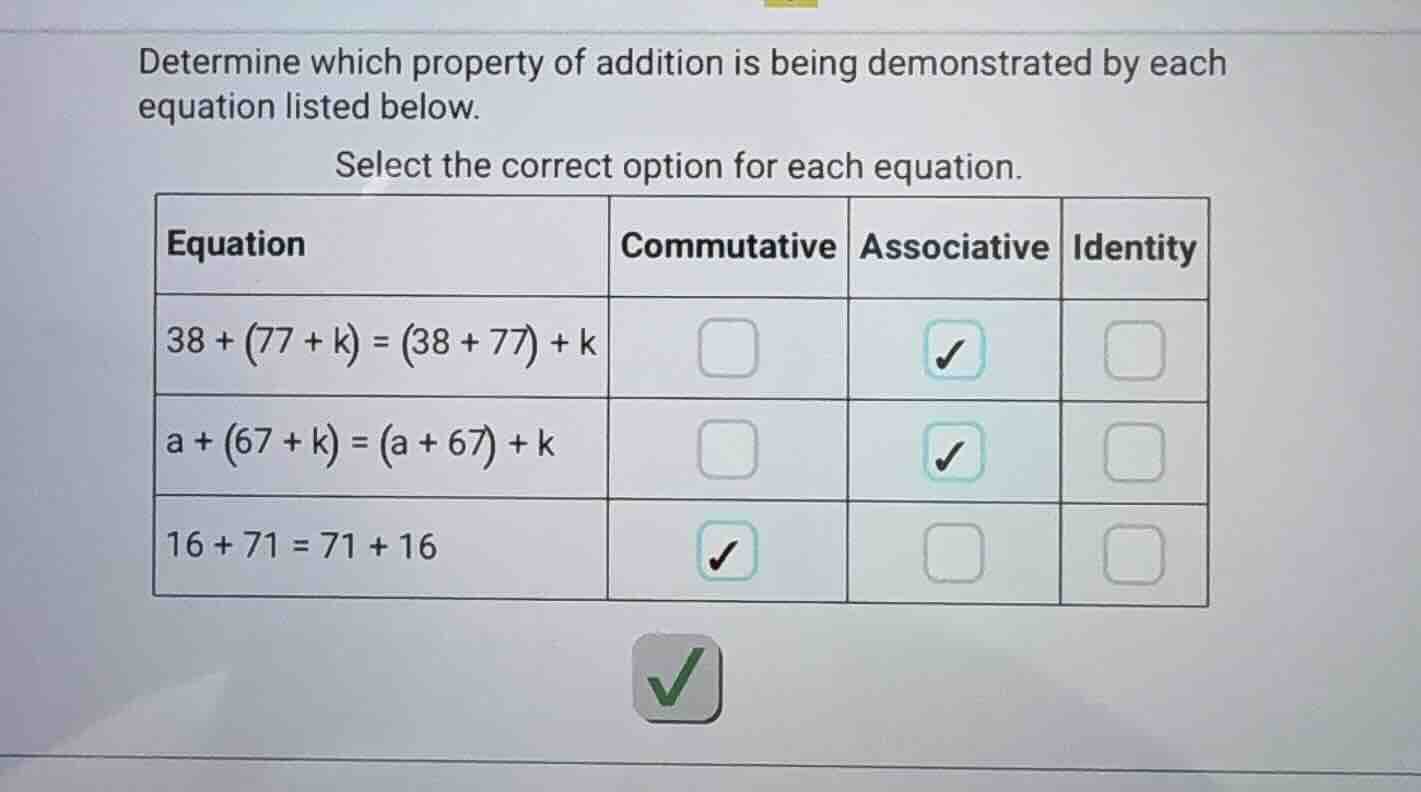
determine which property of addition is being demonstrated by each equation listed below.
select the correct option for each equation.
| equation | commutative | associative | identity |
|---|---|---|---|
| $a + (67 + k) = (a + 67) + k$ | $square$ | $\boldsymbol{checkmark}$ | $square$ |
| $16 + 71 = 71 + 16$ | $\boldsymbol{checkmark}$ | $square$ | $square$ |
Brief Explanations
- For the equation \(38 + (77 + k)=(38 + 77)+k\): The associative property of addition states that \((a + b)+c=a+(b + c)\) (or in the form here, \(a+(b + c)=(a + b)+c\) which is the same structure). Here we are regrouping the addition of \(38\), \(77\), and \(k\), so it's associative.
- For the equation \(a+(67 + k)=(a + 67)+k\): Similar to the first equation, we are regrouping the addends \(a\), \(67\), and \(k\) while keeping the sum the same. This follows the associative property of addition \((a + b)+c=a+(b + c)\) (or the re - ordered form here).
- For the equation \(16 + 71=71 + 16\): The commutative property of addition states that \(a + b=b + a\). Here we are swapping the order of \(16\) and \(71\) and the sum remains the same, so it's commutative.
The current selections in the table are correct:
- For \(38+(77 + k)=(38 + 77)+k\), the associative option is correctly checked.
- For \(a+(67 + k)=(a + 67)+k\), the associative option is correctly checked.
- For \(16 + 71 = 71+16\), the commutative option is correctly checked.

Snap & solve any problem in the app
Get step-by-step solutions on Sovi AI
Photo-based solutions with guided steps
Explore more problems and detailed explanations
The selections in the table are correct.
- For \(38+(77 + k)=(38 + 77)+k\): Associative is correct.
- For \(a+(67 + k)=(a + 67)+k\): Associative is correct.
- For \(16 + 71 = 71+16\): Commutative is correct.