QUESTION IMAGE
Question
determining the number of possible triangles
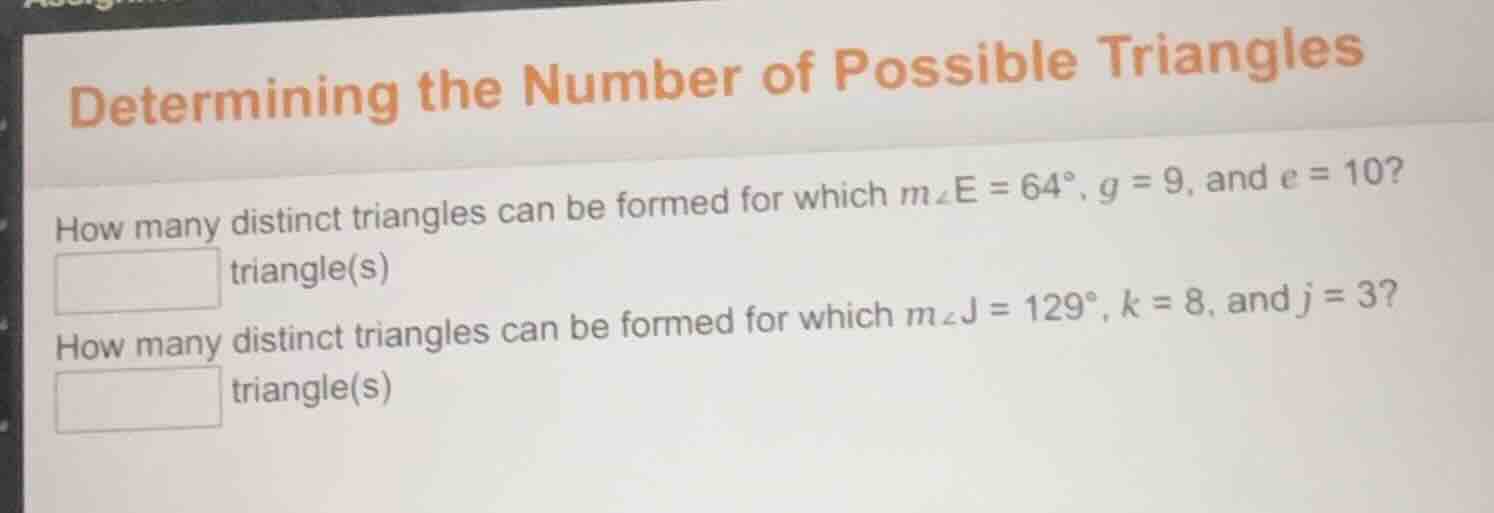
how many distinct triangles can be formed for which $m\angle e = 64^\circ$, $g = 9$, and $e = 10$?
$\boldsymbol{\square}$ triangle(s)
how many distinct triangles can be formed for which $m\angle j = 129^\circ$, $k = 8$, and $j = 3$?
$\boldsymbol{\square}$ triangle(s)
Step1: Analyze first triangle (SSA case)
We use the Law of Sines: $\frac{\sin G}{g} = \frac{\sin E}{e}$
Substitute values: $\sin G = \frac{g \cdot \sin E}{e} = \frac{9 \cdot \sin 64^\circ}{10}$
Calculate $\sin 64^\circ \approx 0.8988$, so $\sin G \approx \frac{9 \cdot 0.8988}{10} \approx 0.8089$
Since $0 < 0.8089 < 1$, and $e > g$ (10 > 9), only one valid acute $G$ exists (as the obtuse supplement would make the total angle exceed $180^\circ$).
Step2: Analyze second triangle (SSA case)
Use Law of Sines: $\frac{\sin K}{k} = \frac{\sin J}{j}$
Substitute values: $\sin K = \frac{k \cdot \sin J}{j} = \frac{8 \cdot \sin 129^\circ}{3}$
Calculate $\sin 129^\circ \approx 0.7771$, so $\sin K \approx \frac{8 \cdot 0.7771}{3} \approx 2.0723$
Since $\sin K$ cannot exceed 1, no valid triangle exists.

Snap & solve any problem in the app
Get step-by-step solutions on Sovi AI
Photo-based solutions with guided steps
Explore more problems and detailed explanations
1 triangle(s)
0 triangle(s)