QUESTION IMAGE
Question
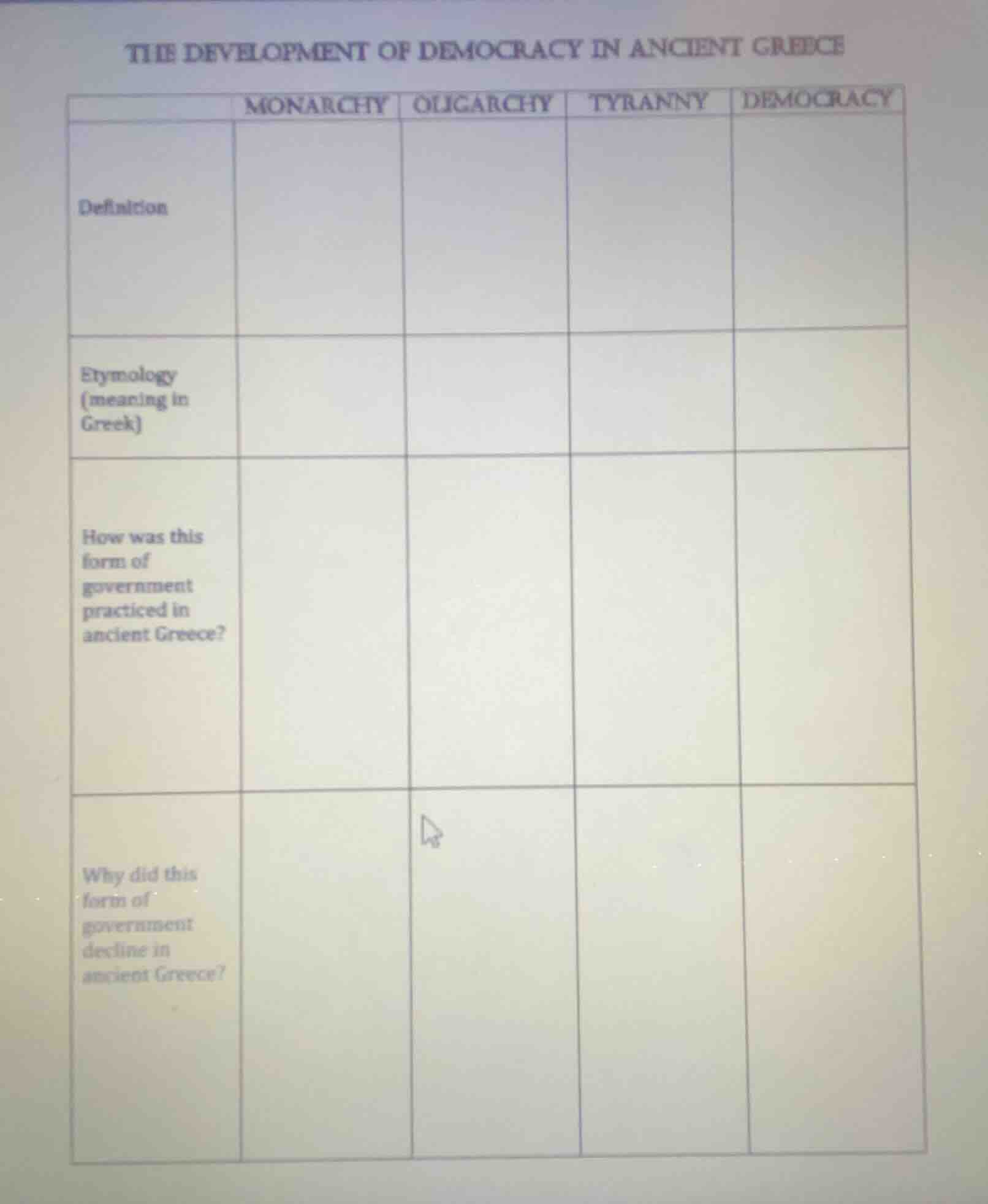
the development of democracy in ancient greece
monarchy | oligarchy | tyranny | democracy
definition
etymology (meaning in greek)
how was this form of government practiced in ancient greece?
why did this form of government decline in ancient greece?
This table covers the four key forms of government in ancient Greek city-states, with details on their core definitions, Greek linguistic roots, real-world practice in ancient Greece, and the reasons for their decline. Below is the completed table with accurate historical details:
| MONARCHY | OLIGARCHY | TYRANNY | DEMOCRACY | |
|---|---|---|---|---|
| Etymology (meaning in Greek) | From monarchēs, meaning "single ruler" | From oligarchia, meaning "rule by the few" | From tyrannos, meaning "illegitimate ruler" | From dēmokratia, meaning "rule by the people" |
| How was this form of government practiced in ancient Greece? | Found in early city-states like Mycenae; kings held religious, military, and legal power, often advised by a council. Sparta had two hereditary kings for military leadership. | Dominated in city-states like Corinth; power held by wealthy landowners or aristocrats who controlled laws and resources, excluding the poor from political participation. | Tyrants often gained support from the poor and middle class by opposing oligarchs; they would seize power via force, and some (like Pisistratus of Athens) implemented popular reforms (e.g., land redistribution) to maintain control. | Fully developed in Athens under Cleisthenes and Pericles; adult male citizens could vote directly on laws, serve on juries, and hold public office via lot. Women, slaves, and foreigners were excluded. |
| Why did this form of government decline in ancient Greece? | Kings lost power as aristocrats gained wealth and influence, demanding a share of political control; frequent civil wars and invasions also weakened hereditary rule. | Oligarchies were overthrown by tyrants or popular uprisings, as the poor resented being excluded from power and exploited by the elite; some oligarchies collapsed after military defeats. | Tyrants were often overthrown by rival elites or citizen uprisings once their popular support faded; many city-states rejected one-person rule after experiencing oppressive tyrants. | Athenian democracy was destroyed by the Spartan victory in the Peloponnesian War (404 BCE), replaced by an oligarchy. Later, Macedonian conquests (4th century BCE) ended self-rule for most Greek city-states, including democratic systems. |

Snap & solve any problem in the app
Get step-by-step solutions on Sovi AI
Photo-based solutions with guided steps
Explore more problems and detailed explanations
The completed table above provides the full details for each form of ancient Greek government as requested.