QUESTION IMAGE
Question
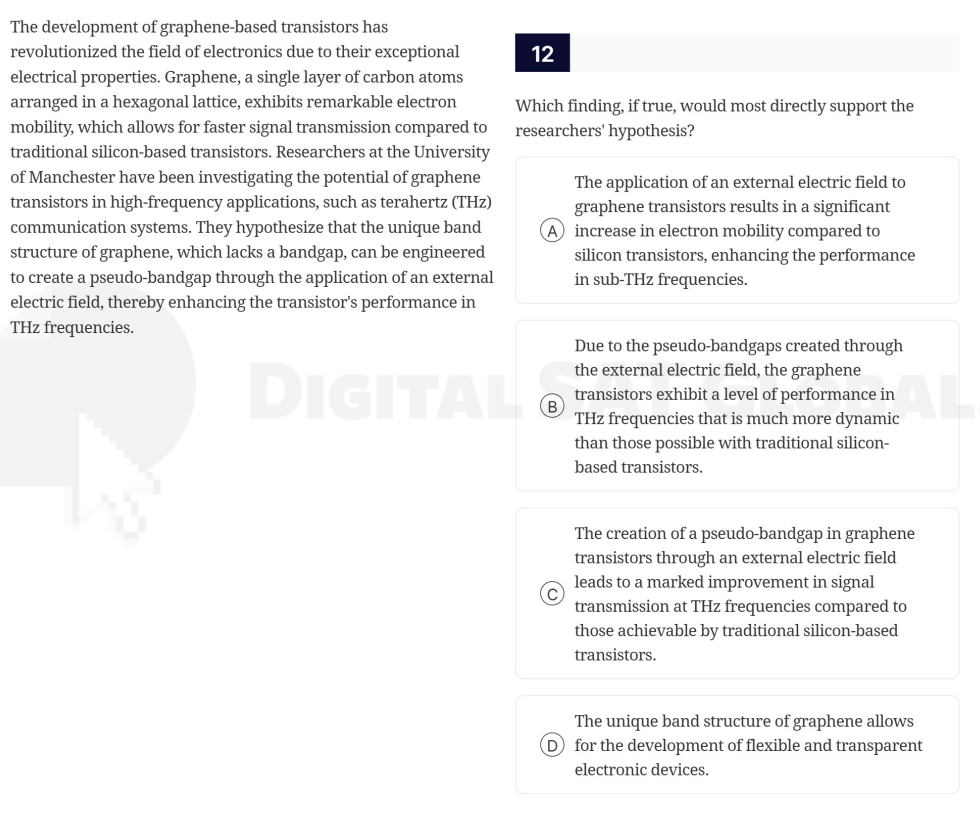
the development of graphene - based transistors has revolutionized the field of electronics due to their exceptional electrical properties. graphene, a single layer of carbon atoms arranged in a hexagonal lattice, exhibits remarkable electron mobility, which allows for faster signal transmission compared to traditional silicon - based transistors. researchers at the university of manchester have been investigating the potential of graphene transistors in high - frequency applications, such as terahertz (thz) communication systems. they hypothesize that the unique band structure of graphene, which lacks a bandgap, can be engineered to create a pseudo - bandgap through the application of an external electric field, thereby enhancing the transistor’s performance in thz frequencies.
12
which finding, if true, would most directly support the researchers hypothesis?
a the application of an external electric field to graphene transistors results in a significant increase in electron mobility compared to silicon transistors, enhancing the performance in sub - thz frequencies.
b due to the pseudo - bandgaps created through the external electric field, the graphene transistors exhibit a level of performance in thz frequencies that is much more dynamic than those possible with traditional silicon - based transistors.
c the creation of a pseudo - bandgap in graphene transistors through an external electric field leads to a marked improvement in signal transmission at thz frequencies compared to those achievable by traditional silicon - based transistors.
d the unique band structure of graphene allows for the development of flexible and transparent electronic devices.
The researchers' hypothesis states that graphene's band structure (lacking a bandgap) can be engineered via an external electric field to create a pseudo-bandgap, enhancing transistor performance in THz frequencies. Option C directly links the creation of the pseudo-bandgap via an external field to improved THz signal transmission over silicon transistors, which directly supports the core claim of the hypothesis. Other options either focus on unrelated properties (D), vague "dynamic performance" (B), or electron mobility without tying to the pseudo-bandgap and THz performance (A).

Snap & solve any problem in the app
Get step-by-step solutions on Sovi AI
Photo-based solutions with guided steps
Explore more problems and detailed explanations
C. The creation of a pseudo-bandgap in graphene transistors through an external electric field leads to a marked improvement in signal transmission at THz frequencies compared to those achievable by traditional silicon-based transistors.