QUESTION IMAGE
Question
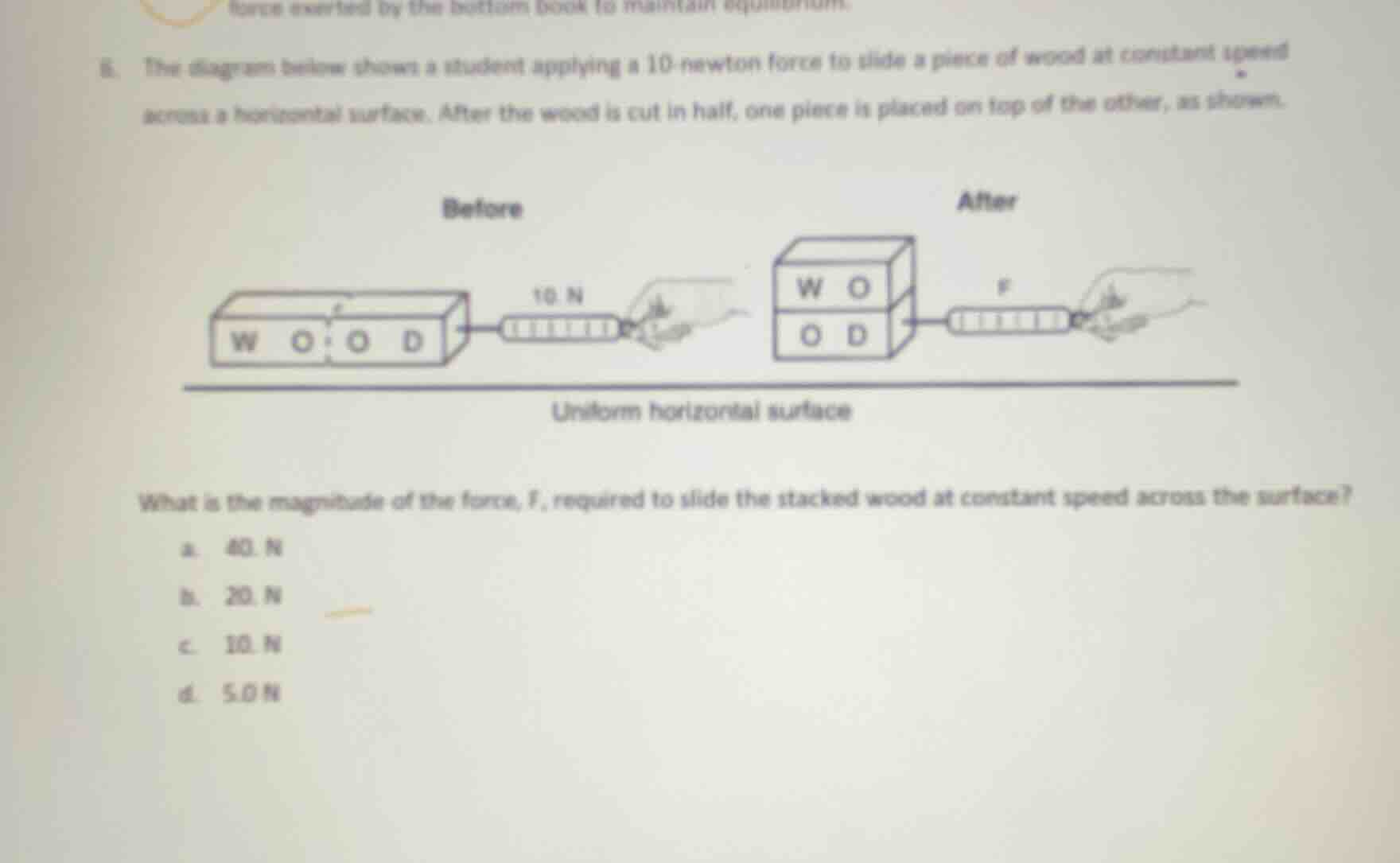
- the diagram below shows a student applying a 10 - newton force to slide a piece of wood at constant speed across a horizontal surface. after the wood is cut in half, one piece is placed on top of the other, as shown.
diagram showing before with a single block of wood and a 10 n force, and after with two stacked blocks of wood and a force f
what is the magnitude of the force, f, required to slide the stacked wood at constant speed across the surface?
a. 40 n
b. 20 n
c. 10 n
d. 5.0 n
Step1: Recall sliding friction formula
The magnitude of sliding friction is given by $f = \mu_k N$, where $\mu_k$ is the coefficient of kinetic friction, and $N$ is the normal force (equal to the object's weight $W$ on a horizontal surface).
Step2: Analyze initial condition
When moving at constant speed, applied force equals friction: $F_1 = f_1 = \mu_k W$. Here, $F_1 = 10\ \text{N}$, so $\mu_k W = 10\ \text{N}$.
Step3: Analyze stacked condition
After stacking, total weight remains $W$ (wood is just rearranged), so normal force $N = W$. Friction is $f_2 = \mu_k W$. At constant speed, applied force $F = f_2$.
Step4: Equate forces
Since $\mu_k W = 10\ \text{N}$, $F = 10\ \text{N}$.

Snap & solve any problem in the app
Get step-by-step solutions on Sovi AI
Photo-based solutions with guided steps
Explore more problems and detailed explanations
c. 10. N