QUESTION IMAGE
Question
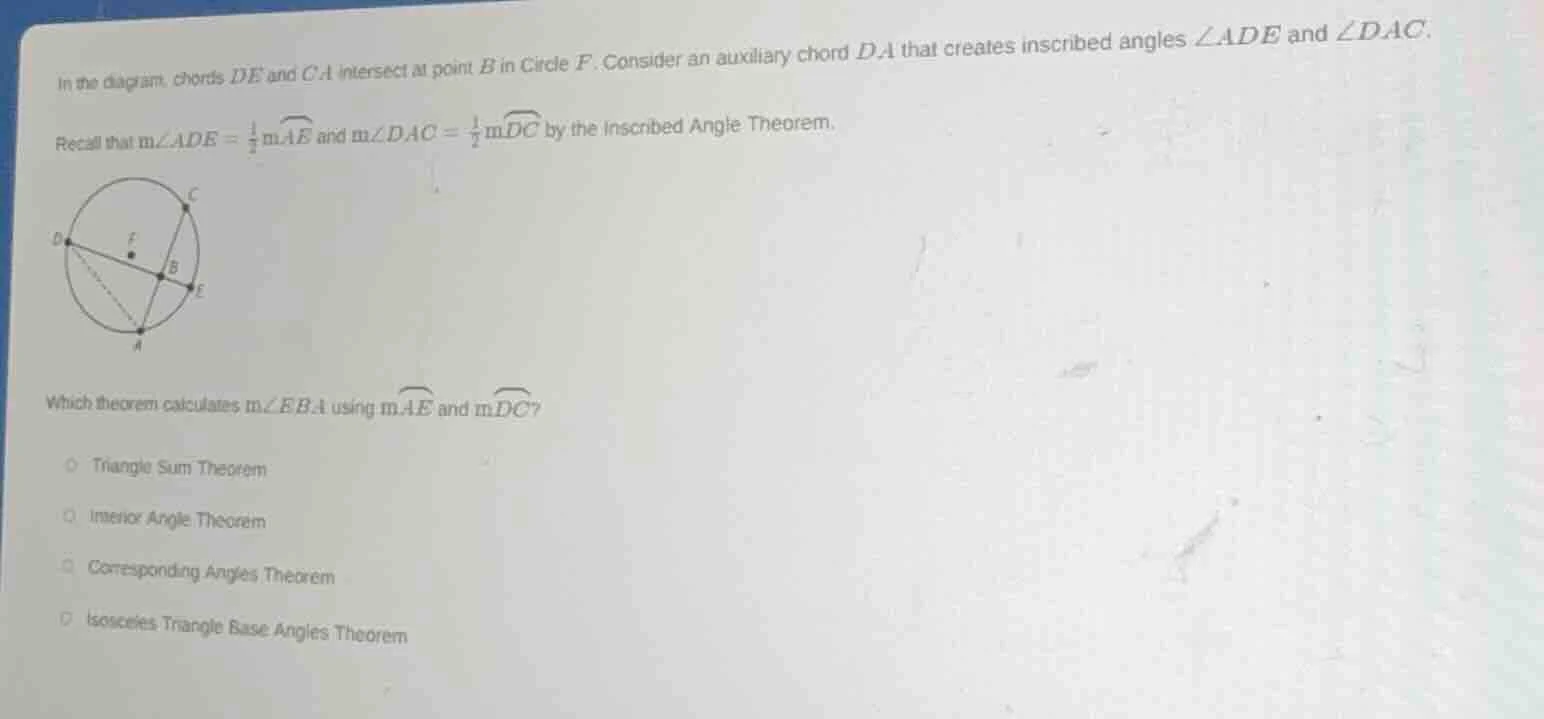
in the diagram, chords de and ca intersect at point b in circle f. consider an auxiliary chord da that creates inscribed angles ∠ade and ∠dac. recall that m∠ade = \\(\frac{1}{2}\\)m\\(\widehat{ae}\\) and m∠dac = \\(\frac{1}{2}\\)m\\(\widehat{dc}\\) by the inscribed angle theorem. which theorem calculates m∠eba using m\\(\widehat{ae}\\) and m\\(\widehat{dc}\\)? \\(\circ\\) triangle sum theorem \\(\circ\\) interior angle theorem \\(\circ\\) corresponding angles theorem \\(\circ\\) isosceles triangle base angles theorem
To determine which theorem calculates \( m\angle EBA \) using \( m\overarc{AE} \) and \( m\overarc{DC} \), we analyze each option:
- Triangle Sum Theorem: States the sum of angles in a triangle is \( 180^\circ \). Not directly related to arc measures and exterior angles formed by intersecting chords.
- Interior Angle Theorem (Exterior Angle Theorem): The exterior angle of a triangle equals the sum of the two non - adjacent interior angles. Here, \( \angle EBA \) is an exterior angle to \( \triangle ABD \), with \( \angle ADE \) and \( \angle DAC \) as the non - adjacent interior angles. Given \( m\angle ADE=\frac{1}{2}m\overarc{AE} \) and \( m\angle DAC = \frac{1}{2}m\overarc{DC} \), by the Exterior Angle Theorem (a type of Interior Angle - related theorem for exterior angles), \( m\angle EBA=m\angle ADE + m\angle DAC=\frac{1}{2}(m\overarc{AE}+m\overarc{DC}) \).
- Corresponding Angles Theorem: Applies to parallel lines cut by a transversal, not to angles formed by intersecting chords in a circle.
- Isosceles Triangle Base Angles Theorem: Deals with equal angles in an isosceles triangle, not with arc - angle relationships for exterior angles of triangles formed by chords.

Snap & solve any problem in the app
Get step-by-step solutions on Sovi AI
Photo-based solutions with guided steps
Explore more problems and detailed explanations
Interior Angle Theorem (specifically the Exterior Angle Theorem, which is a sub - case of interior - angle related theorems for triangles)