QUESTION IMAGE
Question
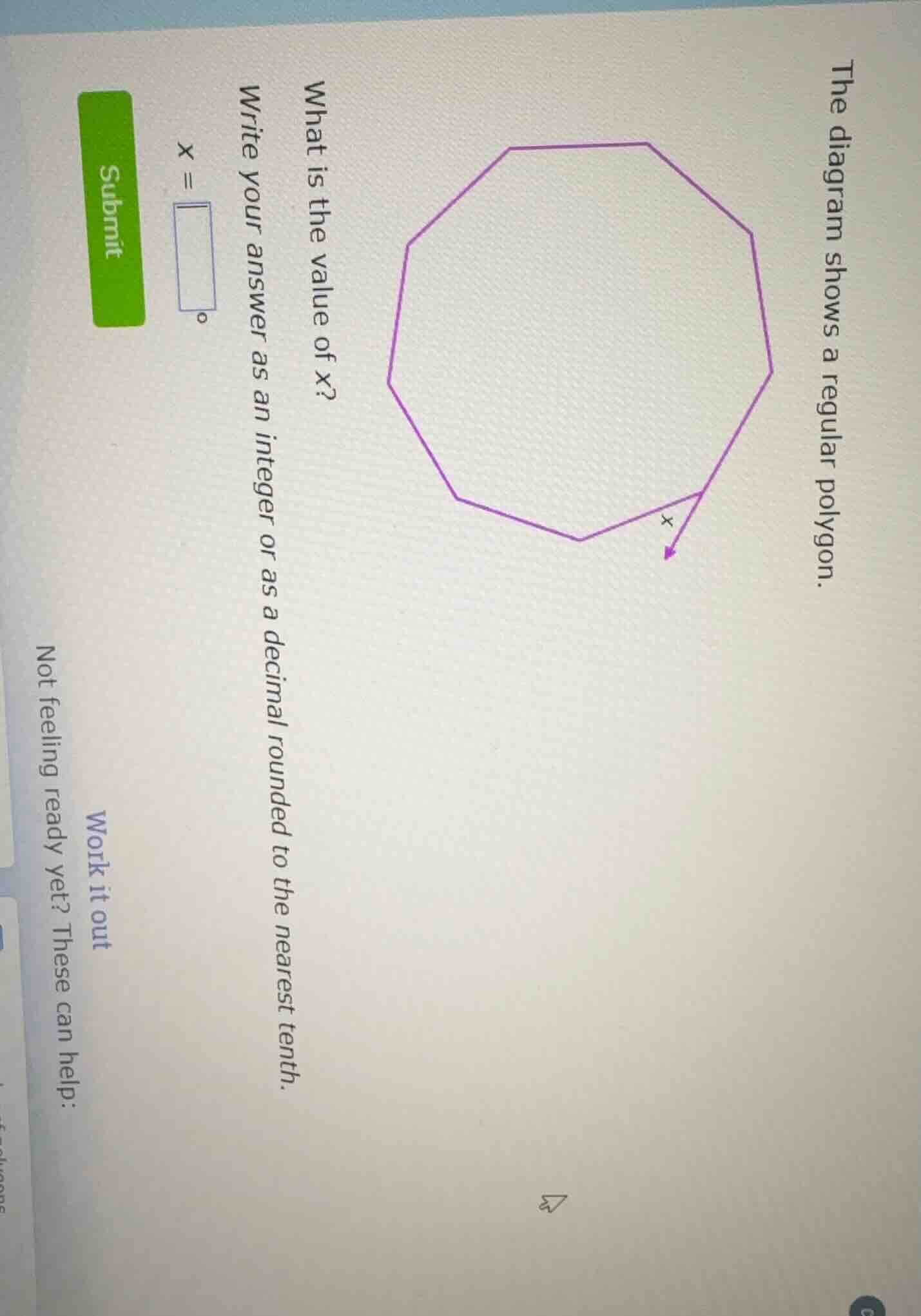
the diagram shows a regular polygon. what is the value of x? write your answer as an integer or as a decimal rounded to the nearest tenth. x = \\(\square\\)° submit work it out not feeling ready yet? these can help:
Step1: Determine the number of sides
The polygon is a regular octagon, so \( n = 8 \).
Step2: Find the measure of an interior angle
The formula for the measure of an interior angle of a regular polygon is \( \frac{(n - 2)\times180^{\circ}}{n} \). Substituting \( n = 8 \), we get \( \frac{(8 - 2)\times180^{\circ}}{8}=\frac{6\times180^{\circ}}{8}=135^{\circ} \).
Step3: Find the value of \( x \)
The angle \( x \) and the interior angle form a linear pair with the angle adjacent to the triangle? Wait, actually, the triangle formed is an isosceles triangle with the two base angles equal to \( x \), and the vertex angle is supplementary to the interior angle of the octagon. Wait, no, the angle at the vertex of the triangle (the one inside the polygon) is the interior angle, and the triangle is formed by two radii (if we consider the center, but here it's a regular polygon, so the triangle is formed by two sides and a segment. Wait, actually, the angle \( x \) is half of the exterior angle? Wait, no. Let's correct:
The exterior angle of a regular polygon is \( \frac{360^{\circ}}{n} \). For \( n = 8 \), exterior angle is \( \frac{360^{\circ}}{8}=45^{\circ} \). Wait, no, the angle \( x \) is in a triangle where the two equal angles are \( x \), and the vertex angle is the interior angle? Wait, no, looking at the diagram, the polygon is a regular octagon (8 sides). The triangle is formed by two sides of the octagon and a segment, making an isosceles triangle. The angle at the vertex of the triangle (inside the octagon) is the interior angle, which we found as \( 135^{\circ} \). Then, in the isosceles triangle, the sum of angles is \( 180^{\circ} \), so \( 2x + 135^{\circ}=180^{\circ} \)? Wait, no, that would be if the triangle is adjacent to the interior angle. Wait, no, actually, the angle \( x \) is half of the angle supplementary to the interior angle? Wait, no, let's think again.
Wait, the regular octagon has interior angle \( 135^{\circ} \). The triangle formed is such that the two angles at the base (the \( x \) angles) and the angle at the top (which is \( 180^{\circ}- 135^{\circ}=45^{\circ} \))? No, that's not right. Wait, no, the angle \( x \) is the angle of the triangle, and the triangle is formed by two sides of the octagon and a diagonal? Wait, no, the diagram shows a regular octagon, and a triangle is drawn with one side as a side of the octagon, and the other two sides forming an angle \( x \). Wait, actually, the correct approach is:
In a regular polygon, the central angle is \( \frac{360^{\circ}}{n} \). For \( n = 8 \), central angle is \( 45^{\circ} \). But the triangle here is not a central triangle. Wait, maybe the angle \( x \) is equal to the angle of the triangle formed by two radii and a side, but no. Wait, let's look at the formula for the angle in such a triangle.
Wait, the interior angle of a regular octagon is \( 135^{\circ} \). The triangle is isosceles with the two equal angles being \( x \), and the vertex angle is \( 180^{\circ}- 135^{\circ}=45^{\circ} \)? No, that would mean \( 2x + 45^{\circ}=180^{\circ} \), so \( 2x = 135^{\circ} \), \( x = 67.5^{\circ} \). Wait, that makes sense. Because the interior angle is \( 135^{\circ} \), so the angle adjacent to the triangle (the one inside the triangle's vertex) is \( 180^{\circ}- 135^{\circ}=45^{\circ} \), and since the triangle is isosceles, the two base angles are equal, so \( 2x + 45^{\circ}=180^{\circ} \), so \( 2x = 135^{\circ} \), \( x = 67.5^{\circ} \). Wait, but let's check with the exterior angle. The exterior angle is \( 45^{\circ} \), and t…

Snap & solve any problem in the app
Get step-by-step solutions on Sovi AI
Photo-based solutions with guided steps
Explore more problems and detailed explanations
\( 67.5 \)