QUESTION IMAGE
Question
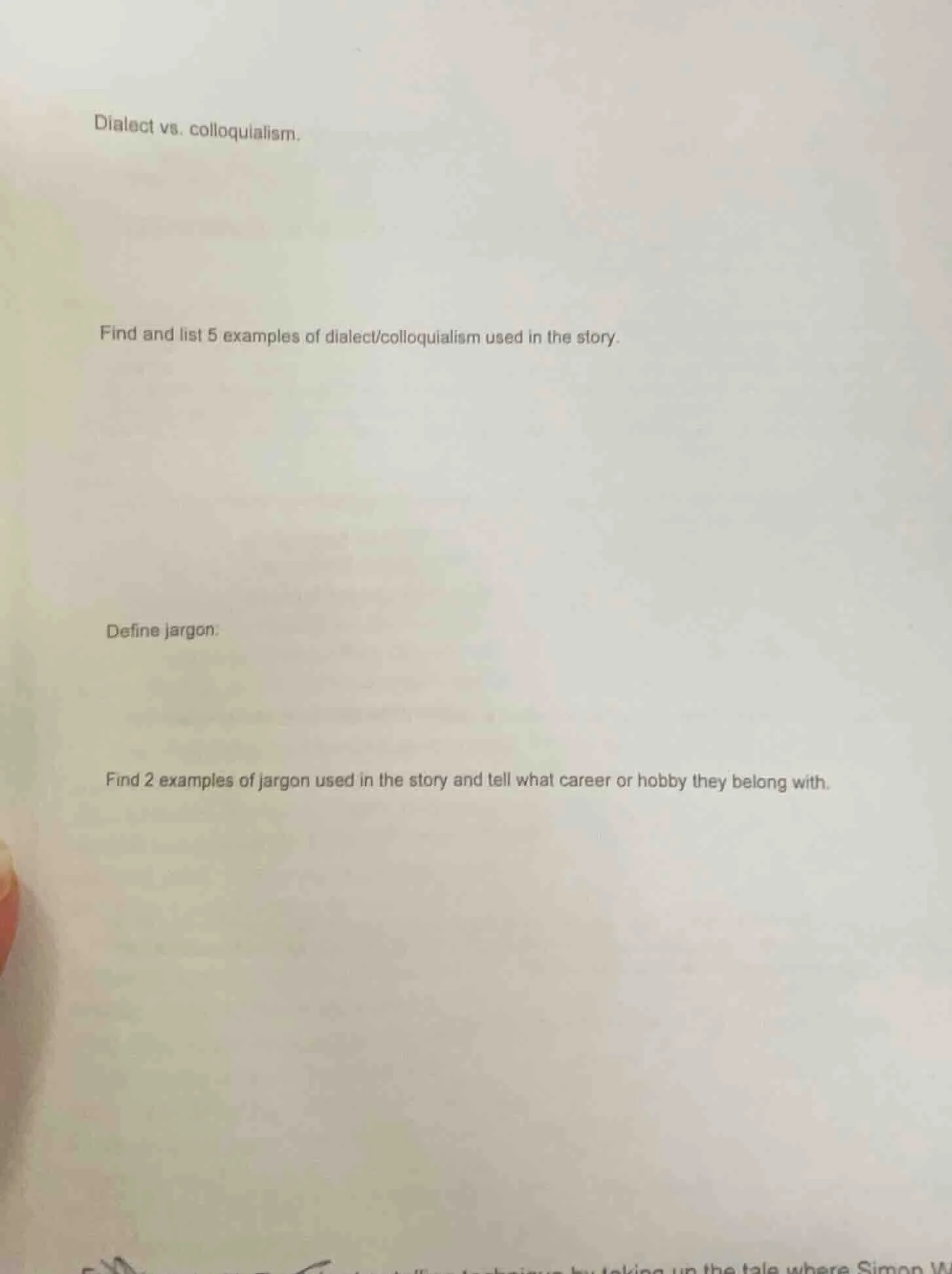
dialect vs. colloquialism.
find and list 5 examples of dialect/colloquialism used in the story.
define jargon.
find 2 examples of jargon used in the story and tell what career or hobby they belong with.
To answer these questions, we need the text of the story (the literary work) in which we are to identify dialects, colloquialisms, and jargon. Since the story is not provided, here's how you can approach each task once you have the story:
1. Find and list 5 examples of dialect/colloquialism
- Dialect: A form of a language specific to a region or social group (e.g., “y’all” for “you all” in Southern U.S. English, “ain’t” as a non - standard variant, or regional vocabulary like “barmy” in British English).
- Colloquialism: Informal, everyday language (e.g., “gonna” for “going to”, “wanna” for “want to”, “kinda” for “kind of”).
To complete this, scan the story for words or phrases that are informal (colloquial) or specific to a region/group (dialect).
2. Define jargon
Jargon is specialized vocabulary used by a particular profession, hobby, or group. It is often not easily understood by those outside the group (e.g., “MRI” in medicine, “SEO” in digital marketing, “checkmate” in chess).
3. Find 2 examples of jargon and their associated career/hobby
- Look for words in the story that are tied to a specific field. For example:
- If the story involves a doctor, “diagnosis” or “prescription” are medical jargon.
- If it involves a gamer, “respawn” or “NPC” (Non - Player Character) are gaming jargon.
Next Step:
Share the text of the story (or its title/author) so we can analyze it and provide specific examples!

Snap & solve any problem in the app
Get step-by-step solutions on Sovi AI
Photo-based solutions with guided steps
Explore more problems and detailed explanations
To answer these questions, we need the text of the story (the literary work) in which we are to identify dialects, colloquialisms, and jargon. Since the story is not provided, here's how you can approach each task once you have the story:
1. Find and list 5 examples of dialect/colloquialism
- Dialect: A form of a language specific to a region or social group (e.g., “y’all” for “you all” in Southern U.S. English, “ain’t” as a non - standard variant, or regional vocabulary like “barmy” in British English).
- Colloquialism: Informal, everyday language (e.g., “gonna” for “going to”, “wanna” for “want to”, “kinda” for “kind of”).
To complete this, scan the story for words or phrases that are informal (colloquial) or specific to a region/group (dialect).
2. Define jargon
Jargon is specialized vocabulary used by a particular profession, hobby, or group. It is often not easily understood by those outside the group (e.g., “MRI” in medicine, “SEO” in digital marketing, “checkmate” in chess).
3. Find 2 examples of jargon and their associated career/hobby
- Look for words in the story that are tied to a specific field. For example:
- If the story involves a doctor, “diagnosis” or “prescription” are medical jargon.
- If it involves a gamer, “respawn” or “NPC” (Non - Player Character) are gaming jargon.
Next Step:
Share the text of the story (or its title/author) so we can analyze it and provide specific examples!