QUESTION IMAGE
Question
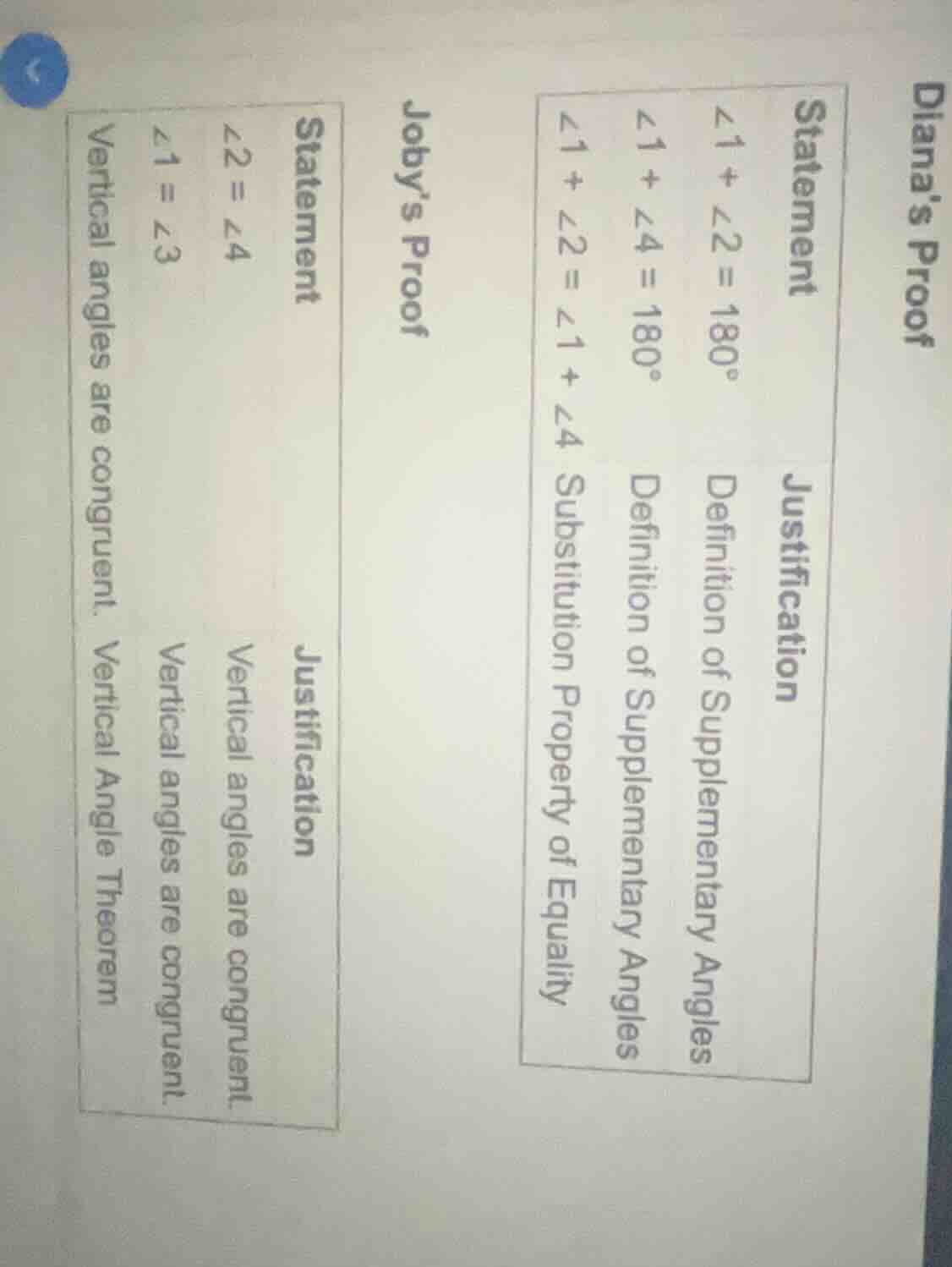
diana’s proof
statement\tjustification
∠1 + ∠2 = 180°\tdefinition of supplementary angles
∠1 + ∠4 = 180°\tdefinition of supplementary angles
∠1 + ∠2 = ∠1 + ∠4\tsubstitution property of equality
joby’s proof
statement\tjustification
∠2 = ∠4\tvertical angles are congruent.
∠1 = ∠3\tvertical angles are congruent.
vertical angles are congruent.\tvertical angle theorem
To determine the issue with Joby’s proof, we analyze the structure and logic:
Step 1: Recall Proof Requirements
A proof of vertical angles congruent typically uses supplementary angles (linear pairs sum to \(180^\circ\)) and the substitution property (or transitive property) to show vertical angles are equal.
Step 2: Analyze Diana’s Proof (Correct Structure)
Diana’s steps:
- \(\angle 1 + \angle 2 = 180^\circ\) (linear pair, supplementary angles).
- \(\angle 1 + \angle 4 = 180^\circ\) (linear pair, supplementary angles).
- \(\angle 1 + \angle 2 = \angle 1 + \angle 4\) (substitution, since both equal \(180^\circ\)).
- Subtract \(\angle 1\) from both sides: \(\angle 2 = \angle 4\) (vertical angles congruent).
Step 3: Analyze Joby’s Proof (Error)
Joby’s statements:
- \(\angle 2 = \angle 4\) (conclusion)
- \(\angle 1 = \angle 3\) (another pair of vertical angles)
- “Vertical angles are congruent” (theorem, but Joby uses it as a justification for the statements, not as a conclusion).
Key Issue:
Joby assumes the conclusion (\(\angle 2 = \angle 4\), \(\angle 1 = \angle 3\)) and uses the Vertical Angle Theorem as a justification before proving it. In a proof, you must derive the conclusion using known properties (like supplementary angles) first, not assume the theorem to prove itself.
Final Issue
Joby’s proof is circular reasoning—he uses the Vertical Angle Theorem (the statement he is trying to prove) as a justification for his statements, rather than deriving the theorem from simpler properties (supplementary angles, substitution).

Snap & solve any problem in the app
Get step-by-step solutions on Sovi AI
Photo-based solutions with guided steps
Explore more problems and detailed explanations
Joby’s proof is invalid because it uses the Vertical Angle Theorem (the statement being proven) as a justification for its own statements, resulting in circular reasoning. He should derive \(\angle 2 = \angle 4\) and \(\angle 1 = \angle 3\) using supplementary angles and substitution (like Diana’s proof), not assume the theorem to prove it.