QUESTION IMAGE
Question
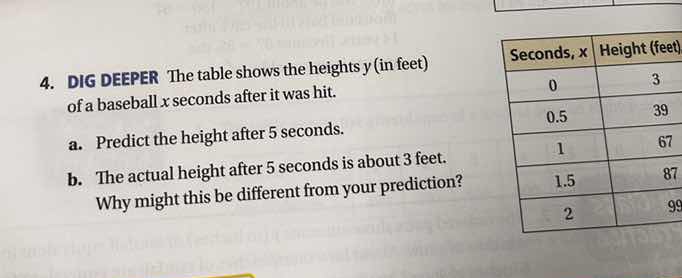
- dig deeper the table shows the heights ( y ) (in feet) of a baseball ( x ) seconds after it was hit.
a. predict the height after 5 seconds.
b. the actual height after 5 seconds is about 3 feet. why might this be different from your prediction?
| seconds, ( x ) | height (feet) |
|---|---|
| 0.5 | 39 |
| 1 | 67 |
| 1.5 | 87 |
| 2 | 99 |
Part (a)
First, we need to determine the relationship between \( x \) (seconds) and \( y \) (height). Let's assume a quadratic model \( y = ax^2 + bx + c \) since the height of a projectile follows a parabolic path.
We have the following points:
- When \( x = 0 \), \( y = 3 \): So \( c = 3 \).
- When \( x = 0.5 \), \( y = 39 \): Substitute into the equation: \( 39 = a(0.5)^2 + b(0.5) + 3 \)
- Simplify: \( 39 - 3 = 0.25a + 0.5b \) → \( 36 = 0.25a + 0.5b \) → Multiply by 4: \( 144 = a + 2b \) (Equation 1)
- When \( x = 1 \), \( y = 67 \): Substitute into the equation: \( 67 = a(1)^2 + b(1) + 3 \)
- Simplify: \( 67 - 3 = a + b \) → \( 64 = a + b \) (Equation 2)
Now, subtract Equation 2 from Equation 1:
\( (a + 2b) - (a + b) = 144 - 64 \)
\( a + 2b - a - b = 80 \)
\( b = 80 \)
Substitute \( b = 80 \) into Equation 2:
\( a + 80 = 64 \)
\( a = 64 - 80 = -16 \)
So the quadratic model is \( y = -16x^2 + 80x + 3 \)
Now, predict the height at \( x = 5 \):
\( y = -16(5)^2 + 80(5) + 3 \)
\( y = -16(25) + 400 + 3 \)
\( y = -400 + 400 + 3 \)
\( y = 3 \)
The prediction assumes a quadratic (projectile) motion model, but in reality, factors like air resistance, wind, or the ball hitting the ground (or other objects) before 5 seconds can affect the actual height. The model is a simplification and doesn't account for real - world disturbances.

Snap & solve any problem in the app
Get step-by-step solutions on Sovi AI
Photo-based solutions with guided steps
Explore more problems and detailed explanations
The predicted height after 5 seconds is 3 feet.