QUESTION IMAGE
Question
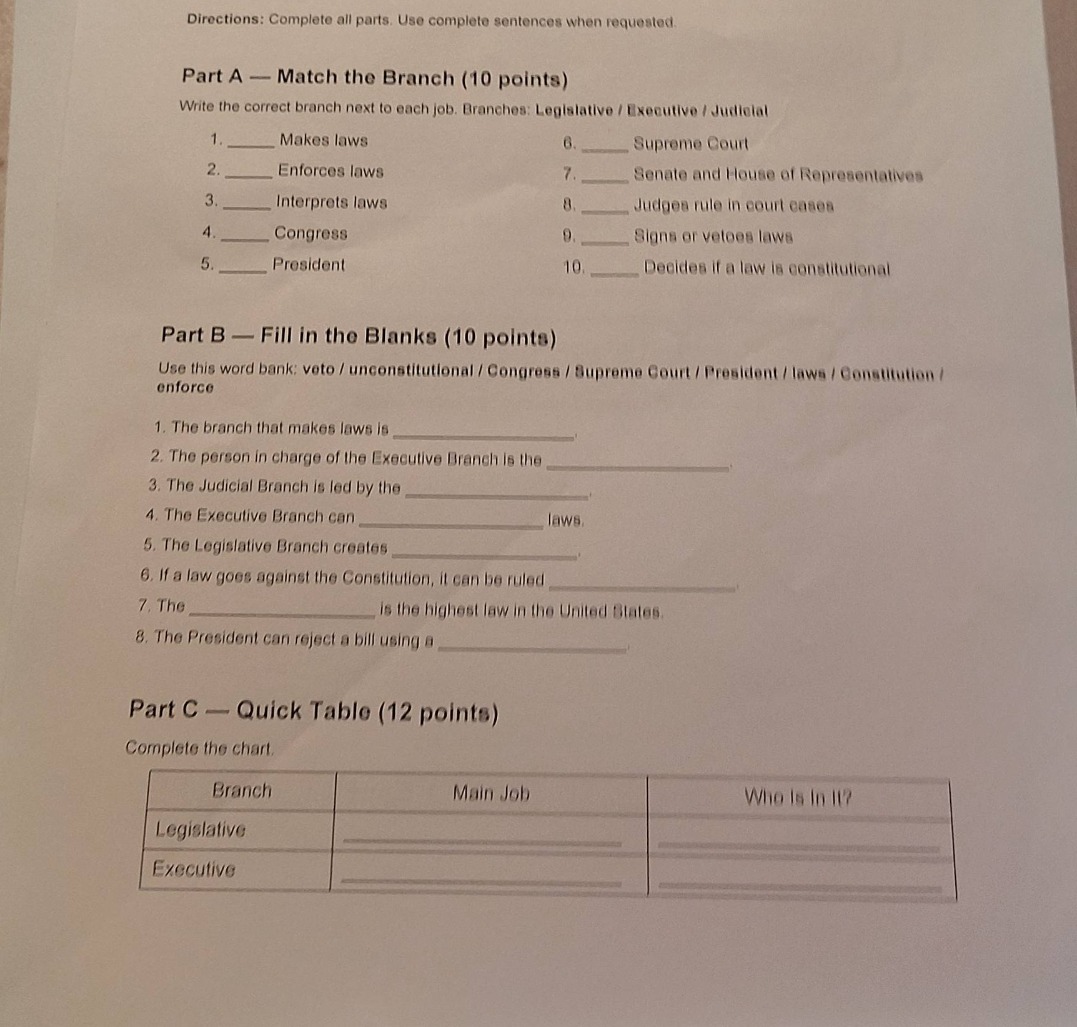
directions: complete all parts. use complete sentences when requested.
part a — match the branch (10 points)
write the correct branch next to each job. branches: legislative / executive / judicial
- ___ makes laws \t\t\t\t6. ___ supreme court
- ___ enforces laws \t\t\t\t7. ___ senate and house of representatives
- ___ interprets laws \t\t\t\t8. ___ judges rule in court cases
- ___ congress \t\t\t\t9. ___ signs or vetoes laws
- ___ president \t\t\t\t10. ___ decides if a law is constitutional
part b — fill in the blanks (10 points)
use this word bank: veto / unconstitutional / congress / supreme court / president / laws / constitution / enforce
- the branch that makes laws is ______________.
- the person in charge of the executive branch is the ______________.
- the judicial branch is led by the ______________.
- the executive branch can ______________ laws.
- the legislative branch creates ______________.
- if a law goes against the constitution, it can be ruled ______________.
- the ______________ is the highest law in the united states.
- the president can reject a bill using a ______________.
part c — quick table (12 points)
complete the chart.
| branch | main job | who is in it? |
|---|---|---|
| executive | ______________ | ______________ |
Response
Part A
- Brief Explanations: The Legislative Branch's main role is lawmaking.
- Answer: Legislative
- Brief Explanations: The Executive Branch is responsible for enforcing laws.
- Answer: Executive
- Brief Explanations: The Judicial Branch interprets laws.
- Answer: Judicial
- Brief Explanations: Congress is part of the Legislative Branch.
- Answer: Legislative
- Brief Explanations: The President heads the Executive Branch.
- Answer: Executive
- Brief Explanations: The Supreme Court is part of the Judicial Branch.
- Answer: Judicial
- Brief Explanations: Senate and House of Representatives are part of Congress (Legislative Branch).
- Answer: Legislative
- Brief Explanations: Judges in court cases are part of the Judicial Branch (interpreting laws).
- Answer: Judicial
- Brief Explanations: The President (Executive Branch) signs or vetoes laws.
- Answer: Executive
- Brief Explanations: The Judicial Branch (Supreme Court) decides constitutional validity.
- Answer: Judicial
Part B
- Brief Explanations: Legislative Branch (Congress) makes laws.
- Answer: Congress
- Brief Explanations: President leads the Executive Branch.
- Answer: President
- Brief Explanations: Supreme Court leads the Judicial Branch.
- Answer: Supreme Court
- Brief Explanations: Executive Branch enforces laws.
- Answer: enforce
- Brief Explanations: Legislative Branch creates laws.
- Answer: laws
- Brief Explanations: A law against the Constitution is unconstitutional.
- Answer: unconstitutional
- Brief Explanations: The Constitution is the highest law in the US.
- Answer: Constitution
- Brief Explanations: President uses veto to reject a bill.
- Answer: veto
Part C
| Branch | Main Job | Who Is In It? |
|---|---|---|
| Executive | Enforces laws, signs/vetoes laws | President, Executive agencies (e.g., Cabinet) |

Snap & solve any problem in the app
Get step-by-step solutions on Sovi AI
Photo-based solutions with guided steps
Explore more problems and detailed explanations
Part A
- Brief Explanations: The Legislative Branch's main role is lawmaking.
- Answer: Legislative
- Brief Explanations: The Executive Branch is responsible for enforcing laws.
- Answer: Executive
- Brief Explanations: The Judicial Branch interprets laws.
- Answer: Judicial
- Brief Explanations: Congress is part of the Legislative Branch.
- Answer: Legislative
- Brief Explanations: The President heads the Executive Branch.
- Answer: Executive
- Brief Explanations: The Supreme Court is part of the Judicial Branch.
- Answer: Judicial
- Brief Explanations: Senate and House of Representatives are part of Congress (Legislative Branch).
- Answer: Legislative
- Brief Explanations: Judges in court cases are part of the Judicial Branch (interpreting laws).
- Answer: Judicial
- Brief Explanations: The President (Executive Branch) signs or vetoes laws.
- Answer: Executive
- Brief Explanations: The Judicial Branch (Supreme Court) decides constitutional validity.
- Answer: Judicial
Part B
- Brief Explanations: Legislative Branch (Congress) makes laws.
- Answer: Congress
- Brief Explanations: President leads the Executive Branch.
- Answer: President
- Brief Explanations: Supreme Court leads the Judicial Branch.
- Answer: Supreme Court
- Brief Explanations: Executive Branch enforces laws.
- Answer: enforce
- Brief Explanations: Legislative Branch creates laws.
- Answer: laws
- Brief Explanations: A law against the Constitution is unconstitutional.
- Answer: unconstitutional
- Brief Explanations: The Constitution is the highest law in the US.
- Answer: Constitution
- Brief Explanations: President uses veto to reject a bill.
- Answer: veto
Part C
| Branch | Main Job | Who Is In It? |
|---|---|---|
| Executive | Enforces laws, signs/vetoes laws | President, Executive agencies (e.g., Cabinet) |