QUESTION IMAGE
Question
directions: complete the following problems below. follow this link to a video made by mrs. armstrong that can help you with this assignment. link: https://youtu.be/gtrk2gpor90 (also linked on module 1 of canvas)
problem 1
one way to think about slope or growth triangles is as stair steps on a line
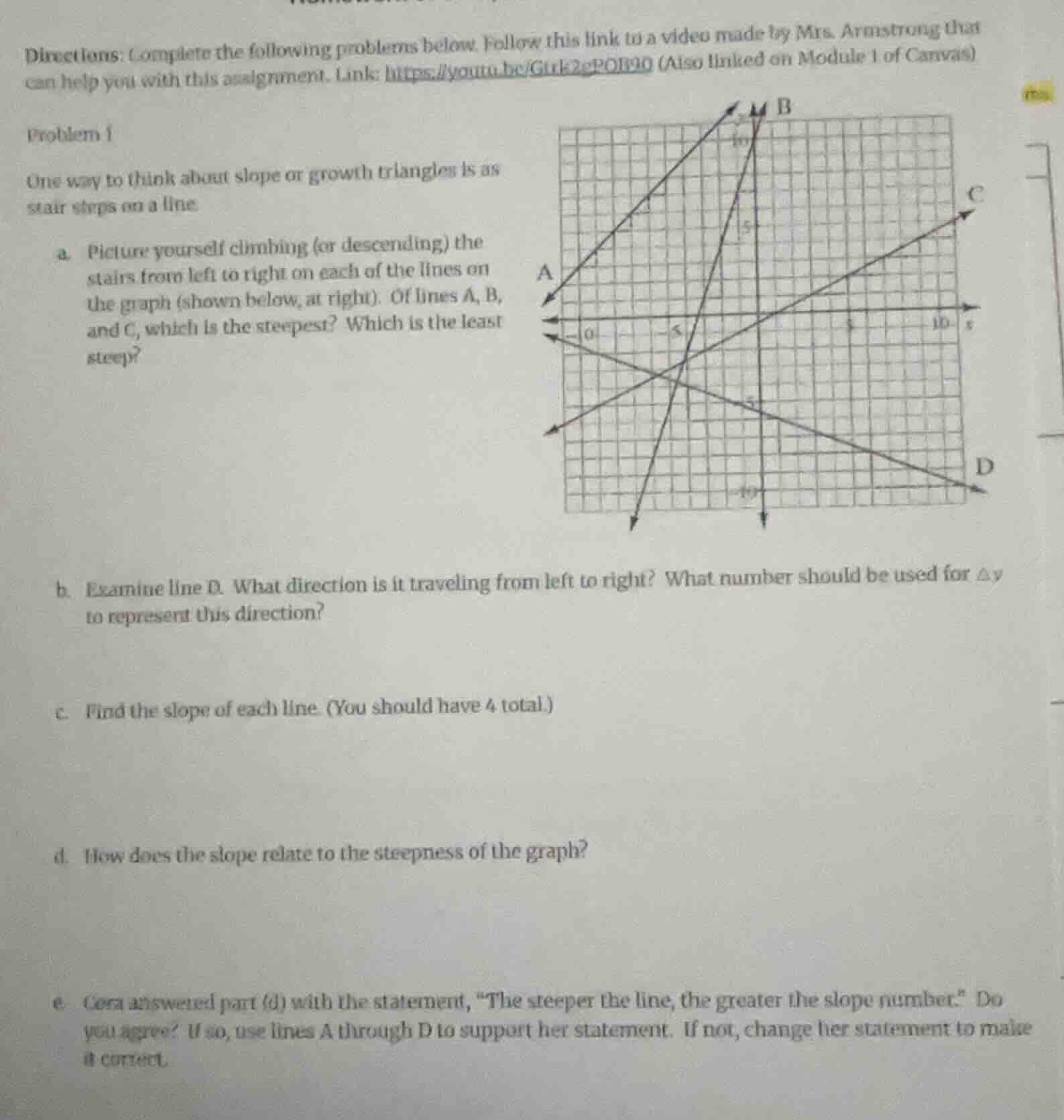
a. picture yourself climbing (or descending) the stairs from left to right on each of the lines on the graph (shown below, at right). of lines a, b, and c, which is the steepest? which is the least steep?
b. examine line d. what direction is it traveling from left to right? what number should be used for $\delta y$ to represent this direction?
c. find the slope of each line. (you should have 4 total.)
d. how does the slope relate to the steepness of the graph?
e. cora answered part (d) with the statement, “the steeper the line, the greater the slope number.” do you agree? if so, use lines a through d to support her statement. if not, change her statement to make it correct.
---
Part a
Step1: Compare line steepness
Steeper lines have larger absolute slope values. Visually, Line B rises most sharply, Line C rises most gently.
Step2: Identify steepest/least steep
Line B is steepest; Line C is least steep.
---
Part b
Step1: Observe line D direction
From left to right, Line D moves downward.
Step2: Define $\Delta y$ sign
Downward direction means negative vertical change, so $\Delta y < 0$. For its slope, $\Delta y = -1$ (per $\Delta x=4$).
---
Part c
Step1: Slope formula
Slope $m = \frac{\Delta y}{\Delta x} = \frac{y_2 - y_1}{x_2 - x_1}$
Step2: Calculate slope of A
Use points $(-10,0)$ and $(0,10)$:
$m_A = \frac{10-0}{0-(-10)} = \frac{10}{10} = 1$
Step3: Calculate slope of B
Use points $(0,10)$ and $(2,0)$:
$m_B = \frac{0-10}{2-0} = \frac{-10}{2} = -5$
Step4: Calculate slope of C
Use points $(-10,-10)$ and $(10,10)$:
$m_C = \frac{10-(-10)}{10-(-10)} = \frac{20}{20} = \frac{1}{2}$
Step5: Calculate slope of D
Use points $(0,-5)$ and $(10,-10)$:
$m_D = \frac{-10-(-5)}{10-0} = \frac{-5}{10} = -\frac{1}{2}$
---
Part d
Step1: Relate slope to steepness
Steepness depends on the absolute value of the slope. Larger absolute value = steeper line.
---
Part e
Step1: Evaluate Cera's statement
Cera's statement is incorrect (ignores negative slopes). Correct: Steeper lines have larger absolute slope values.
Step2: Support with examples
$|m_B|=5$ (steepest), $|m_A|=1$, $|m_C|=|m_D|=\frac{1}{2}$ (least steep). Negative slopes only indicate direction, not steepness.

Snap & solve any problem in the app
Get step-by-step solutions on Sovi AI
Photo-based solutions with guided steps
Explore more problems and detailed explanations
a. Steepest line: Line B; Least steep line: Line C
b. Direction: Descending (downward) from left to right; $\Delta y$ value: negative (e.g., $\Delta y = -1$)
c. Slope of Line A: $1$; Slope of Line B: $-5$; Slope of Line C: $\frac{1}{2}$; Slope of Line D: $-\frac{1}{2}$
d. The steepness of a line is determined by the absolute value of its slope: the larger the absolute value of the slope, the steeper the line.
e. I do not agree. The corrected statement is: "The steeper the line, the greater the absolute value of its slope number." For example, Line B has a slope of $-5$ (absolute value $5$, steepest), while Lines C and D have slopes of $\frac{1}{2}$ and $-\frac{1}{2}$ (absolute value $\frac{1}{2}$, least steep). The negative sign only indicates the line goes downward from left to right, not its steepness.