QUESTION IMAGE
Question
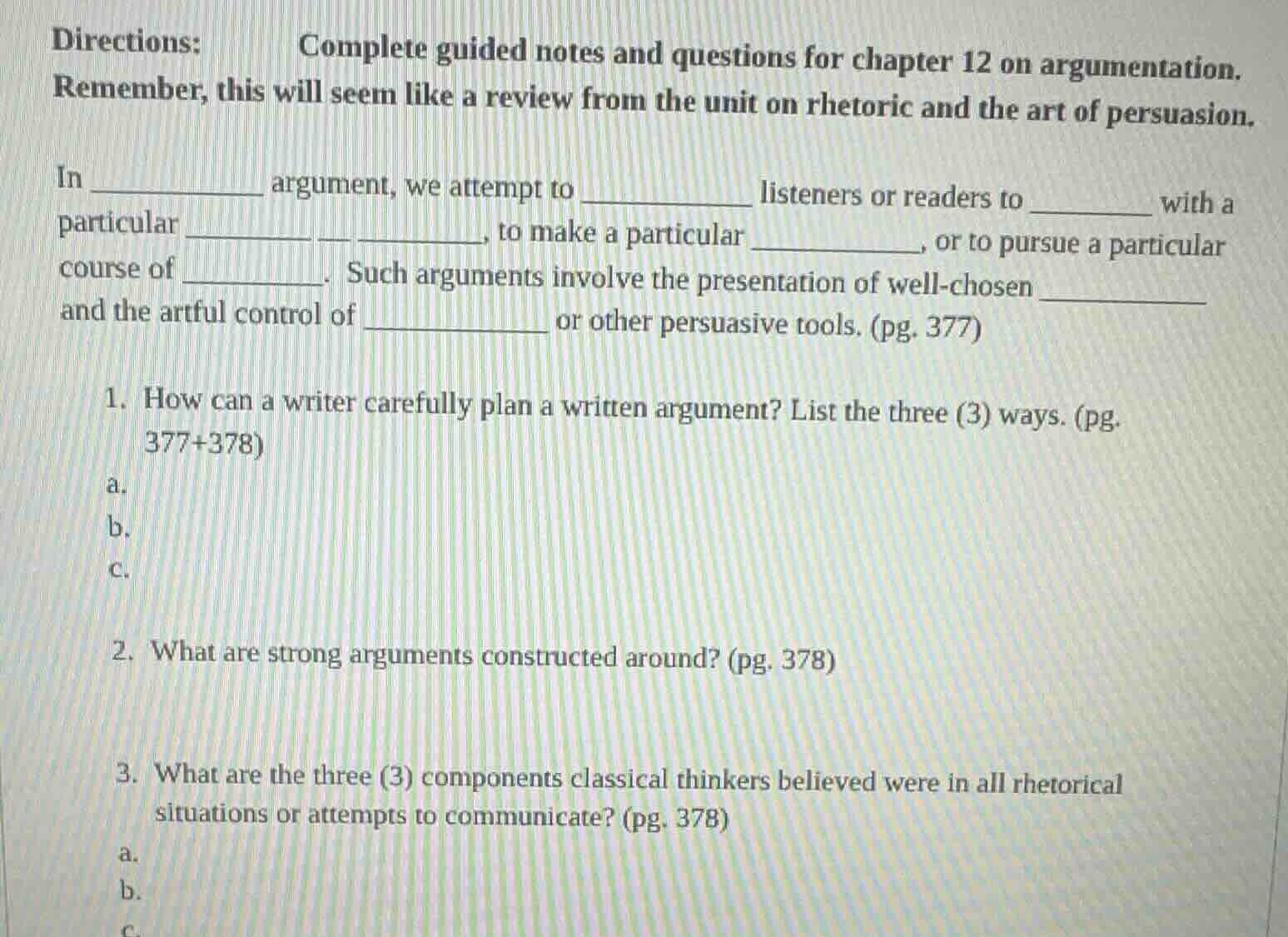
directions: complete guided notes and questions for chapter 12 on argumentation. remember, this will seem like a review from the unit on rhetoric and the art of persuasion. in ____ argument, we attempt to __ listeners or readers to __ with a particular __ ____, to make a particular __, or to pursue a particular course of __. such arguments involve the presentation of well - chosen __ and the artful control of ____ or other persuasive tools. (pg. 377) 1. how can a writer carefully plan a written argument? list the three (3) ways. (pg. 377+378) a. b. c. 2. what are strong arguments constructed around? (pg. 378) 3. what are the three (3) components classical thinkers believed were in all rhetorical situations or attempts to communicate? (pg. 378) a. b. c.
To solve these questions, we would typically refer to the textbook pages (377 - 378) mentioned. Since these are content - based questions about argumentation, rhetoric, and persuasive writing, here are the general steps to answer them:
For the fill - in - the - blanks at the beginning:
We need to recall the relevant concepts from the chapter on argumentation. In a persuasive argument, we attempt to persuade listeners or readers to agree with a particular point of view, to make a particular decision, or to pursue a particular course of action. Such arguments involve the presentation of well - chosen evidence and the artful control of language or other persuasive tools.
For Question 1 (How can a writer carefully plan a written argument? List the three (3) ways):
- Step 1: Recall the planning strategies from the text
- Usually, one way is to analyze the audience (understand who the readers or listeners are, their beliefs, values, and knowledge level).
- Another way is to define the purpose clearly (know if the goal is to inform, persuade, or entertain, but in the case of argumentation, mainly to persuade).
- The third way is to gather and organize evidence (collect relevant facts, examples, expert opinions, etc., and arrange them in a logical order).
For Question 2 (What are strong arguments constructed around?):
- Step 1: Refer to the textbook content
- Strong arguments are typically constructed around sound reasoning, relevant and sufficient evidence, and a clear understanding of the audience's perspective. They are also built around a well - defined claim (the main point the writer wants to make) and logical organization of ideas.
For Question 3 (What are the three (3) components classical thinkers believed were in all rhetorical situations or attempts to communicate?):
- Step 1: Recall classical rhetoric concepts
- Classical thinkers (like Aristotle) believed that the three components of a rhetorical situation are:
- Ethos (the credibility of the speaker or writer).
- Pathos (the emotional appeal to the audience).
- Logos (the logical appeal, using reasoning and evidence).
However, since these are textbook - specific questions, the most accurate answers would come from directly reading pages 377 - 378 of the relevant textbook.
If we assume the textbook is a standard composition or rhetoric textbook, here are the likely answers:
Fill - in - the - blanks:
In \(\boldsymbol{\text{persuasive}}\) argument, we attempt to \(\boldsymbol{\text{persuade}}\) listeners or readers to \(\boldsymbol{\text{agree}}\) with a particular \(\boldsymbol{\text{point of view}}\), to make a particular \(\boldsymbol{\text{decision}}\), or to pursue a particular course of \(\boldsymbol{\text{action}}\). Such arguments involve the presentation of well - chosen \(\boldsymbol{\text{evidence}}\) and the artful control of \(\boldsymbol{\text{language}}\) or other persuasive tools.
Question 1:
a. Analyze the audience.
b. Define the purpose clearly.
c. Gather and organize evidence.
Question 2:
Strong arguments are constructed around sound reasoning, relevant and sufficient evidence, and a clear understanding of the audience's perspective (or around a well - defined claim, logical organization, and appropriate use of rhetorical appeals like ethos, pathos, and logos).
Question 3:
a. Ethos (the speaker's/writer's credibility)
b. Pathos (emotional appeal to the audience)
c. Logos (logical appeal, using reas…

Snap & solve any problem in the app
Get step-by-step solutions on Sovi AI
Photo-based solutions with guided steps
Explore more problems and detailed explanations
To solve these questions, we would typically refer to the textbook pages (377 - 378) mentioned. Since these are content - based questions about argumentation, rhetoric, and persuasive writing, here are the general steps to answer them:
For the fill - in - the - blanks at the beginning:
We need to recall the relevant concepts from the chapter on argumentation. In a persuasive argument, we attempt to persuade listeners or readers to agree with a particular point of view, to make a particular decision, or to pursue a particular course of action. Such arguments involve the presentation of well - chosen evidence and the artful control of language or other persuasive tools.
For Question 1 (How can a writer carefully plan a written argument? List the three (3) ways):
- Step 1: Recall the planning strategies from the text
- Usually, one way is to analyze the audience (understand who the readers or listeners are, their beliefs, values, and knowledge level).
- Another way is to define the purpose clearly (know if the goal is to inform, persuade, or entertain, but in the case of argumentation, mainly to persuade).
- The third way is to gather and organize evidence (collect relevant facts, examples, expert opinions, etc., and arrange them in a logical order).
For Question 2 (What are strong arguments constructed around?):
- Step 1: Refer to the textbook content
- Strong arguments are typically constructed around sound reasoning, relevant and sufficient evidence, and a clear understanding of the audience's perspective. They are also built around a well - defined claim (the main point the writer wants to make) and logical organization of ideas.
For Question 3 (What are the three (3) components classical thinkers believed were in all rhetorical situations or attempts to communicate?):
- Step 1: Recall classical rhetoric concepts
- Classical thinkers (like Aristotle) believed that the three components of a rhetorical situation are:
- Ethos (the credibility of the speaker or writer).
- Pathos (the emotional appeal to the audience).
- Logos (the logical appeal, using reasoning and evidence).
However, since these are textbook - specific questions, the most accurate answers would come from directly reading pages 377 - 378 of the relevant textbook.
If we assume the textbook is a standard composition or rhetoric textbook, here are the likely answers:
Fill - in - the - blanks:
In \(\boldsymbol{\text{persuasive}}\) argument, we attempt to \(\boldsymbol{\text{persuade}}\) listeners or readers to \(\boldsymbol{\text{agree}}\) with a particular \(\boldsymbol{\text{point of view}}\), to make a particular \(\boldsymbol{\text{decision}}\), or to pursue a particular course of \(\boldsymbol{\text{action}}\). Such arguments involve the presentation of well - chosen \(\boldsymbol{\text{evidence}}\) and the artful control of \(\boldsymbol{\text{language}}\) or other persuasive tools.
Question 1:
a. Analyze the audience.
b. Define the purpose clearly.
c. Gather and organize evidence.
Question 2:
Strong arguments are constructed around sound reasoning, relevant and sufficient evidence, and a clear understanding of the audience's perspective (or around a well - defined claim, logical organization, and appropriate use of rhetorical appeals like ethos, pathos, and logos).
Question 3:
a. Ethos (the speaker's/writer's credibility)
b. Pathos (emotional appeal to the audience)
c. Logos (logical appeal, using reasoning and evidence)
These answers are based on general knowledge of rhetoric and argumentation. For the most accurate answers, always refer to the specific textbook pages (377 - 378) as instructed.