QUESTION IMAGE
Question
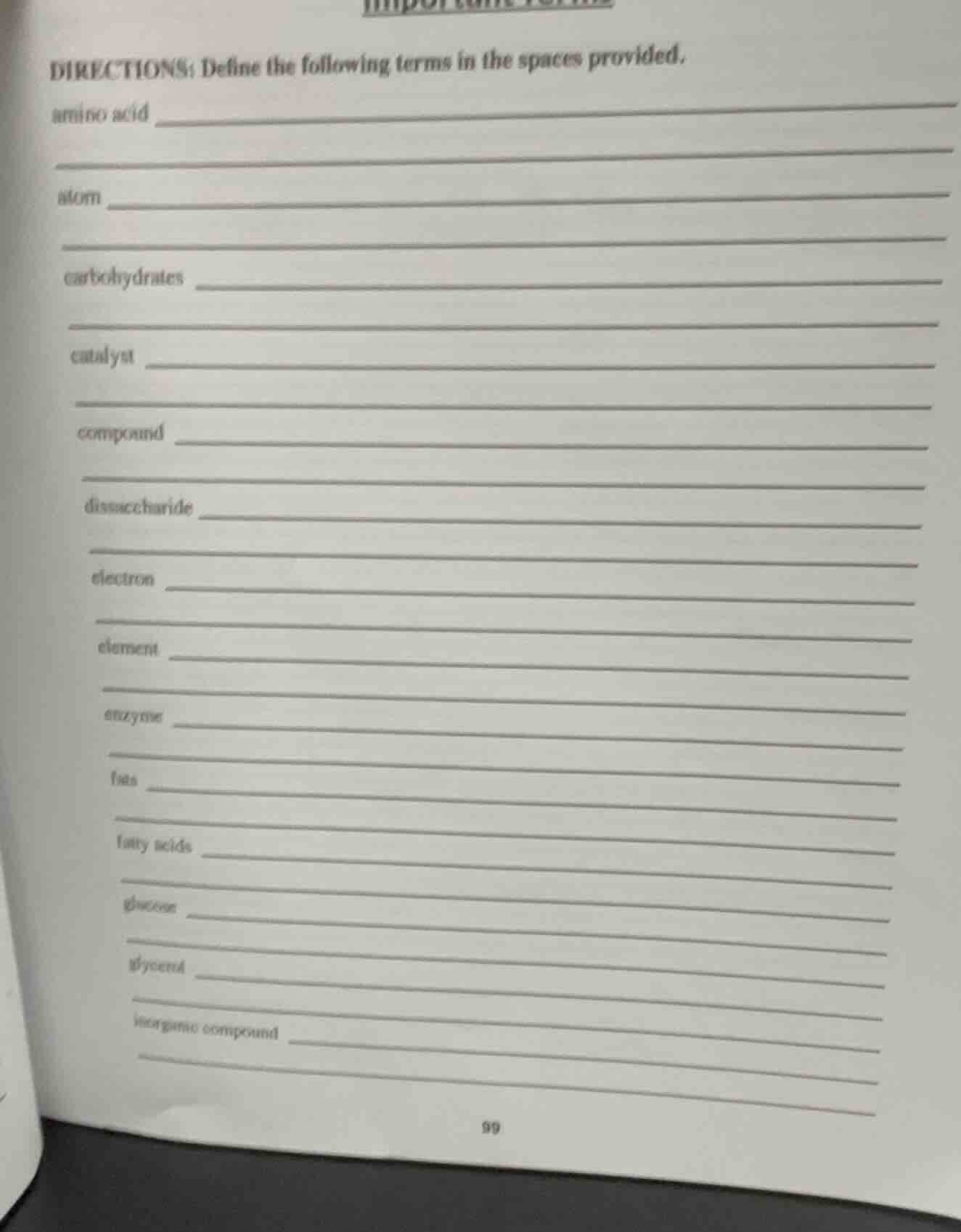
directions: define the following terms in the spaces provided.
amino acid
aom
carbohydrates
catalyst
compound
disaccharide
electron
element
enzyme
fats
fatty acids
glucose
glycerol
inorganic compound
Brief Explanations
Each term is defined with core, precise biological/chemical context:
- Amino acid: Basic building block of proteins, with amine/carboxyl groups.
- Atom: Smallest unit of an element retaining its properties.
- Carbohydrates: Organic molecules (sugars/starches) for energy/storage.
- Catalyst: Substance speeding reactions without being consumed.
- Compound: Substance of two+ bonded different elements.
- Disaccharide: Sugar made of two linked monosaccharide units.
- Electron: Negatively charged subatomic particle orbiting nucleus.
- Element: Pure substance with unique atomic number, no simpler form.
- Enzyme: Protein catalyst speeding biological reactions.
- Fats: Lipids (triglycerides) for long-term energy storage.
- Fatty acids: Carboxylic acids, building blocks of fats/lipids.
- Glucose: Simple sugar, primary cellular energy source.
- Glycerol: Alcohol, backbone for triglycerides (fats).
- Inorganic compound: Molecule without carbon-hydrogen bonds.

Snap & solve any problem in the app
Get step-by-step solutions on Sovi AI
Photo-based solutions with guided steps
Explore more problems and detailed explanations
- amino acid: Organic molecule with an amine group ($\text{-NH}_2$), a carboxyl group ($\text{-COOH}$), and a unique side chain; the basic building block of proteins.
- atom: The smallest unit of a chemical element that retains the element's chemical properties, composed of a nucleus (protons, neutrons) and orbiting electrons.
- carbohydrates: A class of organic compounds consisting of carbon, hydrogen, and oxygen (in a ~1:2:1 ratio), including sugars, starches, and cellulose, used primarily for energy and structural support in organisms.
- catalyst: A substance that increases the rate of a chemical reaction without undergoing any permanent chemical change itself.
- compound: A pure chemical substance composed of two or more different elements that are chemically bonded together in a fixed ratio.
- disaccharide: A type of carbohydrate formed by the covalent bonding of two monosaccharide (simple sugar) units, e.g., sucrose (glucose + fructose).
- electron: A negatively charged subatomic particle that orbits the nucleus of an atom, involved in chemical bonding and electrical phenomena.
- element: A pure substance that cannot be broken down into simpler substances by ordinary chemical means, defined by its unique number of protons (atomic number).
- enzyme: A type of protein that acts as a biological catalyst, speeding up specific chemical reactions in living organisms by lowering activation energy.
- fats: A type of lipid (triglyceride) composed of glycerol and three fatty acid chains, used for long-term energy storage, insulation, and protection in organisms.
- fatty acids: Long-chain carboxylic acids with a hydrocarbon tail and a carboxyl group, serving as building blocks for lipids like fats and phospholipids.
- glucose: A six-carbon monosaccharide ($\text{C}_6\text{H}_{12}\text{O}_6$), the primary source of energy for most living cells, and a building block for larger carbohydrates.
- glycerol: A three-carbon alcohol with hydroxyl groups ($\text{-OH}$), which forms the backbone of triglycerides (fats) and phospholipids.
- inorganic compound: A chemical compound that generally does not contain carbon-hydrogen ($\text{C-H}$) bonds, e.g., water ($\text{H}_2\text{O}$), salts, and carbon dioxide.