QUESTION IMAGE
Question
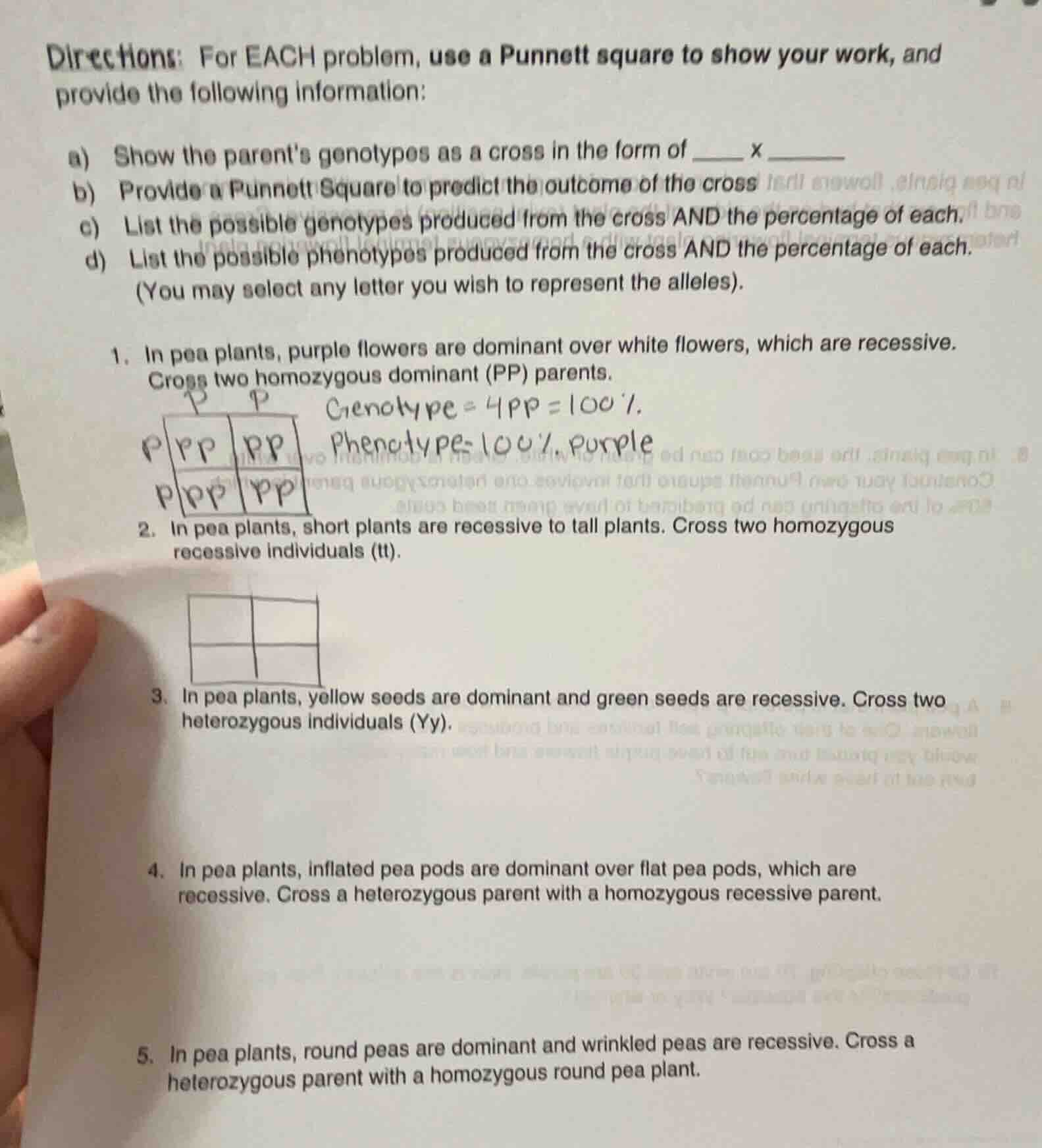
directions: for each problem, use a punnett square to show your work, and provide the following information:
a) show the parents genotypes as a cross in the form of __ x ____
b) provide a punnett square to predict the outcome of the cross
c) list the possible genotypes produced from the cross and the percentage of each.
d) list the possible phenotypes produced from the cross and the percentage of each.
(you may select any letter you wish to represent the alleles).
- in pea plants, purple flowers are dominant over white flowers, which are recessive. cross two homozygous dominant (pp) parents.
- in pea plants, short plants are recessive to tall plants. cross two homozygous recessive individuals (tt).
- in pea plants, yellow seeds are dominant and green seeds are recessive. cross two heterozygous individuals (yy).
- in pea plants, inflated pea pods are dominant over flat pea pods, which are recessive. cross a heterozygous parent with a homozygous recessive parent.
- in pea plants, round peas are dominant and wrinkled peas are recessive. cross a heterozygous parent with a homozygous round pea plant.
Problem 2: Cross two homozygous recessive (tt) pea plants (short plants are recessive to tall)
a) Parent Genotypes Cross
The parents are both homozygous recessive, so the cross is \( \text{tt} \times \text{tt} \).
b) Punnett Square
| t | t | |
|---|---|---|
| t | tt | tt |
c) Possible Genotypes and Percentages
- Genotype: \( \text{tt} \)
- Percentage: Since all 4 cells in the Punnett square are \( \text{tt} \), the percentage is \( \frac{4}{4} \times 100\% = 100\% \).
d) Possible Phenotypes and Percentages
- Phenotype: Short (because \( \text{tt} \) is the recessive genotype, and short is the recessive trait)
- Percentage: \( 100\% \) (all offspring will have the short phenotype).
Problem 3: Cross two heterozygous (Yy) pea plants (yellow seeds dominant, green recessive)
a) Parent Genotypes Cross
The cross is \( \text{Yy} \times \text{Yy} \).
b) Punnett Square
| Y | y | |
|---|---|---|
| y | Yy | yy |
c) Possible Genotypes and Percentages
- Genotype \( \text{YY} \): 1 out of 4 cells, so \( \frac{1}{4} \times 100\% = 25\% \)
- Genotype \( \text{Yy} \): 2 out of 4 cells, so \( \frac{2}{4} \times 100\% = 50\% \)
- Genotype \( \text{yy} \): 1 out of 4 cells, so \( \frac{1}{4} \times 100\% = 25\% \)
d) Possible Phenotypes and Percentages
- Phenotype Yellow (for \( \text{YY} \) and \( \text{Yy} \)): \( 25\% + 50\% = 75\% \)
- Phenotype Green (for \( \text{yy} \)): \( 25\% \)
Problem 4: Cross heterozygous (Ii) and homozygous recessive (ii) pea plants (inflated pods dominant, flat recessive)
a) Parent Genotypes Cross
The cross is \( \text{Ii} \times \text{ii} \).
b) Punnett Square
| I | i | |
|---|---|---|
| i | Ii | ii |
c) Possible Genotypes and Percentages
- Genotype \( \text{Ii} \): 2 out of 4 cells, so \( \frac{2}{4} \times 100\% = 50\% \)
- Genotype \( \text{ii} \): 2 out of 4 cells, so \( \frac{2}{4} \times 100\% = 50\% \)
d) Possible Phenotypes and Percentages
- Phenotype Inflated (for \( \text{Ii} \)): \( 50\% \) (since \( \text{I} \) is dominant)
- Phenotype Flat (for \( \text{ii} \)): \( 50\% \)
Problem 5: Cross heterozygous (Rr) and homozygous round (RR) pea plants (round dominant, wrinkled recessive)
a) Parent Genotypes Cross
The cross is \( \text{Rr} \times \text{RR} \).
b) Punnett Square
| R | R | |
|---|---|---|
| r | Rr | Rr |
c) Possible Genotypes and Percentages
- Genotype \( \text{RR} \): 2 out of 4 cells, so \( \frac{2}{4} \times 100\% = 50\% \)
- Genotype \( \text{Rr} \): 2 out of 4 cells, so \( \frac{2}{4} \times 100\% = 50\% \)
d) Possible Phenotypes and Percentages
- Phenotype Round (for \( \text{RR} \) and \( \text{Rr} \)): \( 50\% + 50\% = 100\% \) (both genotypes show the dominant round phenotype)

Snap & solve any problem in the app
Get step-by-step solutions on Sovi AI
Photo-based solutions with guided steps
Explore more problems and detailed explanations
Problem 2: Cross two homozygous recessive (tt) pea plants (short plants are recessive to tall)
a) Parent Genotypes Cross
The parents are both homozygous recessive, so the cross is \( \text{tt} \times \text{tt} \).
b) Punnett Square
| t | t | |
|---|---|---|
| t | tt | tt |
c) Possible Genotypes and Percentages
- Genotype: \( \text{tt} \)
- Percentage: Since all 4 cells in the Punnett square are \( \text{tt} \), the percentage is \( \frac{4}{4} \times 100\% = 100\% \).
d) Possible Phenotypes and Percentages
- Phenotype: Short (because \( \text{tt} \) is the recessive genotype, and short is the recessive trait)
- Percentage: \( 100\% \) (all offspring will have the short phenotype).
Problem 3: Cross two heterozygous (Yy) pea plants (yellow seeds dominant, green recessive)
a) Parent Genotypes Cross
The cross is \( \text{Yy} \times \text{Yy} \).
b) Punnett Square
| Y | y | |
|---|---|---|
| y | Yy | yy |
c) Possible Genotypes and Percentages
- Genotype \( \text{YY} \): 1 out of 4 cells, so \( \frac{1}{4} \times 100\% = 25\% \)
- Genotype \( \text{Yy} \): 2 out of 4 cells, so \( \frac{2}{4} \times 100\% = 50\% \)
- Genotype \( \text{yy} \): 1 out of 4 cells, so \( \frac{1}{4} \times 100\% = 25\% \)
d) Possible Phenotypes and Percentages
- Phenotype Yellow (for \( \text{YY} \) and \( \text{Yy} \)): \( 25\% + 50\% = 75\% \)
- Phenotype Green (for \( \text{yy} \)): \( 25\% \)
Problem 4: Cross heterozygous (Ii) and homozygous recessive (ii) pea plants (inflated pods dominant, flat recessive)
a) Parent Genotypes Cross
The cross is \( \text{Ii} \times \text{ii} \).
b) Punnett Square
| I | i | |
|---|---|---|
| i | Ii | ii |
c) Possible Genotypes and Percentages
- Genotype \( \text{Ii} \): 2 out of 4 cells, so \( \frac{2}{4} \times 100\% = 50\% \)
- Genotype \( \text{ii} \): 2 out of 4 cells, so \( \frac{2}{4} \times 100\% = 50\% \)
d) Possible Phenotypes and Percentages
- Phenotype Inflated (for \( \text{Ii} \)): \( 50\% \) (since \( \text{I} \) is dominant)
- Phenotype Flat (for \( \text{ii} \)): \( 50\% \)
Problem 5: Cross heterozygous (Rr) and homozygous round (RR) pea plants (round dominant, wrinkled recessive)
a) Parent Genotypes Cross
The cross is \( \text{Rr} \times \text{RR} \).
b) Punnett Square
| R | R | |
|---|---|---|
| r | Rr | Rr |
c) Possible Genotypes and Percentages
- Genotype \( \text{RR} \): 2 out of 4 cells, so \( \frac{2}{4} \times 100\% = 50\% \)
- Genotype \( \text{Rr} \): 2 out of 4 cells, so \( \frac{2}{4} \times 100\% = 50\% \)
d) Possible Phenotypes and Percentages
- Phenotype Round (for \( \text{RR} \) and \( \text{Rr} \)): \( 50\% + 50\% = 100\% \) (both genotypes show the dominant round phenotype)