QUESTION IMAGE
Question
directions: homework
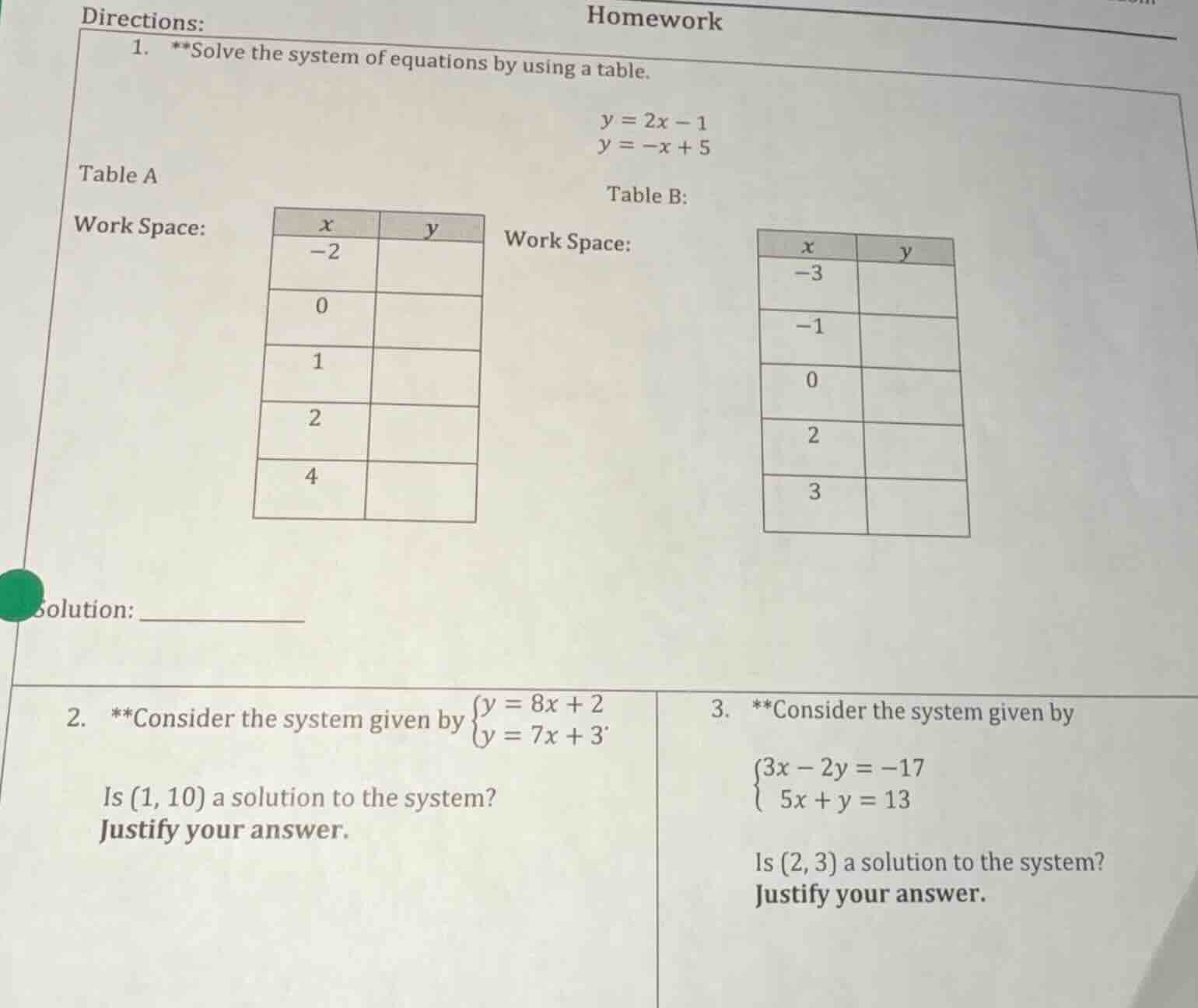
- **solve the system of equations by using a table.
$y = 2x - 1$
$y = -x + 5$
table a
work space:
table b:
work space:
solution:
- **consider the system given by $\
$
is $(1, 10)$ a solution to the system?
justify your answer.
- **consider the system given by
$\
$
is $(2, 3)$ a solution to the system?
justify your answer.
Sub - Question 1: Solve the system of equations \(y = 2x-1\) and \(y=-x + 5\) by using a table.
For Table A (\(y = 2x-1\)):
Step 1: When \(x=-2\)
Substitute \(x=-2\) into \(y = 2x-1\).
\(y=2\times(-2)-1=-4 - 1=-5\)
Step 2: When \(x = 0\)
Substitute \(x = 0\) into \(y = 2x-1\).
\(y=2\times0-1=0 - 1=-1\)
Step 3: When \(x = 1\)
Substitute \(x = 1\) into \(y = 2x-1\).
\(y=2\times1-1=2 - 1 = 1\)
Step 4: When \(x = 2\)
Substitute \(x = 2\) into \(y = 2x-1\).
\(y=2\times2-1=4 - 1=3\)
Step 5: When \(x = 4\)
Substitute \(x = 4\) into \(y = 2x-1\).
\(y=2\times4-1=8 - 1 = 7\)
So Table A (for \(y = 2x - 1\)):
| \(x\) | \(y\) |
|---|---|
| \(0\) | \(-1\) |
| \(1\) | \(1\) |
| \(2\) | \(3\) |
| \(4\) | \(7\) |
For Table B (\(y=-x + 5\)):
Step 1: When \(x=-3\)
Substitute \(x=-3\) into \(y=-x + 5\).
\(y=-(-3)+5=3 + 5=8\)
Step 2: When \(x=-1\)
Substitute \(x=-1\) into \(y=-x + 5\).
\(y=-(-1)+5=1 + 5=6\)
Step 3: When \(x = 0\)
Substitute \(x = 0\) into \(y=-x + 5\).
\(y=-0 + 5=5\)
Step 4: When \(x = 2\)
Substitute \(x = 2\) into \(y=-x + 5\).
\(y=-2 + 5=3\)
Step 5: When \(x = 3\)
Substitute \(x = 3\) into \(y=-x + 5\).
\(y=-3 + 5=2\)
So Table B (for \(y=-x + 5\)):
| \(x\) | \(y\) |
|---|---|
| \(-1\) | \(6\) |
| \(0\) | \(5\) |
| \(2\) | \(3\) |
| \(3\) | \(2\) |
To find the solution of the system, we look for the \(x\) and \(y\) values that are the same in both tables. From the tables, when \(x = 2\), \(y = 3\) for both equations. So the solution of the system \(
\) is \(x = 2,y = 3\) or \((2,3)\).
Sub - Question 2: Is \((1,10)\) a solution to the system \(
\)?
Step 1: Check the first equation \(y = 8x+2\)
Substitute \(x = 1,y = 10\) into \(y = 8x+2\).
Left - hand side (LHS) \(=y = 10\), Right - hand side (RHS) \(=8\times1+2=8 + 2 = 10\). So \(10=10\), the point satisfies the first equation.
Step 2: Check the second equation \(y = 7x+3\)
Substitute \(x = 1,y = 10\) into \(y = 7x+3\).
LHS \(=y = 10\), RHS \(=7\times1+3=7 + 3 = 10\). So \(10 = 10\), the point satisfies the second equation.
Since \((1,10)\) satisfies both equations of the system, \((1,10)\) is a solution to the system.
Sub - Question 3: Is \((2,3)\) a solution to the system \(
\)?
Step 1: Check the first equation \(3x-2y=-17\)
Substitute \(x = 2,y = 3\) into \(3x-2y\).
\(3\times2-2\times3=6 - 6 = 0\). But the right - hand side of the first equation is \(-17\). Since \(0
eq-17\), the point \((2,3)\) does not satisfy the first equation.
Since \((2,3)\) does not satisfy the first equation of the system, \((2,3)\) is not a solution to the system.

Snap & solve any problem in the app
Get step-by-step solutions on Sovi AI
Photo-based solutions with guided steps
Explore more problems and detailed explanations
s:
- The solution of the system \(
\) is \(\boldsymbol{(2,3)}\).
- Yes, \((1,10)\) is a solution to the system \(
\) (because it satisfies both equations).
- No, \((2,3)\) is not a solution to the system \(
\) (because it does not satisfy the first equation).