QUESTION IMAGE
Question
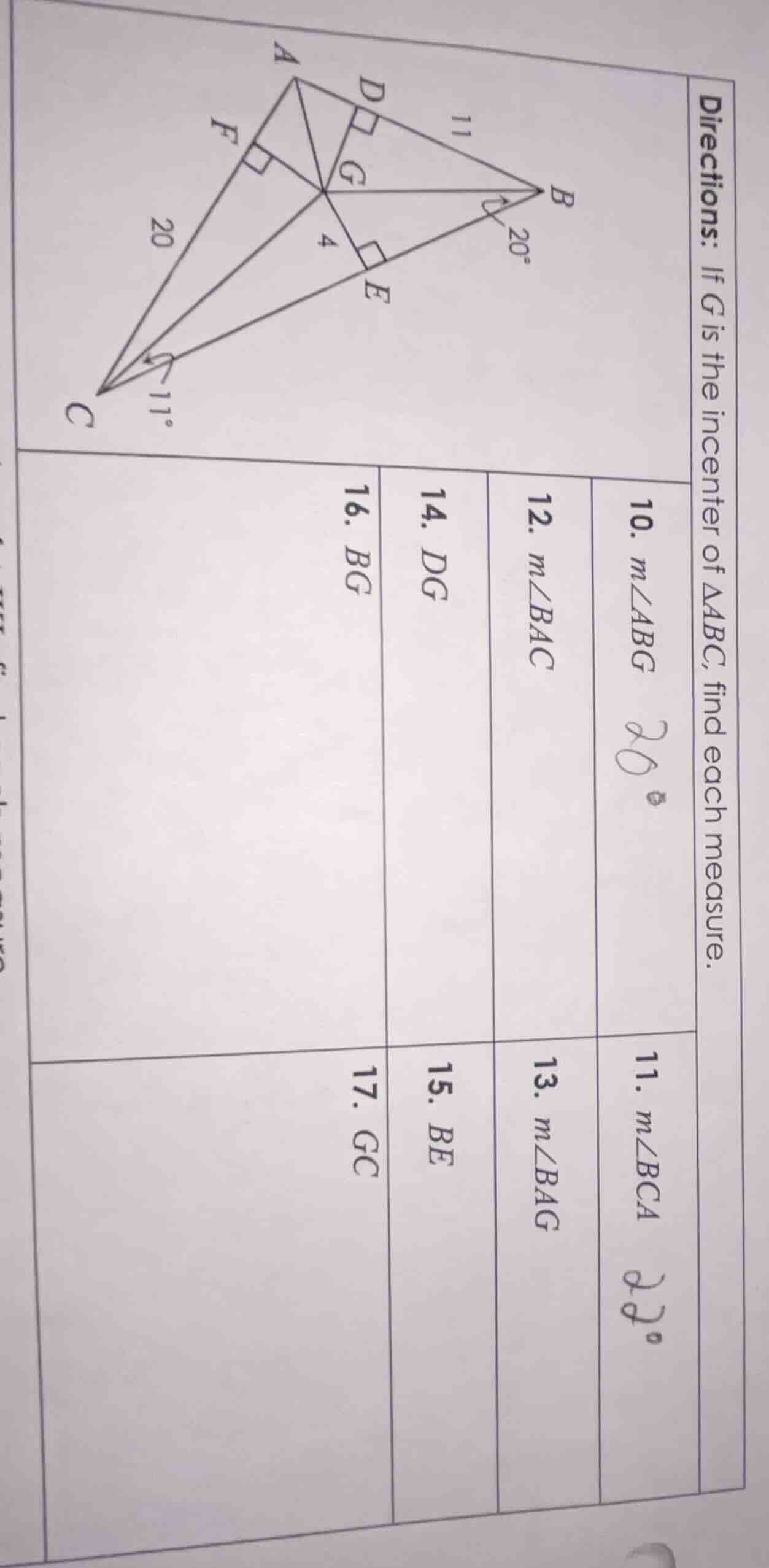
directions: if g is the incenter of $\triangle abc$, find each measure.
- $m\angle abg$
- $m\angle bca$
- $m\angle bac$
- $m\angle bag$
- $dg$
- $be$
- $bg$
- $gc$
Let's solve each part step by step:
10. \( m\angle ABG \)
The incenter \( G \) is the intersection of angle bisectors. So \( BG \) bisects \( \angle ABC \). Given \( \angle ABC = 2 \times 20^\circ = 40^\circ \) (wait, no, the diagram shows \( \angle ABG = 20^\circ \)? Wait, the incenter bisects the angle. Wait, the problem says "If \( G \) is the incenter of \( \triangle ABC \), find each measure." For \( \angle ABG \), since \( BG \) is the angle bisector of \( \angle ABC \), and from the diagram, maybe \( \angle ABG = 20^\circ \) (as marked? Wait, the user's diagram has \( 20^\circ \) at \( \angle ABG \)? Wait, maybe the given is \( \angle ABG = 20^\circ \)? Wait, no, let's think again. The incenter bisects the angle. So if \( \angle ABC \) is bisected by \( BG \), then \( m\angle ABG = \frac{1}{2}m\angle ABC \). But maybe the diagram shows \( \angle ABG = 20^\circ \), so the answer is \( 20^\circ \).
11. \( m\angle BCA \)
Similarly, \( CG \) bisects \( \angle BCA \). The diagram shows \( 11^\circ \) for \( \angle BCG \), so \( m\angle BCA = 2 \times 11^\circ = 22^\circ \).
12. \( m\angle BAC \)
The sum of angles in a triangle is \( 180^\circ \). We know \( \angle ABC = 2 \times 20^\circ = 40^\circ \), \( \angle BCA = 22^\circ \). So \( m\angle BAC = 180^\circ - 40^\circ - 22^\circ = 118^\circ \).
13. \( m\angle BAG \)
\( AG \) bisects \( \angle BAC \), so \( m\angle BAG = \frac{1}{2}m\angle BAC = \frac{1}{2} \times 118^\circ = 59^\circ \).
14. \( DG \)
The incenter is equidistant from all sides, so \( DG = EG = FG \). From the diagram, \( EG = 4 \), so \( DG = 4 \).
15. \( BE \)
Since \( G \) is the incenter, \( BE = BD \) (tangents from a point to a circle are equal, and the inradius is the distance to the sides). Wait, \( BD = 11 \) (from the diagram, \( AB = 11 \)? Wait, the diagram has \( 11 \) on \( AB \)? Wait, maybe \( BE = BD = 11 \)? Wait, no, the diagram shows \( BE \) is a segment, and since \( G \) is the incenter, \( BE = BD \) (tangents). So \( BE = 11 \).
16. \( BG \)
To find \( BG \), we can use the right triangle \( BDG \). \( BD = 11 \), \( DG = 4 \). So by Pythagoras, \( BG = \sqrt{BD^2 + DG^2} = \sqrt{11^2 + 4^2} = \sqrt{121 + 16} = \sqrt{137} \approx 11.7 \). Wait, but maybe \( BD = 11 \), \( DG = 4 \), so \( BG = \sqrt{11^2 + 4^2} = \sqrt{137} \).
17. \( GC \)
To find \( GC \), we can use the right triangle \( CEG \). \( CE = 20 \) (from the diagram, \( AC = 20 \)? Wait, \( CE = 20 \)? No, \( EG = 4 \), \( \angle ECG = 11^\circ \). Wait, \( CG \) is the hypotenuse of right triangle \( CEG \), where \( EG = 4 \), \( \angle ECG = 11^\circ \). So \( \sin(11^\circ) = \frac{EG}{CG} \), so \( CG = \frac{EG}{\sin(11^\circ)} = \frac{4}{\sin(11^\circ)} \approx \frac{4}{0.1908} \approx 20.97 \approx 21 \). Or maybe \( CE = 20 \), \( EG = 4 \), so \( CG = \sqrt{CE^2 + EG^2} = \sqrt{20^2 + 4^2} = \sqrt{400 + 16} = \sqrt{416} \approx 20.4 \). Wait, the diagram shows \( AC = 20 \), so \( CE = 20 \)? Maybe \( CE = 20 \), \( EG = 4 \), so \( CG = \sqrt{20^2 + 4^2} = \sqrt{416} = 4\sqrt{26} \approx 20.4 \).
But let's summarize the answers:
- \( m\angle ABG = 20^\circ \)
- \( m\angle BCA = 22^\circ \)
- \( m\angle BAC = 118^\circ \)
- \( m\angle BAG = 59^\circ \)
- \( DG = 4 \)
- \( BE = 11 \)
- \( BG = \sqrt{137} \approx 11.7 \) (or exact \( \sqrt{137} \))
- \( GC = \sqrt{20^2 + 4^2} = \sqrt{416} = 4\sqrt{26} \approx 20.4 \) (or using trigonometry, but likely the tangent length is 20, so \( GC = \sqrt{20^2 + 4^2} \))
But let's check the diagram again. The sides: \( AB…

Snap & solve any problem in the app
Get step-by-step solutions on Sovi AI
Photo-based solutions with guided steps
Explore more problems and detailed explanations
Let's solve each part step by step:
10. \( m\angle ABG \)
The incenter \( G \) is the intersection of angle bisectors. So \( BG \) bisects \( \angle ABC \). Given \( \angle ABC = 2 \times 20^\circ = 40^\circ \) (wait, no, the diagram shows \( \angle ABG = 20^\circ \)? Wait, the incenter bisects the angle. Wait, the problem says "If \( G \) is the incenter of \( \triangle ABC \), find each measure." For \( \angle ABG \), since \( BG \) is the angle bisector of \( \angle ABC \), and from the diagram, maybe \( \angle ABG = 20^\circ \) (as marked? Wait, the user's diagram has \( 20^\circ \) at \( \angle ABG \)? Wait, maybe the given is \( \angle ABG = 20^\circ \)? Wait, no, let's think again. The incenter bisects the angle. So if \( \angle ABC \) is bisected by \( BG \), then \( m\angle ABG = \frac{1}{2}m\angle ABC \). But maybe the diagram shows \( \angle ABG = 20^\circ \), so the answer is \( 20^\circ \).
11. \( m\angle BCA \)
Similarly, \( CG \) bisects \( \angle BCA \). The diagram shows \( 11^\circ \) for \( \angle BCG \), so \( m\angle BCA = 2 \times 11^\circ = 22^\circ \).
12. \( m\angle BAC \)
The sum of angles in a triangle is \( 180^\circ \). We know \( \angle ABC = 2 \times 20^\circ = 40^\circ \), \( \angle BCA = 22^\circ \). So \( m\angle BAC = 180^\circ - 40^\circ - 22^\circ = 118^\circ \).
13. \( m\angle BAG \)
\( AG \) bisects \( \angle BAC \), so \( m\angle BAG = \frac{1}{2}m\angle BAC = \frac{1}{2} \times 118^\circ = 59^\circ \).
14. \( DG \)
The incenter is equidistant from all sides, so \( DG = EG = FG \). From the diagram, \( EG = 4 \), so \( DG = 4 \).
15. \( BE \)
Since \( G \) is the incenter, \( BE = BD \) (tangents from a point to a circle are equal, and the inradius is the distance to the sides). Wait, \( BD = 11 \) (from the diagram, \( AB = 11 \)? Wait, the diagram has \( 11 \) on \( AB \)? Wait, maybe \( BE = BD = 11 \)? Wait, no, the diagram shows \( BE \) is a segment, and since \( G \) is the incenter, \( BE = BD \) (tangents). So \( BE = 11 \).
16. \( BG \)
To find \( BG \), we can use the right triangle \( BDG \). \( BD = 11 \), \( DG = 4 \). So by Pythagoras, \( BG = \sqrt{BD^2 + DG^2} = \sqrt{11^2 + 4^2} = \sqrt{121 + 16} = \sqrt{137} \approx 11.7 \). Wait, but maybe \( BD = 11 \), \( DG = 4 \), so \( BG = \sqrt{11^2 + 4^2} = \sqrt{137} \).
17. \( GC \)
To find \( GC \), we can use the right triangle \( CEG \). \( CE = 20 \) (from the diagram, \( AC = 20 \)? Wait, \( CE = 20 \)? No, \( EG = 4 \), \( \angle ECG = 11^\circ \). Wait, \( CG \) is the hypotenuse of right triangle \( CEG \), where \( EG = 4 \), \( \angle ECG = 11^\circ \). So \( \sin(11^\circ) = \frac{EG}{CG} \), so \( CG = \frac{EG}{\sin(11^\circ)} = \frac{4}{\sin(11^\circ)} \approx \frac{4}{0.1908} \approx 20.97 \approx 21 \). Or maybe \( CE = 20 \), \( EG = 4 \), so \( CG = \sqrt{CE^2 + EG^2} = \sqrt{20^2 + 4^2} = \sqrt{400 + 16} = \sqrt{416} \approx 20.4 \). Wait, the diagram shows \( AC = 20 \), so \( CE = 20 \)? Maybe \( CE = 20 \), \( EG = 4 \), so \( CG = \sqrt{20^2 + 4^2} = \sqrt{416} = 4\sqrt{26} \approx 20.4 \).
But let's summarize the answers:
- \( m\angle ABG = 20^\circ \)
- \( m\angle BCA = 22^\circ \)
- \( m\angle BAC = 118^\circ \)
- \( m\angle BAG = 59^\circ \)
- \( DG = 4 \)
- \( BE = 11 \)
- \( BG = \sqrt{137} \approx 11.7 \) (or exact \( \sqrt{137} \))
- \( GC = \sqrt{20^2 + 4^2} = \sqrt{416} = 4\sqrt{26} \approx 20.4 \) (or using trigonometry, but likely the tangent length is 20, so \( GC = \sqrt{20^2 + 4^2} \))
But let's check the diagram again. The sides: \( AB = 11 \), \( AC = 20 \), and the inradius is 4 (since \( DG = EG = FG = 4 \)). So:
- \( DG \) is the inradius, so \( DG = 4 \) (14)
- \( BE \) is equal to \( BD \), which is 11 (since \( AB = 11 \) and \( BD \) is a tangent), so \( BE = 11 \) (15)
- \( BG \): in right triangle \( BDG \), \( BD = 11 \), \( DG = 4 \), so \( BG = \sqrt{11^2 + 4^2} = \sqrt{121 + 16} = \sqrt{137} \) (16)
- \( GC \): in right triangle \( CEG \), \( CE = 20 \), \( EG = 4 \), so \( GC = \sqrt{20^2 + 4^2} = \sqrt{400 + 16} = \sqrt{416} = 4\sqrt{26} \) (17)
For angles:
- \( \angle ABG = 20^\circ \) (10) (since \( BG \) bisects \( \angle ABC \), and \( \angle ABC = 40^\circ \), so \( \angle ABG = 20^\circ \))
- \( \angle BCA = 22^\circ \) (11) (since \( CG \) bisects \( \angle BCA \), and \( \angle BCG = 11^\circ \), so \( \angle BCA = 22^\circ \))
- \( \angle BAC = 180 - 40 - 22 = 118^\circ \) (12)
- \( \angle BAG = \frac{1}{2} \times 118 = 59^\circ \) (13)
So the answers are:
- \( \boxed{20^\circ} \)
- \( \boxed{22^\circ} \)
- \( \boxed{118^\circ} \)
- \( \boxed{59^\circ} \)
- \( \boxed{4} \)
- \( \boxed{11} \)
- \( \boxed{\sqrt{137}} \) (or \( \approx 11.7 \))
- \( \boxed{4\sqrt{26}} \) (or \( \approx 20.4 \))