QUESTION IMAGE
Question
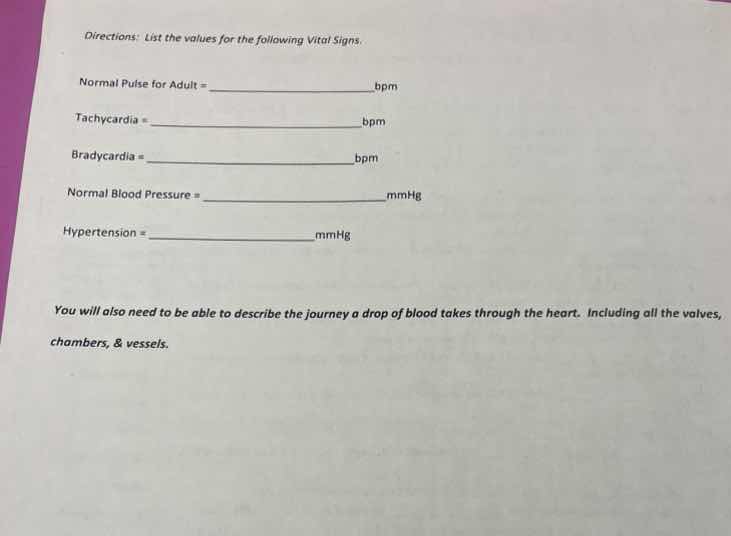
directions: list the values for the following vital signs.
normal pulse for adult = _______________ bpm
tachycardia = _______________ bpm
bradycardia = _______________ bpm
normal blood pressure = _______________ mmhg
hypertension = _______________ mmhg
you will also need to be able to describe the journey a drop of blood takes through the heart. including all the valves, chambers, & vessels.
- For pulse values: Standard adult clinical ranges define normal, fast (tachycardia), and slow (bradycardia) heart rates.
- For blood pressure values: Clinical guidelines set normal and hypertensive thresholds based on systolic/diastolic measurements.
- For blood flow through the heart: The path follows the pulmonary and systemic circuits, passing through all chambers, valves, and connecting vessels in order.

Snap & solve any problem in the app
Get step-by-step solutions on Sovi AI
Photo-based solutions with guided steps
Explore more problems and detailed explanations
Normal Pulse for Adult = 60-100 bpm
Tachycardia = >100 bpm
Bradycardia = <60 bpm
Normal Blood Pressure = 120/80 mmHg (or <120/<80 mmHg)
Hypertension = ≥130/≥80 mmHg
Journey of a drop of blood through the heart:
- Deoxygenated blood enters the right atrium via the superior/inferior vena cava.
- Blood flows through the tricuspid valve into the right ventricle.
- Right ventricle pumps blood through the pulmonary semilunar valve into the pulmonary artery, which carries it to the lungs for oxygenation.
- Oxygenated blood returns to the left atrium via the pulmonary veins.
- Blood flows through the mitral (bicuspid) valve into the left ventricle.
- Left ventricle pumps oxygenated blood through the aortic semilunar valve into the aorta, which distributes it to the rest of the body.