QUESTION IMAGE
Question
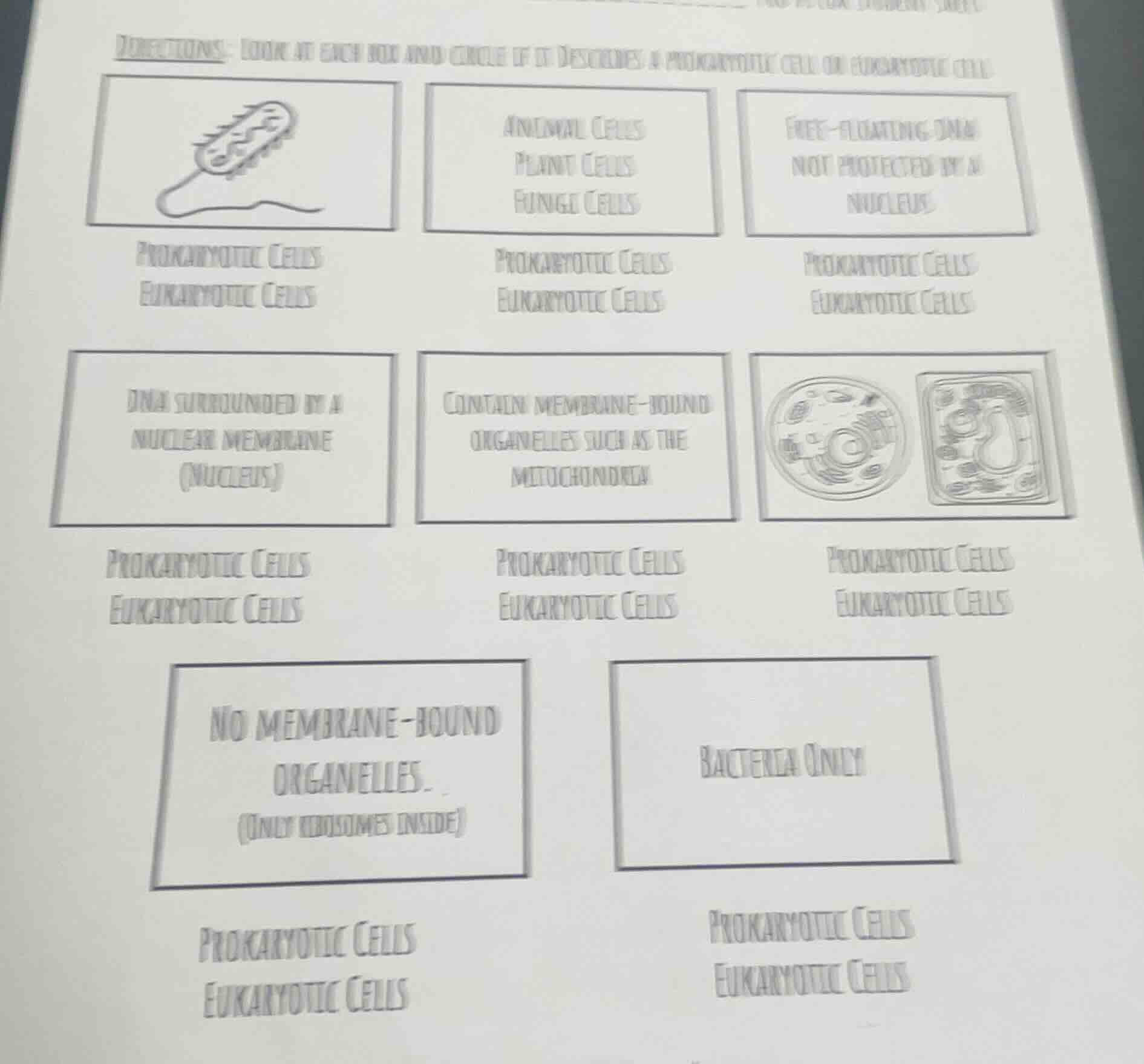
directions: look at each box and circle if it describes a prokaryotic cell or eukaryotic cell.
box with bacteria image
prokaryotic cells
eukaryotic cells
box with text: animal cells
plant cells
fungi cells
prokaryotic cells
eukaryotic cells
box with text: free - floating dna
not protected by a
nucleus
prokaryotic cells
eukaryotic cells
box with text: dna surrounded by a
nuclear membrane
(nucleus)
prokaryotic cells
eukaryotic cells
box with text: contain membrane - bound
organelles such as the
mitochondria
prokaryotic cells
eukaryotic cells
box with animal and plant cell images
prokaryotic cells
eukaryotic cells
box with text: no membrane - bound
organelles.
(only ribosomes inside)
prokaryotic cells
eukaryotic cells
box with text: bacteria only
prokaryotic cells
eukaryotic cells
Box 1 (Bacteria image)
Prokaryotic cells include bacteria (the image is a bacterium). Eukaryotic cells are more complex (animal, plant, fungi). So this describes prokaryotic cells.
Animal, plant, and fungi cells all have a nucleus and membrane - bound organelles, which are characteristics of eukaryotic cells. Prokaryotic cells do not have these complex structures.
Prokaryotic cells have their DNA in a region called the nucleoid, which is not a true nucleus (no nuclear membrane). Eukaryotic cells have DNA in a nucleus. So this is a prokaryotic cell feature.

Snap & solve any problem in the app
Get step-by-step solutions on Sovi AI
Photo-based solutions with guided steps
Explore more problems and detailed explanations
Prokaryotic Cells