QUESTION IMAGE
Question
directions
read the passage about the digestive system. highlight the... you answer each question. then write your answers using details from the passage.
- gas transport by the blood
- gas exchange between the blood and cells
step 1: breathing
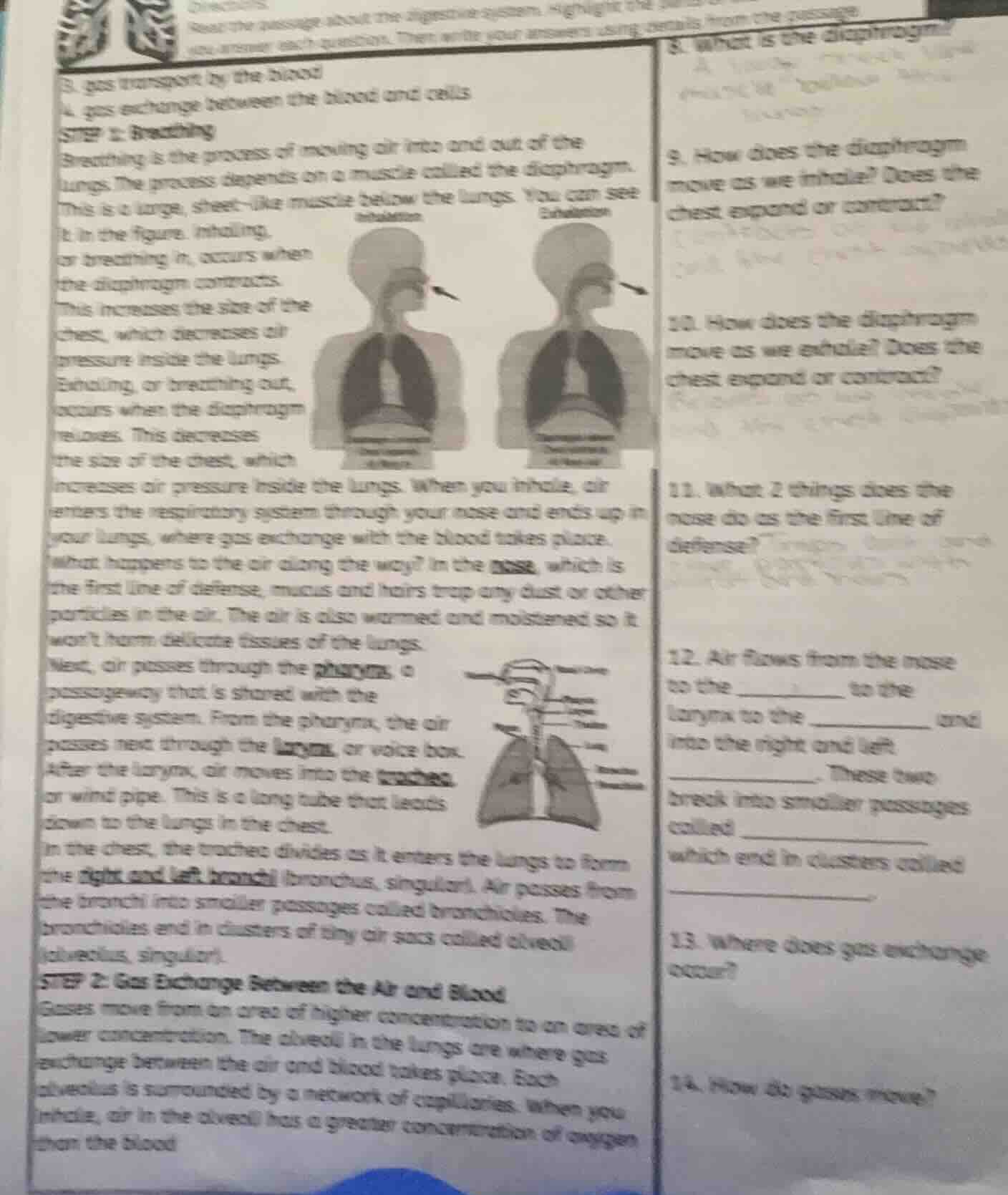
breathing is the process of moving air into and out of the lungs. the process depends on a muscle called the diaphragm. this is a large, sheet - like muscle below the lungs. you can see it in the figure. inhaling, or breathing in, occurs when the diaphragm contracts. this increases the size of the chest, which decreases air pressure inside the lungs. exhaling, or breathing out, occurs when the diaphragm relaxes. this decreases the size of the chest, which increases air pressure inside the lungs. when you inhale, air enters the respiratory system through your nose and ends up in your lungs, where gas exchange with the blood takes place. what happens to the air along the way? in the nose, which is the first line of defense, mucus and hairs trap any dust or other particles in the air. the air is also warmed and moistened so it wont harm delicate tissues of the lungs.
next, air passes through the pharynx, a passageway that is shared with the digestive system. from the pharynx, the air passes next through the larynx, or voice box. after the larynx, air moves into the trachea, or wind pipe. this is a long tube that leads down to the lungs in the chest.
in the chest, the trachea divides as it enters the lungs to form the right and left bronchi (bronchus, singular). air passes from the bronchi into smaller passages called bronchioles. the bronchioles end in clusters of tiny air sacs called alveoli (alveolus, singular).
step 2: gas exchange between the air and blood
gases move from an area of higher concentration to an area of lower concentration. the alveoli in the lungs are where gas exchange between the air and blood takes place. each alveolus is surrounded by a network of capillaries. when you inhale, air in the alveoli has a greater concentration of oxygen than the blood...
- what is the diaphragm?
- how does the diaphragm move as we inhale? does the chest expand or contract?
- how does the diaphragm move as we exhale? does the chest expand or contract?
- what 2 things does the nose do as the first line of defense?
- air flows from the nose to the ____ to the larynx to the __ and into the right and left __. these two break into smaller passages called __ which end in clusters called ____.
- where does gas exchange occur?
- how do gases move?
Step1: Answer Q8 (Define diaphragm)
<Extract definition from text>
Step2: Answer Q9 (Inhale diaphragm/chest movement)
<Extract inhalation mechanics from text>
Step3: Answer Q10 (Exhale diaphragm/chest movement)
<Extract exhalation mechanics from text>
Step4: Answer Q11 (Nose's defense roles)
<Extract nose defense functions from text>
Step5: Answer Q12 (Air flow pathway)
<Extract respiratory pathway from text>
Step6: Answer Q13 (Gas exchange location)
<Extract gas exchange site from text>
Step7: Answer Q14 (Gas movement rule)
<Extract gas movement principle from text>

Snap & solve any problem in the app
Get step-by-step solutions on Sovi AI
Photo-based solutions with guided steps
Explore more problems and detailed explanations
- The diaphragm is a large, sheet-like muscle below the lungs that drives breathing.
- When inhaling, the diaphragm contracts, and the chest expands.
- When exhaling, the diaphragm relaxes, and the chest contracts.
- The nose acts as a first line of defense by using mucus and hairs to trap dust/particles, and it warms and moistens air to protect lung tissues.
- Air flows from the nose to the pharynx to the larynx to the trachea, and into the right and left bronchi. These two break into smaller passages called bronchioles which end in clusters called alveoli.
- Gas exchange occurs in the alveoli of the lungs.
- Gases move from an area of higher concentration to an area of lower concentration.