QUESTION IMAGE
Question
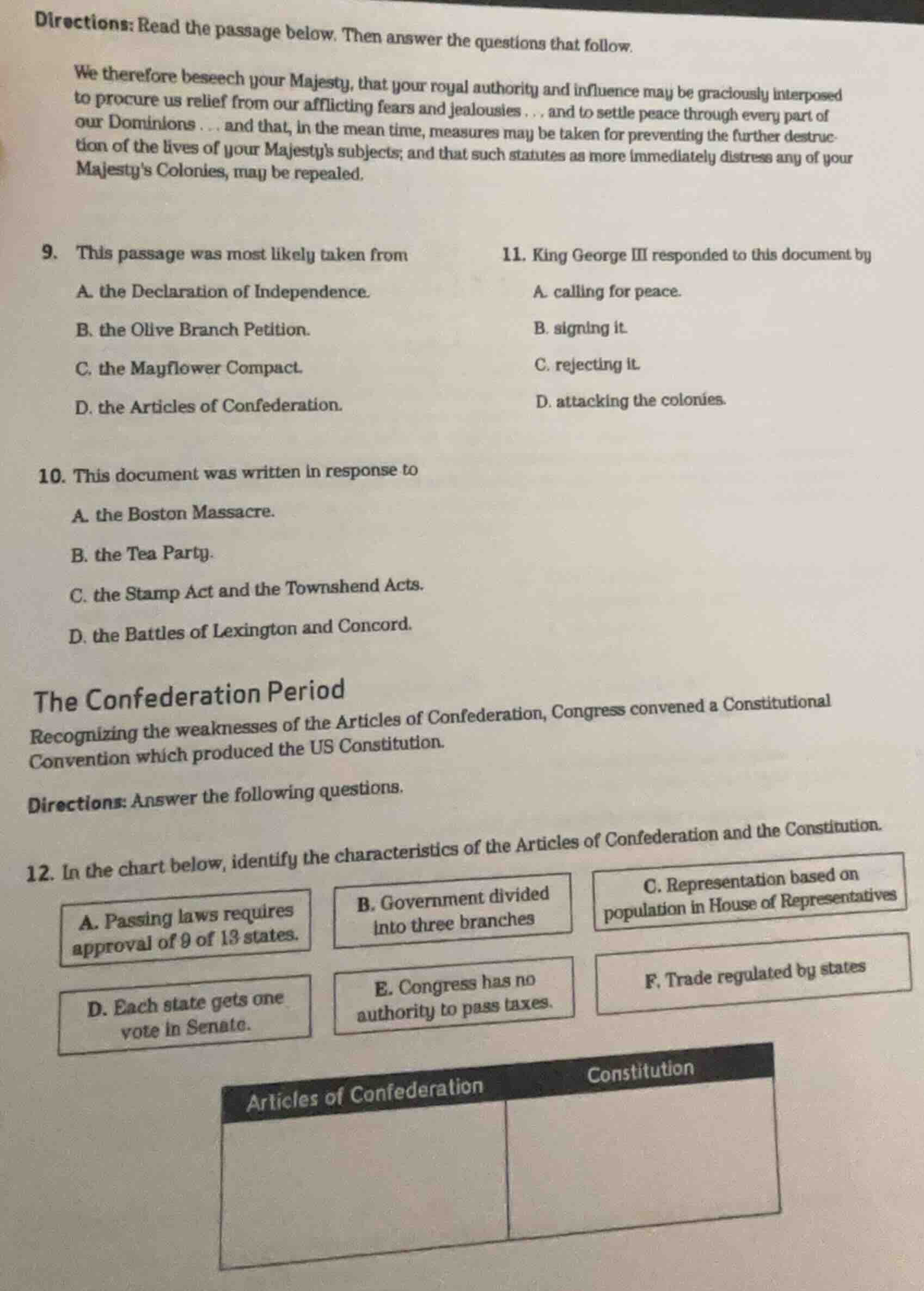
directions: read the passage below. then answer the questions that follow.we therefore beseech your majesty, that your royal authority and influence may be graciously interposed to procure us relief from our afflicting fears and jealousies . . . and to settle peace through every part of our dominions . . . and that, in the mean time, measures may be taken for preventing the further destruction of the lives of your majestys subjects; and that such statutes as more immediately distress any of your majestys colonies, may be repealed.9. this passage was most likely taken froma. the declaration of independence.b. the olive branch petition.c. the mayflower compact.d. the articles of confederation.10. this document was written in response toa. the boston massacre.b. the tea party.c. the stamp act and the townshend acts.d. the battles of lexington and concord.11. king george iii responded to this document bya. calling for peace.b. signing it.c. rejecting it.d. attacking the colonies.the confederation periodrecognizing the weaknesses of the articles of confederation, congress convened a constitutional convention which produced the us constitution.directions: answer the following questions.12. in the chart below, identify the characteristics of the articles of confederation and the constitution.a. passing laws requires approval of 9 of 13 states.b. government divided into three branchesc. representation based on population in house of representativesd. each state gets one vote in senate.e. congress has no authority to pass taxes.f. trade regulated by statesarticles of confederation | constitution
For Question 9:
The passage addresses the British monarch, pleading for relief from oppressive statutes and peace, which matches the Olive Branch Petition's tone of reconciliation with King George III, unlike the other options.
For Question 10:
The Olive Branch Petition was sent in July 1775, right after the Battles of Lexington and Concord (April 1775), as a last attempt at peace before full-scale war.
For Question 11:
King George III rejected the Olive Branch Petition, declaring the colonies in rebellion shortly after receiving it.
For Question 12:
The Articles of Confederation created a weak central government with limited power, while the US Constitution established a stronger, separated system with balanced representation and taxing authority.

Snap & solve any problem in the app
Get step-by-step solutions on Sovi AI
Photo-based solutions with guided steps
Explore more problems and detailed explanations
- B. the Olive Branch Petition.
- D. the Battles of Lexington and Concord.
- C. rejecting it.
12.
| Articles of Confederation | Constitution |
|---|---|
| E. Congress has no authority to pass taxes. | C. Representation based on population in House of Representatives |
| F. Trade regulated by states | D. Each state gets one vote in Senate. |