QUESTION IMAGE
Question
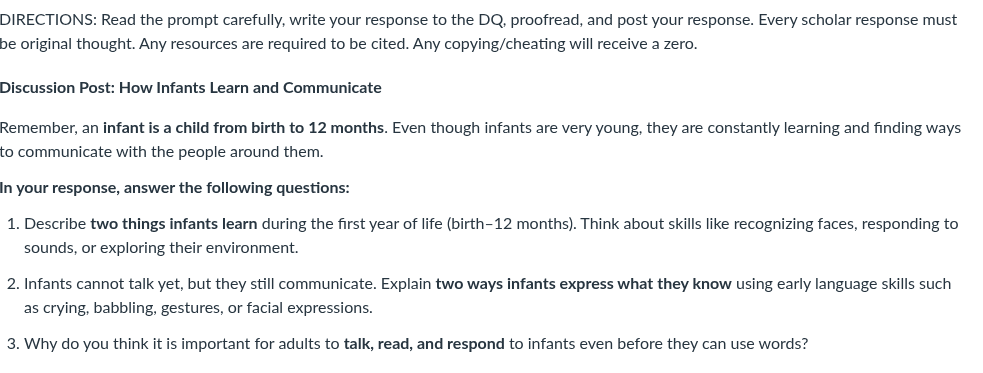
directions: read the prompt carefully, write your response to the dq, proofread, and post your response. every scholar response must be original thought. any resources are required to be cited. any copying/cheating will receive a zero.
discussion post: how infants learn and communicate
remember, an infant is a child from birth to 12 months. even though infants are very young, they are constantly learning and finding ways to communicate with the people around them.
in your response, answer the following questions:
- describe two things infants learn during the first year of life (birth–12 months). think about skills like recognizing faces, responding to sounds, or exploring their environment.
- infants cannot talk yet, but they still communicate. explain two ways infants express what they know using early language skills such as crying, babbling, gestures, or facial expressions.
- why do you think it is important for adults to talk, read, and respond to infants even before they can use words?
Response
1. Two things infants learn in the first year:
- Face recognition: By around 2 - 3 months, infants start to recognize familiar faces (like parents) and show preferences for them over strangers. This is a key social - cognitive skill as it helps them form early attachments. For example, a baby might smile more at their mother's face than at a unfamiliar caregiver's face.
- Responding to sounds: Infants learn to respond to different sounds. At first, they are startled by loud noises, but as they grow (around 4 - 6 months), they start to turn their heads towards the source of familiar sounds, like their mother's voice. They also begin to differentiate between different types of sounds, such as the sound of a toy rattle and a human voice.
2. Two ways infants communicate:
- Crying: Infants use crying to communicate different needs. A hungry cry might be different from a cry of discomfort (like when they have a wet diaper) or a cry of fear. For instance, a short, low - pitched cry might indicate hunger, while a more intense, high - pitched cry could be a sign of pain or fear.
- Babbling and gestures: Around 6 - 12 months, infants start babbling (making repetitive sounds like “ba - ba - ba”) which is a precursor to language. They also use gestures, like reaching out their arms when they want to be picked up. A baby might babble while reaching for a toy, indicating that they want to play with it.
3. Importance of adults talking, reading, and responding to infants:
- Language development: When adults talk to infants, they expose them to a rich vocabulary and the structure of language. Reading to infants introduces them to different sounds, rhythms, and words. For example, reading a simple board book with repetitive phrases helps infants start to recognize patterns in language. Responding to their non - verbal cues (like coos or gestures) also encourages them to communicate more, as they learn that their actions elicit a response.
- Social - emotional development: Talking, reading, and responding to infants helps build a strong bond between the adult and the infant. It makes the infant feel secure and understood. For instance, when a parent responds to an infant's babble with a smile and a word, the infant learns that their communication is valued, which boosts their self - esteem and social skills. It also helps them learn to regulate their emotions, as the consistent interaction provides a sense of stability.

Snap & solve any problem in the app
Get step-by-step solutions on Sovi AI
Photo-based solutions with guided steps
Explore more problems and detailed explanations
1. Two things infants learn in the first year:
- Face recognition: By around 2 - 3 months, infants start to recognize familiar faces (like parents) and show preferences for them over strangers. This is a key social - cognitive skill as it helps them form early attachments. For example, a baby might smile more at their mother's face than at a unfamiliar caregiver's face.
- Responding to sounds: Infants learn to respond to different sounds. At first, they are startled by loud noises, but as they grow (around 4 - 6 months), they start to turn their heads towards the source of familiar sounds, like their mother's voice. They also begin to differentiate between different types of sounds, such as the sound of a toy rattle and a human voice.
2. Two ways infants communicate:
- Crying: Infants use crying to communicate different needs. A hungry cry might be different from a cry of discomfort (like when they have a wet diaper) or a cry of fear. For instance, a short, low - pitched cry might indicate hunger, while a more intense, high - pitched cry could be a sign of pain or fear.
- Babbling and gestures: Around 6 - 12 months, infants start babbling (making repetitive sounds like “ba - ba - ba”) which is a precursor to language. They also use gestures, like reaching out their arms when they want to be picked up. A baby might babble while reaching for a toy, indicating that they want to play with it.
3. Importance of adults talking, reading, and responding to infants:
- Language development: When adults talk to infants, they expose them to a rich vocabulary and the structure of language. Reading to infants introduces them to different sounds, rhythms, and words. For example, reading a simple board book with repetitive phrases helps infants start to recognize patterns in language. Responding to their non - verbal cues (like coos or gestures) also encourages them to communicate more, as they learn that their actions elicit a response.
- Social - emotional development: Talking, reading, and responding to infants helps build a strong bond between the adult and the infant. It makes the infant feel secure and understood. For instance, when a parent responds to an infant's babble with a smile and a word, the infant learns that their communication is valued, which boosts their self - esteem and social skills. It also helps them learn to regulate their emotions, as the consistent interaction provides a sense of stability.