QUESTION IMAGE
Question
directions:
- read the speech.
- circle examples of ethos (credibility or trust).
- underline examples of pathos (emotion).
- highlight examples of logos (facts or logic).
then, read the speech again.
- star (★) any persuasive techniques you find.
- use the notes area to write any observations or thoughts that help you understand the speech.
\on surrender to us army, 1877\
delivered by chief joseph of the nez perce
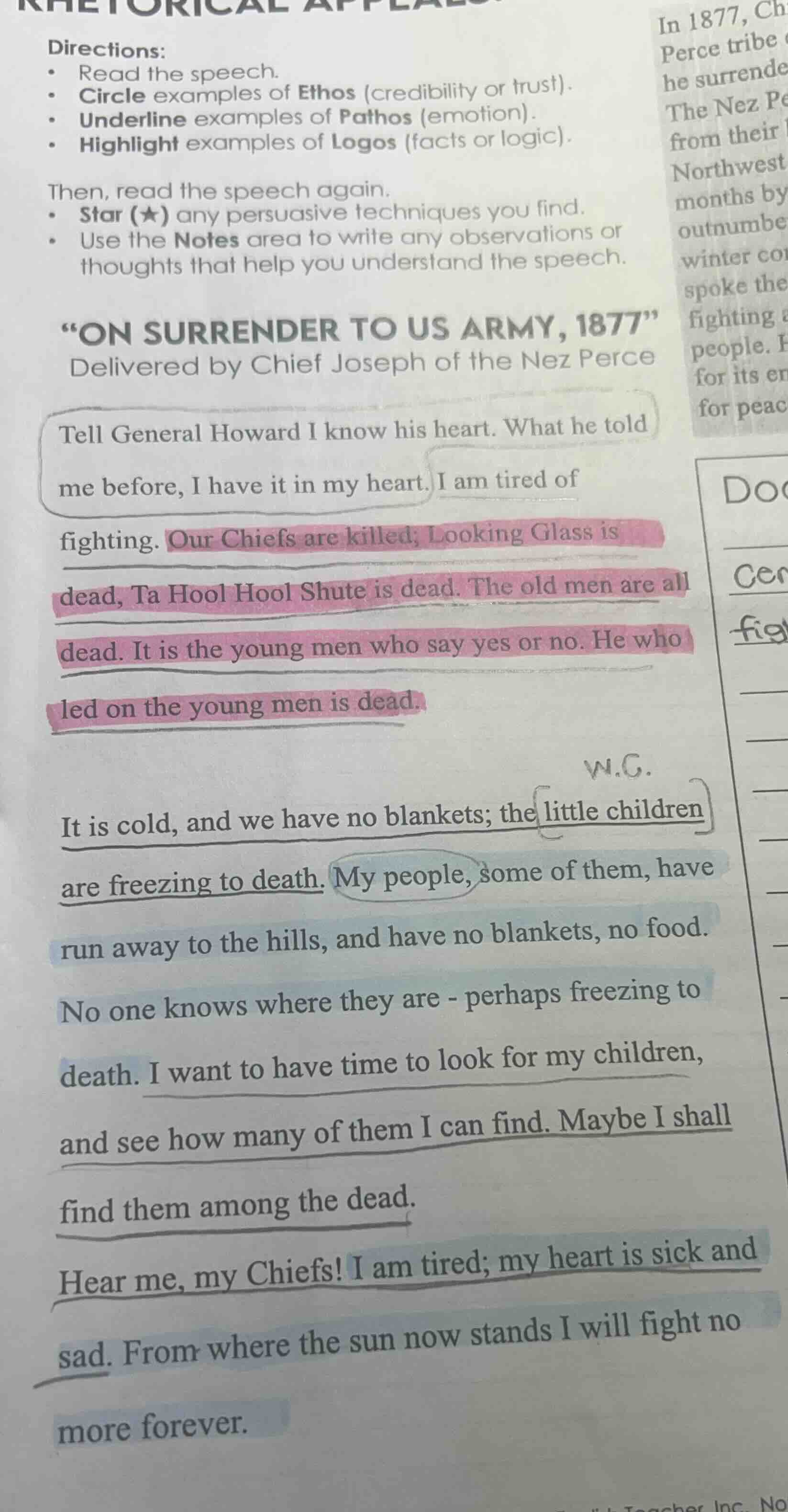
tell general howard i know his heart. what he told me before, i have it in my heart. i am tired of fighting. our chiefs are killed; looking glass is dead, ta hool hool shute is dead. the old men are all dead. it is the young men who say yes or no. he who led on the young men is dead.
it is cold, and we have no blankets; the little children are freezing to death. my people, some of them, have run away to the hills, and have no blankets, no food. no one knows where they are - perhaps freezing to death. i want to have time to look for my children, and see how many of them i can find. maybe i shall find them among the dead.
hear me, my chiefs! i am tired; my heart is sick and sad. from where the sun now stands i will fight no more forever.
To analyze the rhetorical appeals (Ethos, Pathos, Logos) and persuasive techniques in Chief Joseph’s speech:
Ethos (Credibility/Trust)
- Phrases like “Tell General Howard I know his heart. What he told me before, I have it in my heart” and “My people, some of them…” build trust by showing personal knowledge, honesty, and a connection to his community. The use of “my Chiefs” and “my people” also establishes his role as a leader, adding credibility.
Pathos (Emotion)
- Descriptions of suffering: “the little children are freezing to death”, “my heart is sick and sad”, and “Maybe I shall find them among the dead” evoke empathy. The repetition of loss (dead Chiefs, old men, children) and hardship (cold, no blankets/food) stirs sadness, compassion, and pity.
Logos (Facts/Logic)
- Statements like “Our Chiefs are killed; Looking Glass is dead, Ta Hool Hool Shute is dead. The old men are all dead… He who led on the young men is dead” use logical enumeration of losses to explain why fighting is futile. The cause-effect reasoning (no leaders → young men decide, but their leader is dead) supports his argument to surrender.
Persuasive Techniques
- Repetition: Phrases like “dead” (repeated to emphasize loss) and “I am tired” (to stress weariness) reinforce key emotions/ideas.
- Imagery: Vivid descriptions (e.g., “freezing to death,” “no blankets, no food”) create mental pictures of suffering, urging empathy.
- Appeal to Authority/Leadership: Addressing “my Chiefs” and referencing General Howard shows respect for hierarchy while making his plea.
To mark them:
- Circle (Ethos): “Tell General Howard I know his heart…”, “My people, some of them…”, “Hear me, my Chiefs!”
- Underline (Pathos): “the little children are freezing to death”, “my heart is sick and sad”, “Maybe I shall find them among the dead”, “Our Chiefs are killed… He who led on the young men is dead” (also evokes emotion through loss)
- Highlight (Logos): “Our Chiefs are killed; Looking Glass is dead… He who led on the young men is dead” (logical list of losses), “It is cold, and we have no blankets; the little children are freezing to death” (cause-effect: cold + no blankets → children suffer)
- Star (Persuasive Techniques): Repetition of “dead,” emotional imagery (“freezing to death”), and appeals to shared leadership (“my Chiefs”) can be starred.

Snap & solve any problem in the app
Get step-by-step solutions on Sovi AI
Photo-based solutions with guided steps
Explore more problems and detailed explanations
To analyze the rhetorical appeals (Ethos, Pathos, Logos) and persuasive techniques in Chief Joseph’s speech:
Ethos (Credibility/Trust)
- Phrases like “Tell General Howard I know his heart. What he told me before, I have it in my heart” and “My people, some of them…” build trust by showing personal knowledge, honesty, and a connection to his community. The use of “my Chiefs” and “my people” also establishes his role as a leader, adding credibility.
Pathos (Emotion)
- Descriptions of suffering: “the little children are freezing to death”, “my heart is sick and sad”, and “Maybe I shall find them among the dead” evoke empathy. The repetition of loss (dead Chiefs, old men, children) and hardship (cold, no blankets/food) stirs sadness, compassion, and pity.
Logos (Facts/Logic)
- Statements like “Our Chiefs are killed; Looking Glass is dead, Ta Hool Hool Shute is dead. The old men are all dead… He who led on the young men is dead” use logical enumeration of losses to explain why fighting is futile. The cause-effect reasoning (no leaders → young men decide, but their leader is dead) supports his argument to surrender.
Persuasive Techniques
- Repetition: Phrases like “dead” (repeated to emphasize loss) and “I am tired” (to stress weariness) reinforce key emotions/ideas.
- Imagery: Vivid descriptions (e.g., “freezing to death,” “no blankets, no food”) create mental pictures of suffering, urging empathy.
- Appeal to Authority/Leadership: Addressing “my Chiefs” and referencing General Howard shows respect for hierarchy while making his plea.
To mark them:
- Circle (Ethos): “Tell General Howard I know his heart…”, “My people, some of them…”, “Hear me, my Chiefs!”
- Underline (Pathos): “the little children are freezing to death”, “my heart is sick and sad”, “Maybe I shall find them among the dead”, “Our Chiefs are killed… He who led on the young men is dead” (also evokes emotion through loss)
- Highlight (Logos): “Our Chiefs are killed; Looking Glass is dead… He who led on the young men is dead” (logical list of losses), “It is cold, and we have no blankets; the little children are freezing to death” (cause-effect: cold + no blankets → children suffer)
- Star (Persuasive Techniques): Repetition of “dead,” emotional imagery (“freezing to death”), and appeals to shared leadership (“my Chiefs”) can be starred.