QUESTION IMAGE
Question
directions: solve the problems shown below. any data, calculations, or models you use to support your thinking should be explained.
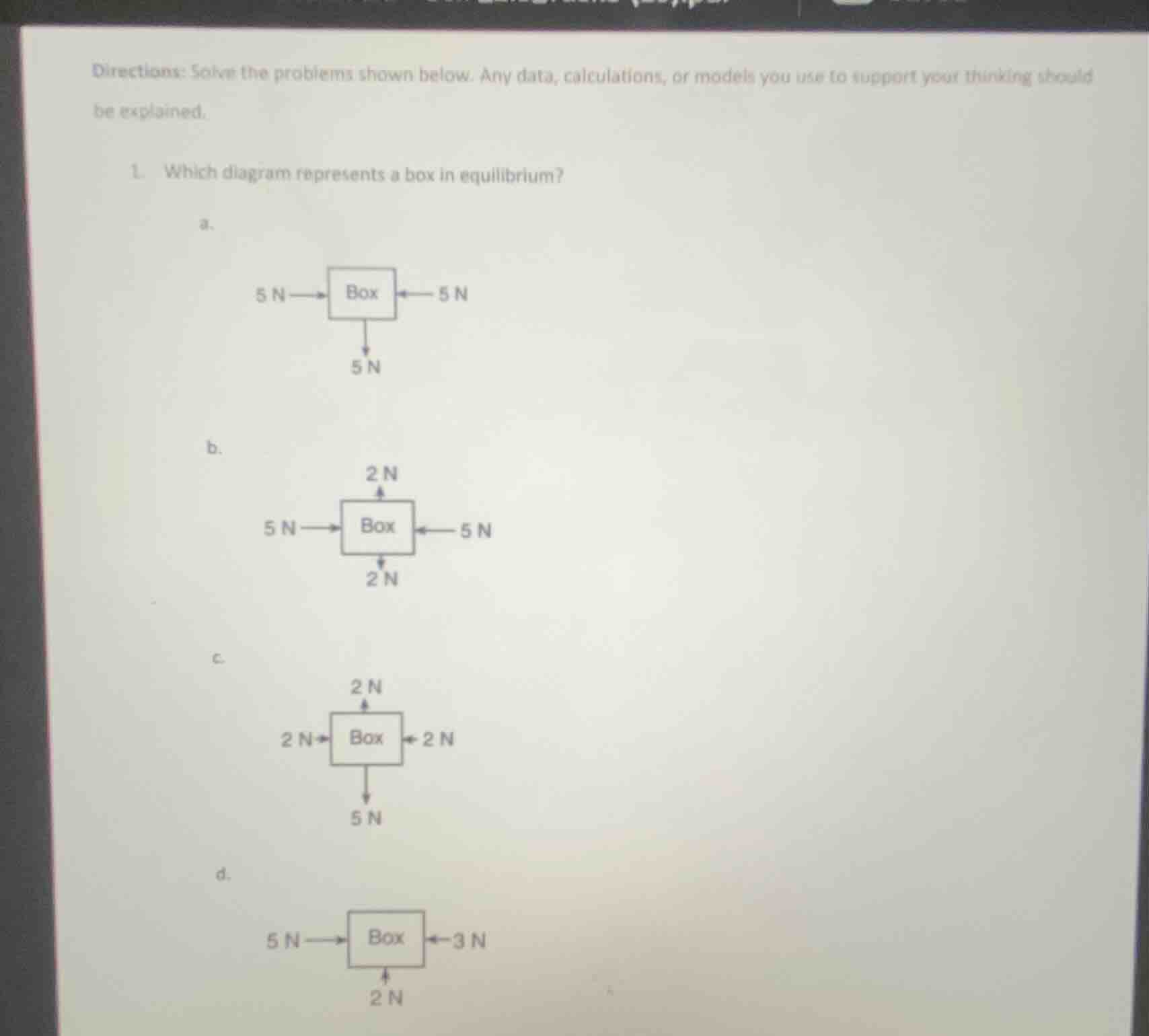
- which diagram represents a box in equilibrium?
a.
5 n → box ← 5 n
↓
5 n
b.
2 n
5 n → box ← 5 n
↓
2 n
c.
2 n
2 n ← box ← 2 n
↓
5 n
d.
5 n → box ← 3 n
↑
2 n
To determine which diagram represents a box in equilibrium, we need to check if the net force in both the horizontal (x - axis) and vertical (y - axis) directions is zero. For an object to be in equilibrium, the sum of forces in the x - direction ($\sum F_x$) and the sum of forces in the y - direction ($\sum F_y$) must both be equal to zero.
Step 1: Analyze Option a
- Horizontal Forces: There is a 5 N force to the right and a 5 N force to the left. So, $\sum F_x=5\ N - 5\ N = 0$.
- Vertical Forces: There is a 5 N force downward and no upward force. So, $\sum F_y=- 5\ N$ (taking upward as positive) $
eq0$. So, the box is not in equilibrium.
Step 2: Analyze Option b
- Horizontal Forces: A 5 N force to the right and a 5 N force to the left. $\sum F_x = 5\ N-5\ N=0$.
- Vertical Forces: A 2 N force upward and a 2 N force downward. $\sum F_y=2\ N - 2\ N = 0$. Since both $\sum F_x = 0$ and $\sum F_y=0$, the box is in equilibrium. But we will still check the other options for completeness.
Step 3: Analyze Option c
- Horizontal Forces: A 2 N force to the left and a 2 N force to the left (wait, no, looking at the diagram: 2 N to the left (from the right - hand side) and 2 N to the left (from the left - hand side)? Wait, no, the diagram for c: left force is 2 N (direction: towards the box from the left, so to the right? Wait, no, the arrows: in option c, the left arrow is 2 N (pointing to the box, so direction is right) and the right arrow is 2 N (pointing to the box, direction is left). Wait, no, let's re - examine:
Horizontal forces: 2 N to the right (from the left - hand arrow) and 2 N to the left (from the right - hand arrow). So, $\sum F_x=2\ N - 2\ N = 0$.
Vertical forces: 2 N upward and 5 N downward. $\sum F_y=2\ N-5\ N=- 3\ N
eq0$. So, the box is not in equilibrium.
Step 4: Analyze Option d
- Horizontal Forces: 5 N to the right and 3 N to the left. $\sum F_x=5\ N - 3\ N = 2\ N
eq0$.
- Vertical Forces: 2 N upward and no downward force (other than what? Wait, the diagram has a 2 N upward force and no other vertical forces? Wait, no, the diagram for d: vertical force is 2 N upward, horizontal forces: 5 N right and 3 N left. Since $\sum F_x
eq0$, the box is not in equilibrium.

Snap & solve any problem in the app
Get step-by-step solutions on Sovi AI
Photo-based solutions with guided steps
Explore more problems and detailed explanations
b. The diagram with 5 N right, 5 N left, 2 N up, and 2 N down (the diagram labeled b) represents a box in equilibrium.