QUESTION IMAGE
Question
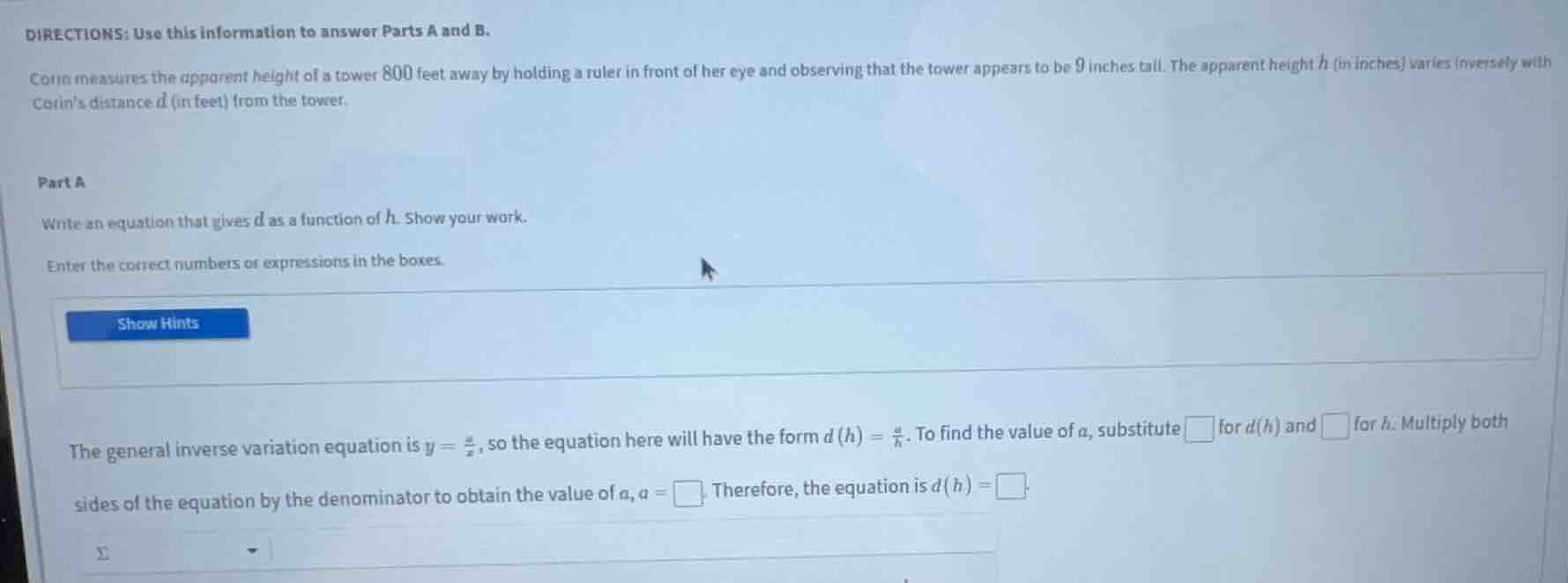
directions: use this information to answer parts a and b. corin measures the apparent height of a tower 800 feet away by holding a ruler in front of her eye and observing that the tower appears to be 9 inches tall. the apparent height ( h ) (in inches) varies inversely with corin’s distance ( d ) (in feet) from the tower. part a write an equation that gives ( d ) as a function of ( h ). show your work. enter the correct numbers or expressions in the boxes. the general inverse variation equation is ( y = \frac{a}{x} ), so the equation here will have the form ( d(h) = \frac{a}{h} ). to find the value of ( a ), substitute ( square ) for ( d(h) ) and ( square ) for ( h ). multiply both sides of the equation by the denominator to obtain the value of ( a ), ( a = square ). therefore, the equation is ( d(h) = square ).
Step1: Recall inverse variation form
Inverse variation follows $d(h) = \frac{a}{h}$, where $a$ is the constant of variation.
Step2: Substitute known values
We know when $d=800$, $h=9$. Substitute these into the equation:
$800 = \frac{a}{9}$
Step3: Solve for constant $a$
Multiply both sides by 9 to isolate $a$:
$a = 800 \times 9 = 7200$
Step4: Write final function
Substitute $a=7200$ back into the inverse variation form.

Snap & solve any problem in the app
Get step-by-step solutions on Sovi AI
Photo-based solutions with guided steps
Explore more problems and detailed explanations
Fill the boxes as follows:
- Substitute $\boldsymbol{800}$ for $d(h)$ and $\boldsymbol{9}$ for $h$.
- $a = \boldsymbol{7200}$
- The equation is $d(h) = \boldsymbol{\frac{7200}{h}}$