QUESTION IMAGE
Question
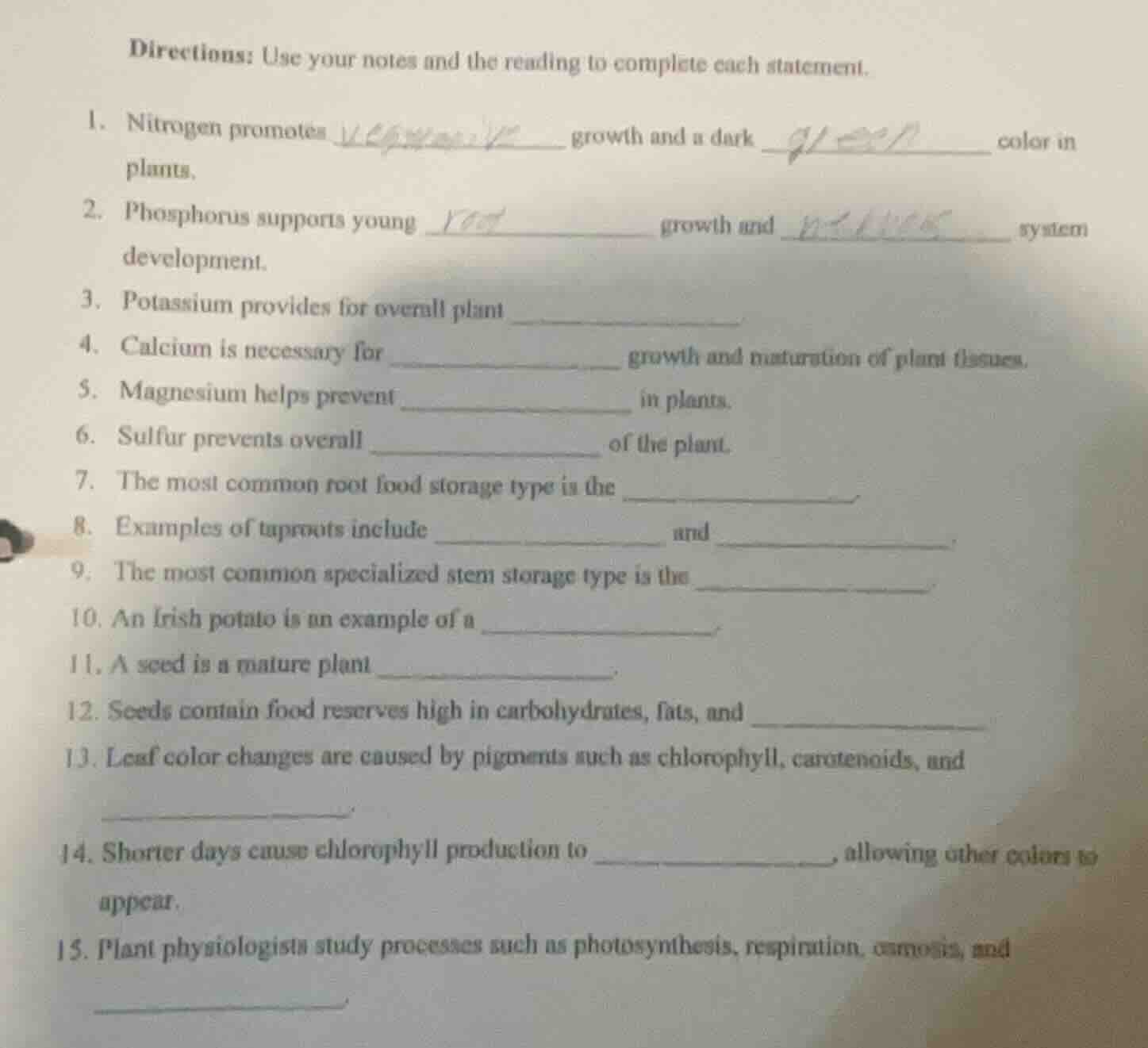
directions: use your notes and the reading to complete each statement. 1. nitrogen promotes ____ growth and a dark __ color in plants. 2. phosphorus supports young __ growth and __ system development. 3. potassium provides for overall plant __. 4. calcium is necessary for __ growth and maturation of plant tissues. 5. magnesium helps prevent __ in plants. 6. sulfur prevents overall __ of the plant. 7. the most common root food storage type is the __. 8. examples of taproots include __ and __. 9. the most common specialized stem storage type is the __. 10. an irish potato is an example of a __. 11. a seed is a mature plant __. 12. seeds contain food reserves high in carbohydrates, fats, and __. 13. leaf color changes are caused by pigments such as chlorophyll, carotenoids, and __. 14. shorter days cause chlorophyll production to __, allowing other colors to appear. 15. plant physiologists study processes such as photosynthesis, respiration, osmosis, and ____.
These questions are about plant physiology and nutrient functions, which fall under Biology (a subfield of Natural Science). The answers are based on standard knowledge in plant science:
- Nitrogen promotes vegetative growth and a dark green color in plants (nitrogen is key for leafy growth and chlorophyll production).
- Phosphorus supports young root growth and reproductive system development (phosphorus aids root establishment and flowering/fruiting).
- Potassium provides for overall plant health/strength (potassium boosts disease resistance and stress tolerance).
- Calcium is necessary for cell wall growth and maturation of plant tissues (calcium strengthens cell walls).
- Magnesium helps prevent chlorosis in plants (magnesium is central to chlorophyll, so deficiency causes yellowing).
- Sulfur prevents overall stunting of the plant (sulfur is vital for protein synthesis, deficiency stunts growth).
- The most common root food storage type is the taproot (e.g., carrots store food in taproots).
- Examples of taproots include carrots and radishes (these are classic taproot examples).
- The most common specialized stem storage type is the tuber (stems modified to store food, like potatoes).
- An Irish potato is an example of a tuber (it’s a stem tuber, not a root).
- A seed is a mature plant embryo (seeds contain the embryo plus food reserves).
- Seeds contain food reserves high in carbohydrates, fats, and proteins (seeds store proteins for embryo growth).
- Leaf color changes are caused by pigments such as chlorophyll, carotenoids, and anthocyanins (anthocyanins produce red/purple hues in fall).
- Shorter days cause chlorophyll production to decrease/stop, allowing other colors to appear (less light reduces chlorophyll, revealing carotenoids/anthocyanins).
- Plant physiologists study processes such as photosynthesis, respiration, osmosis, and transpiration (transpiration is water movement in plants, a key physiological process).

Snap & solve any problem in the app
Get step-by-step solutions on Sovi AI
Photo-based solutions with guided steps
Explore more problems and detailed explanations
- vegetative; green
- root; reproductive
- health (or strength)
- cell wall
- chlorosis
- stunting
- taproot
- carrots; radishes (other examples: turnips, beets)
- tuber
- tuber
- embryo
- proteins
- anthocyanins
- decrease (or stop)
- transpiration (other examples: germination, nutrient uptake)