QUESTION IMAGE
Question
directions:
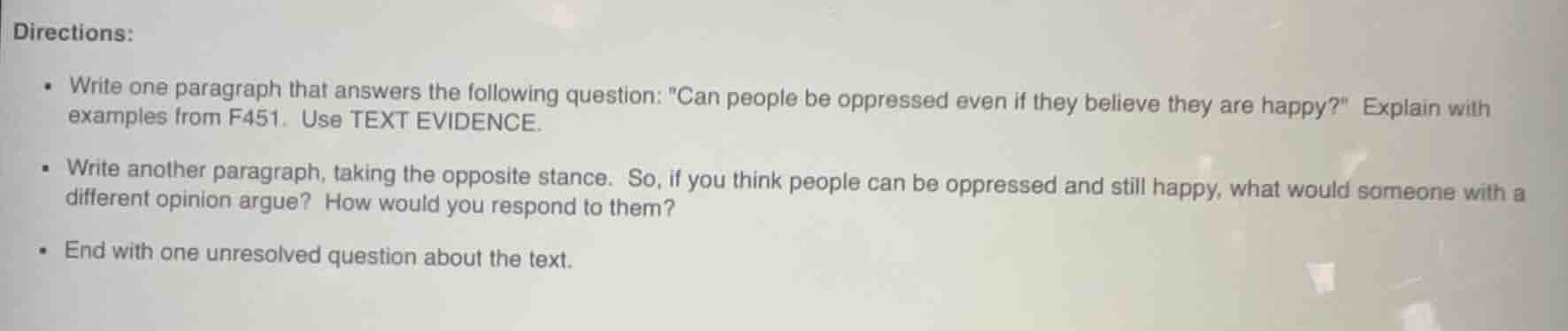
- write one paragraph that answers the following question: \can people be oppressed even if they believe they are happy?\ explain with examples from f451. use text evidence.
- write another paragraph, taking the opposite stance. so, if you think people can be oppressed and still happy, what would someone with a different opinion argue? how would you respond to them?
- end with one unresolved question about the text.
Brief Explanations
- First paragraph: Argue that people can be oppressed while believing they are happy, using Fahrenheit 451 text evidence. The citizens of the novel's society are conditioned to avoid critical thought through constant mindless entertainment (like the wall-sized televisions and seashell radios) and are forbidden from reading books, which is a form of intellectual oppression. Even though they claim to be happy—Montag's wife Mildred repeatedly says she is content with her parlor "family" and her drug-induced calm—they lack autonomy, emotional depth, and the ability to question their circumstances. Beatty's explanation that the state eliminated books to prevent unhappiness from conflicting ideas reveals that the "happiness" is a manufactured, oppressive construct; people are oppressed by the erasure of their right to knowledge and critical thinking, even as they feel superficially happy.
- Second paragraph: Present the opposing stance and a response. Someone arguing against this might say that if people genuinely feel happy, they cannot be oppressed—they would recognize and resist oppression if it were present. They could point to Mildred's voluntary engagement with her parlor walls and her rejection of books as proof that she is making free, happy choices, not being oppressed. A response would note that the society's systemic conditioning (from childhood, through censorship, and chemical manipulation) has stripped people of the ability to recognize oppression as oppression. Their "choice" to embrace the status quo is not a free one, as they have never been exposed to the alternative of a life with intellectual freedom and genuine self-determination.
- Unresolved question: How might the citizens of Fahrenheit 451's society react if they were suddenly given unfiltered access to books, and would their perception of their "happiness" shift permanently, or would they revert to their conditioned state?

Snap & solve any problem in the app
Get step-by-step solutions on Sovi AI
Photo-based solutions with guided steps
Explore more problems and detailed explanations
- People can absolutely be oppressed while believing they are happy, as demonstrated in Fahrenheit 451. The novel’s society enforces brutal intellectual oppression by banning books and flooding citizens’ lives with mindless, addictive entertainment like parlor wall "families" and seashell radios. Mildred, Montag’s wife, embodies this dynamic: she insists she is "happy" with her shallow, media-saturated existence, yet she is trapped in a cycle of emotional emptiness, relying on sleeping pills to cope and rejecting any meaningful conversation or critical thought. Captain Beatty explicitly confirms this manufactured happiness is a tool of oppression, explaining that books were banned because they "make people unhappy" by introducing conflicting ideas, nuance, and the ability to question authority. The citizens are oppressed by the erasure of their right to knowledge and self-determination, but their conditioning is so complete that they mistake their superficial, controlled contentment for genuine happiness.
- Critics might argue that true oppression cannot coexist with perceived happiness, claiming that if people felt they were being oppressed, they would resist, and Mildred’s embrace of her parlor walls and rejection of books is a free choice that proves she is not oppressed. This view fails to account for the systemic, lifelong conditioning that defines Fahrenheit 451’s society: citizens are raised to fear books, taught that critical thinking is dangerous, and given constant distractions to prevent them from ever questioning their circumstances. Mildred’s "choice" is not a free one—she has never been allowed to experience the intellectual freedom or emotional depth that would let her recognize her oppression. Her happiness is a cage she cannot see, built by a state that has stripped her of the tools to break it.
- If the surviving intellectuals outside the city’s limits were to return and attempt to rebuild a society with books, would the remaining conditioned citizens be able to unlearn their fear of critical thought, or would the allure of the state’s manufactured happiness pull them back into oppression?