QUESTION IMAGE
Question
directions: as you read the text, highlight the problem faced by the united states. then answer the following questions.
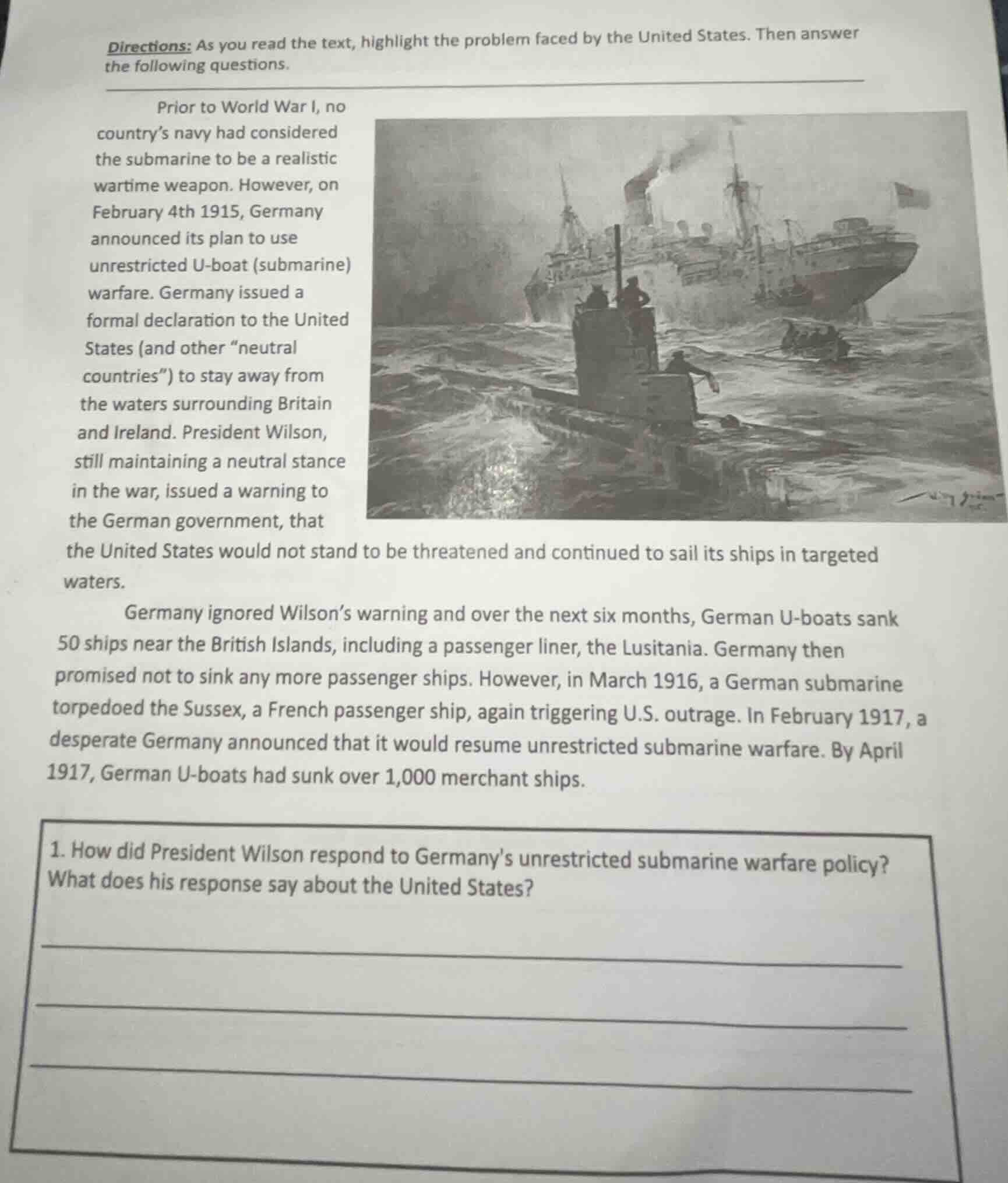
prior to world war i, no country’s navy had considered the submarine to be a realistic wartime weapon. however, on february 4th 1915, germany announced its plan to use unrestricted u - boat (submarine) warfare. germany issued a formal declaration to the united states (and other “neutral countries”) to stay away from the waters surrounding britain and ireland. president wilson, still maintaining a neutral stance in the war, issued a warning to the german government, that the united states would not stand to be threatened and continued to sail its ships in targeted waters.
germany ignored wilson’s warning and over the next six months, german u - boats sank 50 ships near the british islands, including a passenger liner, the lusitania. germany then promised not to sink any more passenger ships. however, in march 1916, a german submarine torpedoed the sussex, a french passenger ship, again triggering u.s. outrage. in february 1917, a desperate germany announced that it would resume unrestricted submarine warfare. by april 1917, german u - boats had sunk over 1,000 merchant ships.
- how did president wilson respond to germanys unrestricted submarine warfare policy? what does his response say about the united states?
First, President Wilson, while keeping the U.S. neutral, issued a warning to Germany that the U.S. would not accept threats from its unrestricted submarine warfare policy, and continued sailing U.S. ships in the restricted waters around Britain and Ireland. This response shows that the U.S. was committed to protecting its maritime interests and maintaining its stance of neutrality while refusing to be intimidated by Germany's aggressive naval actions.

Snap & solve any problem in the app
Get step-by-step solutions on Sovi AI
Photo-based solutions with guided steps
Explore more problems and detailed explanations
- President Wilson responded by issuing a warning to Germany that the U.S. would not tolerate the threat of its unrestricted submarine warfare, and he continued to send U.S. ships into the waters Germany had restricted, all while keeping the U.S. neutral in the war.
- His response shows that the United States was determined to protect its maritime rights and interests, and was unwilling to be coerced by foreign powers, even as it tried to avoid entering World War I at that time.