QUESTION IMAGE
Question
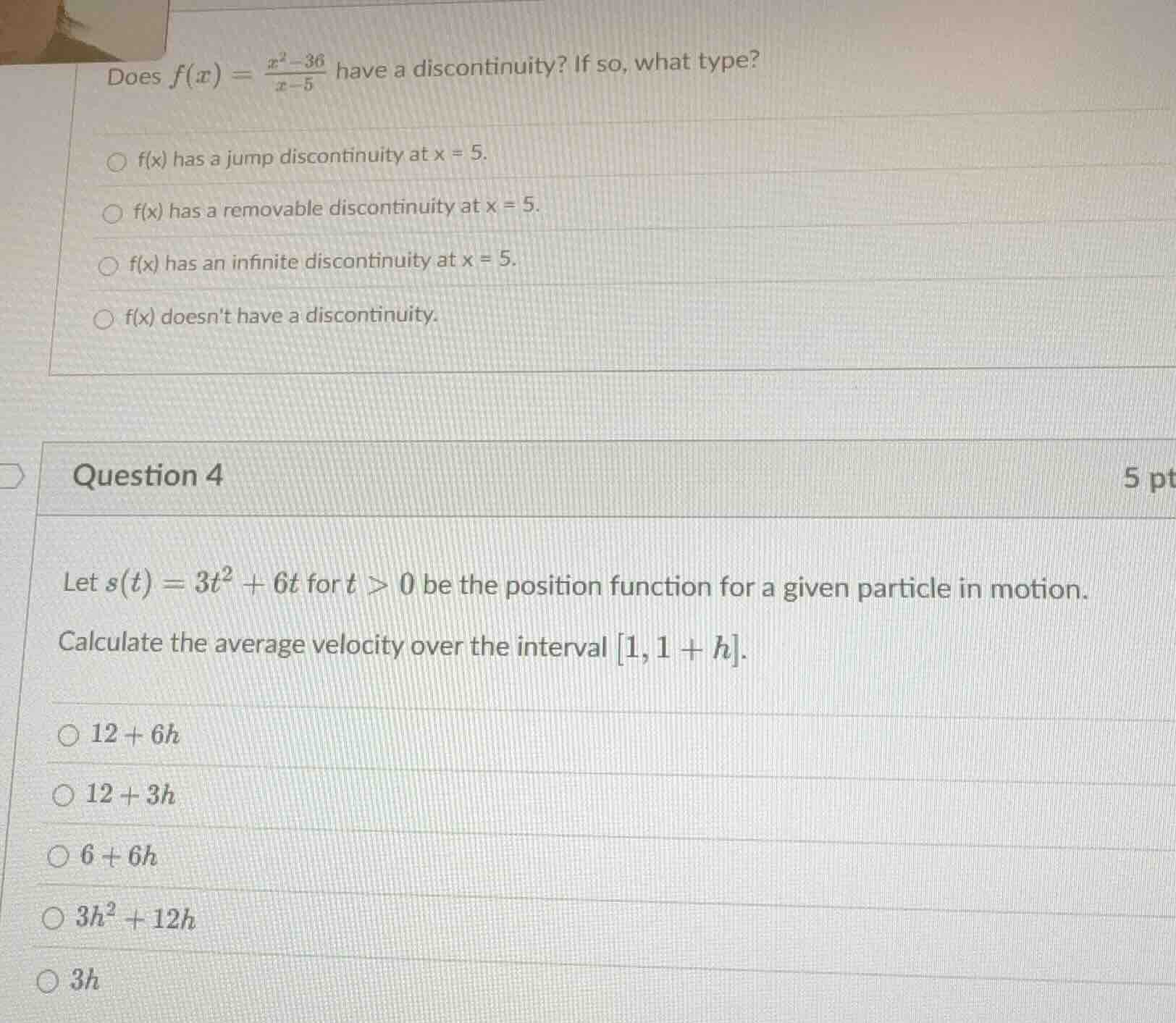
does $f(x) = \frac{x^2 - 36}{x - 5}$ have a discontinuity? if so, what type?
\bigcirc f(x) has a jump discontinuity at $x = 5$.
\bigcirc f(x) has a removable discontinuity at $x = 5$.
\bigcirc f(x) has an infinite discontinuity at $x = 5$.
\bigcirc f(x) doesnt have a discontinuity.
question 4 5 pt
let $s(t) = 3t^2 + 6t$ for $t > 0$ be the position function for a given particle in motion.
calculate the average velocity over the interval $1, 1 + h$.
\bigcirc $12 + 6h$
\bigcirc $12 + 3h$
\bigcirc $6 + 6h$
\bigcirc $3h^2 + 12h$
\bigcirc $3h$
First Question (Discontinuity of \( f(x) = \frac{x^2 - 36}{x - 5} \))
To determine the discontinuity of \( f(x)=\frac{x^{2}-36}{x - 5} \), we first check the domain. The function is undefined when the denominator \( x - 5=0 \), i.e., \( x = 5 \). Now, we analyze the limit as \( x \) approaches 5. The numerator \( x^{2}-36=(x - 6)(x + 6) \), and the denominator is \( x - 5 \). There is no common factor between the numerator and the denominator that can cancel out the \( x - 5 \) term. So, we check the limit as \( x
ightarrow5 \). As \( x \) approaches 5, the denominator approaches 0, and the numerator approaches \( 5^{2}-36=25 - 36=- 11
eq0 \). So, \( \lim_{x
ightarrow5}\frac{x^{2}-36}{x - 5} \) will be either \(+\infty\) or \( -\infty \), which means the function has an infinite discontinuity at \( x = 5 \).
Step 1: Recall the formula for average velocity
The formula for average velocity \( v_{avg} \) over the interval \([a,b]\) for a position function \( s(t) \) is \( v_{avg}=\frac{s(b)-s(a)}{b - a} \). Here, \( a = 1 \) and \( b=1 + h \).
Step 2: Calculate \( s(1+h) \) and \( s(1) \)
First, find \( s(1+h) \):
\( s(1 + h)=3(1 + h)^{2}+6(1 + h) \)
Expand \( (1 + h)^{2}=1 + 2h+h^{2} \), so \( s(1 + h)=3(1 + 2h+h^{2})+6 + 6h=3 + 6h+3h^{2}+6 + 6h=3h^{2}+12h + 9 \)
Then, find \( s(1) \):
\( s(1)=3(1)^{2}+6(1)=3 + 6 = 9 \)
Step 3: Substitute into the average velocity formula
\( v_{avg}=\frac{s(1 + h)-s(1)}{(1 + h)-1}=\frac{(3h^{2}+12h + 9)-9}{h}=\frac{3h^{2}+12h}{h} \)
Factor out \( h \) from the numerator: \( \frac{h(3h + 12)}{h} \) (since \( h
eq0 \) as \( h \) is a small interval change, we can cancel \( h \))
So, \( v_{avg}=3h + 12=12 + 3h \)

Snap & solve any problem in the app
Get step-by-step solutions on Sovi AI
Photo-based solutions with guided steps
Explore more problems and detailed explanations
C. \( f(x) \) has an infinite discontinuity at \( x = 5 \).