QUESTION IMAGE
Question
- discuss with a small group, discuss the following scenario: two birds are flying away from the same tree at the same time. they both fly at 10 km/h for 15 minutes. why do the birds end up in different places? summarize your conclusions here.
velocity and acceleration
the speeds of the birds in the example were the same, but their velocities were different.
speed is the rate at which a distance is traveled. velocity is the speed of an object in a particular direction. the sign of a velocity indicates its direction. for a given situation, a velocity in a certain direction is positive, and a velocity in the opposite direction is negative. an object’s velocity changes if either its speed or its direction changes. for instance, if a bus speeds up, slows down, or makes a turn, then its velocity has changed. the bus accelerated. acceleration is the rate at which velocity changes over time.
forces can change the motion of objects, so both velocity and acceleration are important quantities in describing forces.
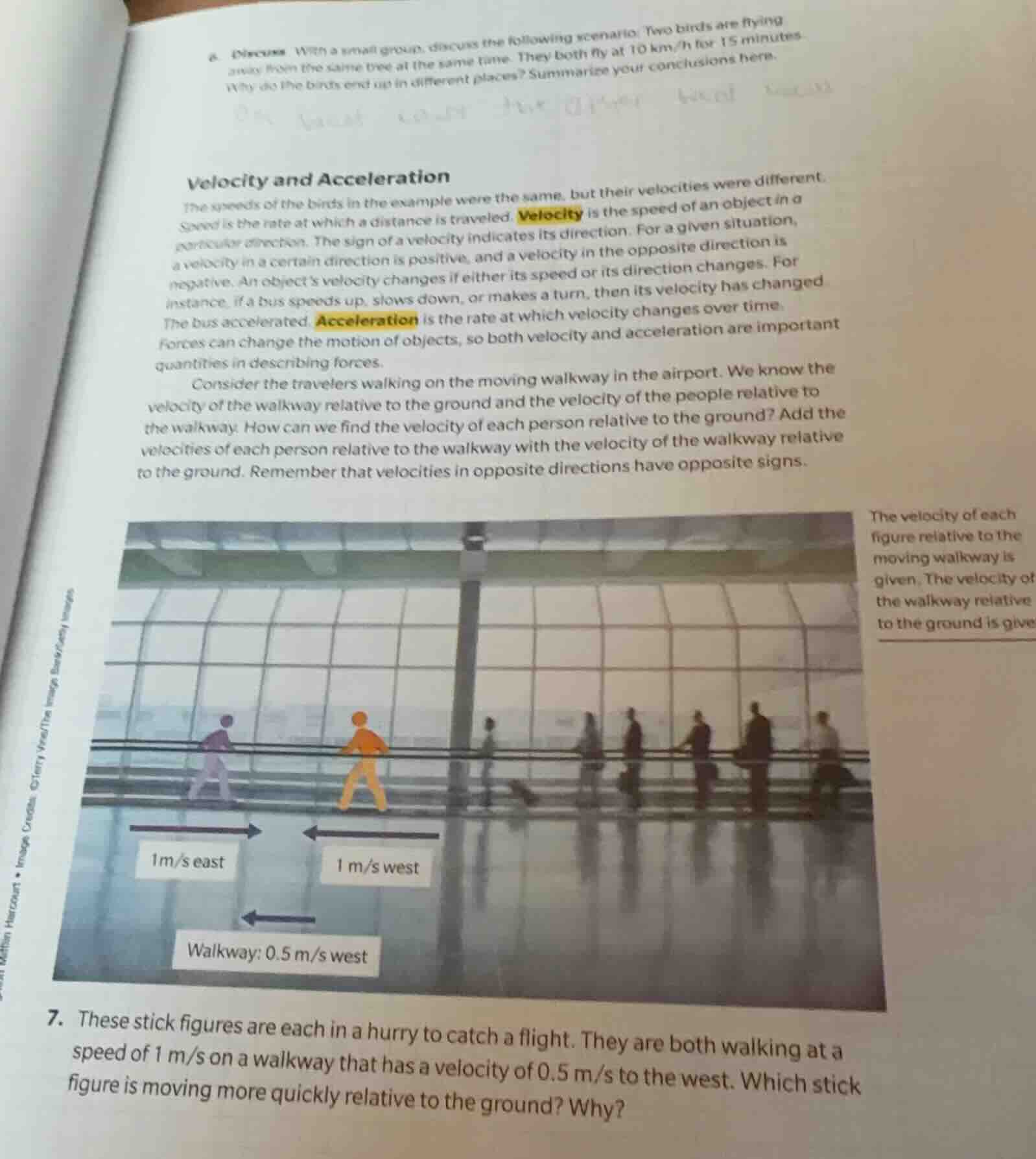
consider the travelers walking on the moving walkway in the airport. we know the velocity of the walkway relative to the ground and the velocity of the people relative to the walkway. how can we find the velocity of each person relative to the ground? add the velocities of each person relative to the walkway with the velocity of the walkway relative to the ground. remember that velocities in opposite directions have opposite signs.
the velocity of each figure relative to the moving walkway is given. the velocity of the walkway relative to the ground is give
- these stick figures are each in a hurry to catch a flight. they are both walking at a speed of 1 m/s on a walkway that has a velocity of 0.5 m/s to the west. which stick figure is moving more quickly relative to the ground? why?
Step1: Define direction sign convention
Let west = positive, east = negative.
Step2: Calculate velocity of east-walking figure
Velocity relative to ground: $v_1 = (-1\ \text{m/s}) + 0.5\ \text{m/s} = -0.5\ \text{m/s}$
Magnitude: $|v_1| = 0.5\ \text{m/s}$
Step3: Calculate velocity of west-walking figure
Velocity relative to ground: $v_2 = 1\ \text{m/s} + 0.5\ \text{m/s} = 1.5\ \text{m/s}$
Magnitude: $|v_2| = 1.5\ \text{m/s}$
Step4: Compare speeds
$1.5\ \text{m/s} > 0.5\ \text{m/s}$, so the west-walking figure is faster.

Snap & solve any problem in the app
Get step-by-step solutions on Sovi AI
Photo-based solutions with guided steps
Explore more problems and detailed explanations
The stick figure walking west at 1 m/s relative to the walkway is moving more quickly relative to the ground.