QUESTION IMAGE
Question
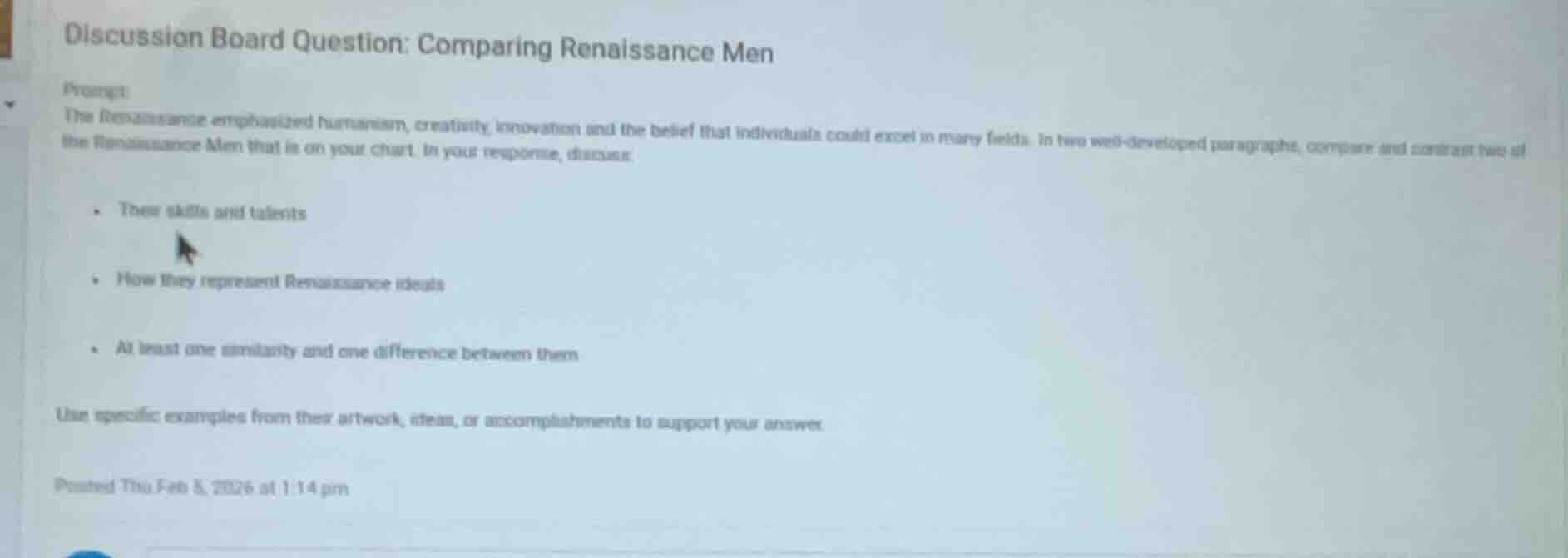
discussion board question: comparing renaissance men
prompt:
the renaissance emphasized humanism, creativity, innovation and the belief that individuals could excel in many fields. in two well - developed paragraphs, compare and contrast two of the renaissance men that is on your chart. in your response, discuss:
- their skills and talents
- how they represent renaissance ideals
- at least one similarity and one difference between them
use specific examples from their artwork, ideas, or accomplishments to support your answer.
posted thu feb 6, 2026 at 1:14 pm
To answer this, we can choose Leonardo da Vinci and Michelangelo as the two Renaissance Men.
For skills and talents: Leonardo was a polymath with skills in painting (e.g., Mona Lisa), engineering, anatomy. Michelangelo excelled in sculpture (e.g., David), painting (Sistine Chapel ceiling), and architecture.
For representing Renaissance ideals: Both embodied humanism through their focus on human form (Leonardo’s anatomical studies, Michelangelo’s lifelike sculptures). They showed creativity and innovation in their works.
Similarity: Both were masters of multiple art forms and advanced artistic techniques, contributing to the Renaissance’s artistic revolution. Difference: Leonardo’s work often integrated science (e.g., his flying machine designs), while Michelangelo’s work was more centered on monumental art for religious and civic spaces.

Snap & solve any problem in the app
Get step-by-step solutions on Sovi AI
Photo-based solutions with guided steps
Explore more problems and detailed explanations
To compare and contrast Leonardo da Vinci and Michelangelo (two Renaissance Men):
Paragraph 1: Skills, Talents, and Renaissance Ideals
Leonardo da Vinci was a quintessential Renaissance Man, excelling in painting (e.g., Mona Lisa, The Last Supper), engineering (designs for flying machines, bridges), and anatomy (detailed studies of human musculature). His work reflected Renaissance humanism through a fascination with the human form and a drive to understand the natural world, blending art and science. Michelangelo, meanwhile, dominated sculpture (David, Pietà), painting (the Sistine Chapel ceiling, with its dynamic depictions of biblical figures), and architecture (designs for St. Peter’s Basilica). His art emphasized human grandeur and emotion, embodying humanism’s celebration of human potential. Both men represented Renaissance ideals of creativity, innovation, and multi-disciplinary excellence: Leonardo’s scientific inquiries and Michelangelo’s artistic mastery demonstrated the era’s belief in human achievement across fields.
Paragraph 2: Similarities and Differences
A key similarity is their dedication to pushing artistic boundaries. Leonardo pioneered techniques like sfumato (softening edges for realism), while Michelangelo revolutionized sculpture with lifelike, emotionally charged figures. However, a notable difference lies in their focus: Leonardo integrated science into his art (e.g., using optics to enhance perspective in paintings) and explored practical inventions, whereas Michelangelo’s work centered on monumental, often religiously themed art for public spaces (e.g., the Sistine Chapel) and civic commissions. Leonardo’s curiosity spanned beyond art to engineering and biology, while Michelangelo’s legacy is rooted in transforming how art conveyed spiritual and human drama.
In sum, both Leonardo and Michelangelo exemplified the Renaissance’s emphasis on humanism and multi-faceted genius, yet their unique approaches—scientific exploration vs. monumental artistic expression—highlight the diversity of Renaissance achievement.