QUESTION IMAGE
Question
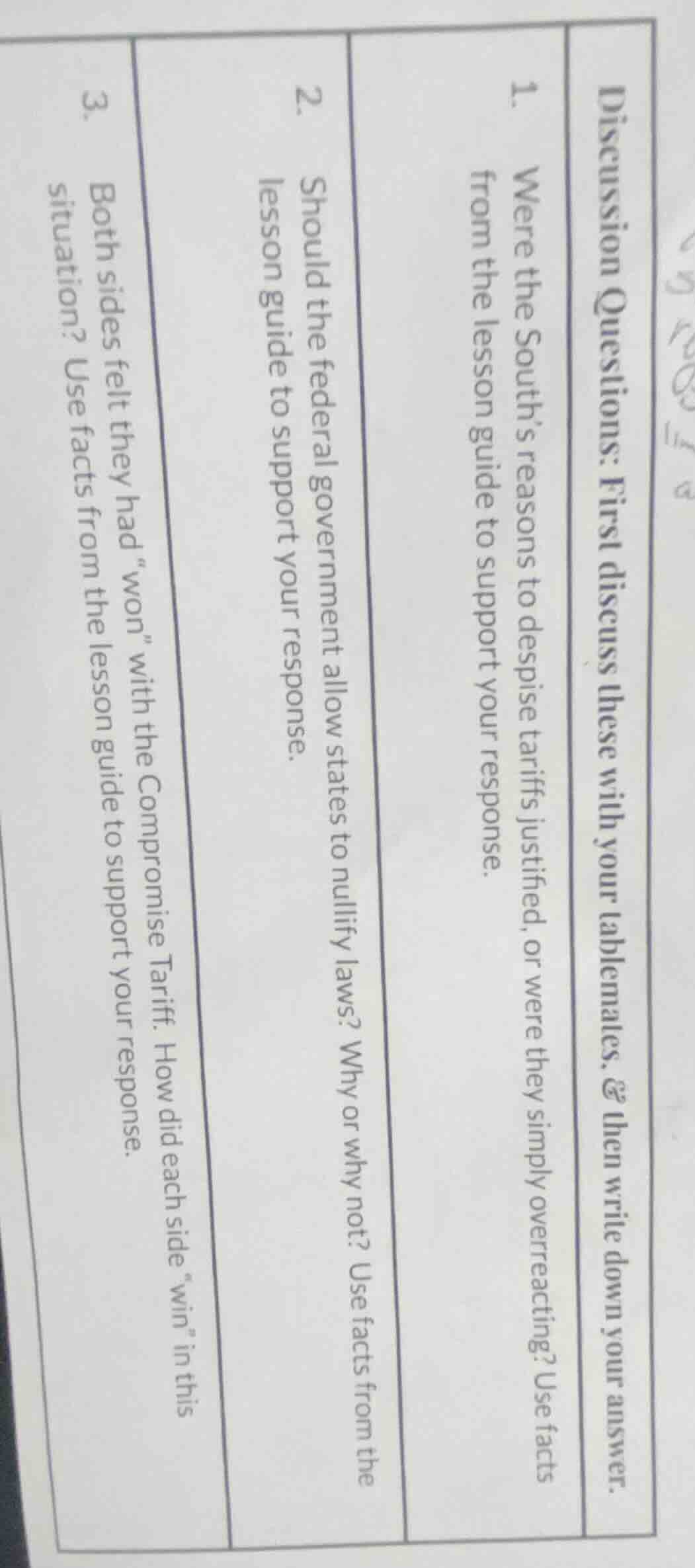
discussion questions: first discuss these with your tablemates, then write down your answer. 1. were the south’s reasons to despise tariffs justified, or were they simply overreacting? use facts from the lesson guide to support your response. 2. should the federal government allow states to nullify laws? why or why not? use facts from the lesson guide to support your response. 3. both sides felt they had “won” with the compromise tariff. how did each side “win” in this situation? use facts from the lesson guide to support your response.
Brief Explanations
- The South's anger over tariffs had some justification: the 1828 "Tariff of Abominations" raised taxes on imported manufactured goods, which the South relied on heavily, while protecting Northern industrial interests. Southern planters also feared foreign nations would retaliate with tariffs on their cash crop exports (like cotton). However, their extreme rhetoric and nullification threats were an overreaction, as the tariff did not threaten their core economic system of slavery directly, and there were political avenues to address the issue.
- No, the federal government should not allow states to nullify laws. Under the U.S. Constitution, the Supremacy Clause (Article VI) establishes federal law as the supreme law of the land, overriding state laws. Allowing nullification would break the foundational principle of a unified federal government, as seen in the Nullification Crisis where South Carolina's attempt to nullify tariffs threatened the country's stability and the rule of law.
- Both sides could claim a win with the Compromise Tariff of 1833:
- For the South (especially South Carolina), the tariff reduced tax rates gradually over 10 years, addressing their economic grievances, and the federal government avoided using military force against the state, which validated their concerns being taken seriously.
- For the federal government, it upheld the principle of federal supremacy: South Carolina backed down from nullification, confirming that states could not unilaterally reject federal laws, preserving the integrity of the union.

Snap & solve any problem in the app
Get step-by-step solutions on Sovi AI
Photo-based solutions with guided steps
Explore more problems and detailed explanations
- The South's concerns had partial justification due to the tariff's disproportionate harm to their agrarian, import-dependent economy, but their nullification threats were an overreaction, as the tariff did not threaten their core system and political remedies existed.
- No. The U.S. Constitution's Supremacy Clause establishes federal law as supreme, so allowing nullification would undermine federal authority and the union's stability, as seen in the risks of the Nullification Crisis.
- Yes, both sides could claim a win:
- South Carolina: Won gradual tariff reductions and avoided federal military intervention.
- Federal government: Upheld federal supremacy as South Carolina abandoned nullification, preserving the union's integrity.