QUESTION IMAGE
Question
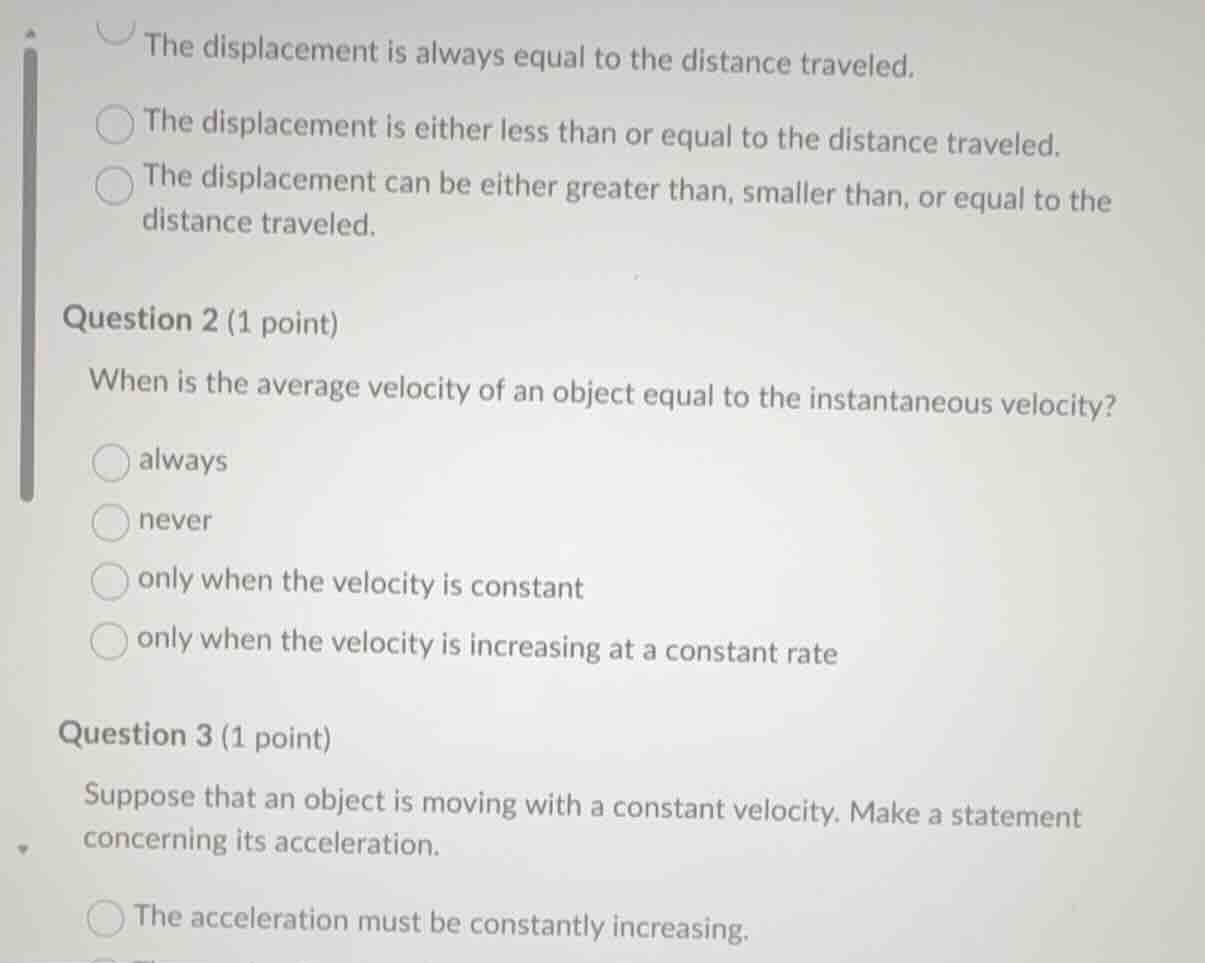
the displacement is always equal to the distance traveled.
the displacement is either less than or equal to the distance traveled.
the displacement can be either greater than, smaller than, or equal to the distance traveled.
question 2 (1 point)
when is the average velocity of an object equal to the instantaneous velocity?
always
never
only when the velocity is constant
only when the velocity is increasing at a constant rate
question 3 (1 point)
suppose that an object is moving with a constant velocity. make a statement concerning its acceleration.
the acceleration must be constantly increasing.
Question 1 (about displacement and distance)
Displacement is the straight - line distance from the initial to the final position (a vector quantity), while distance traveled is the total length of the path taken (a scalar quantity). In a straight - line motion without changing direction, displacement equals distance. But if there is a change in direction (like moving in a curved path or back - and - forth), displacement will be less than the distance traveled. So displacement is either less than or equal to the distance traveled.
Average velocity is given by $\bar{v}=\frac{\Delta x}{\Delta t}$, where $\Delta x$ is the displacement and $\Delta t$ is the time interval. Instantaneous velocity is the velocity at a particular instant, $v = \lim_{\Delta t
ightarrow0}\frac{\Delta x}{\Delta t}$. If the velocity is constant, then the velocity at every instant (instantaneous velocity) is the same, and the average velocity over any time interval will also be equal to that constant velocity. If velocity is changing (either in magnitude or direction), the average velocity over a time interval will not be equal to the instantaneous velocity at all instants within that interval.
Acceleration is defined as the rate of change of velocity, $a=\frac{\Delta v}{\Delta t}$. If an object is moving with a constant velocity, $\Delta v = 0$ (because the velocity doesn't change). So from the formula for acceleration, when $\Delta v = 0$, $a = 0$.

Snap & solve any problem in the app
Get step-by-step solutions on Sovi AI
Photo-based solutions with guided steps
Explore more problems and detailed explanations
The displacement is either less than or equal to the distance traveled.