QUESTION IMAGE
Question
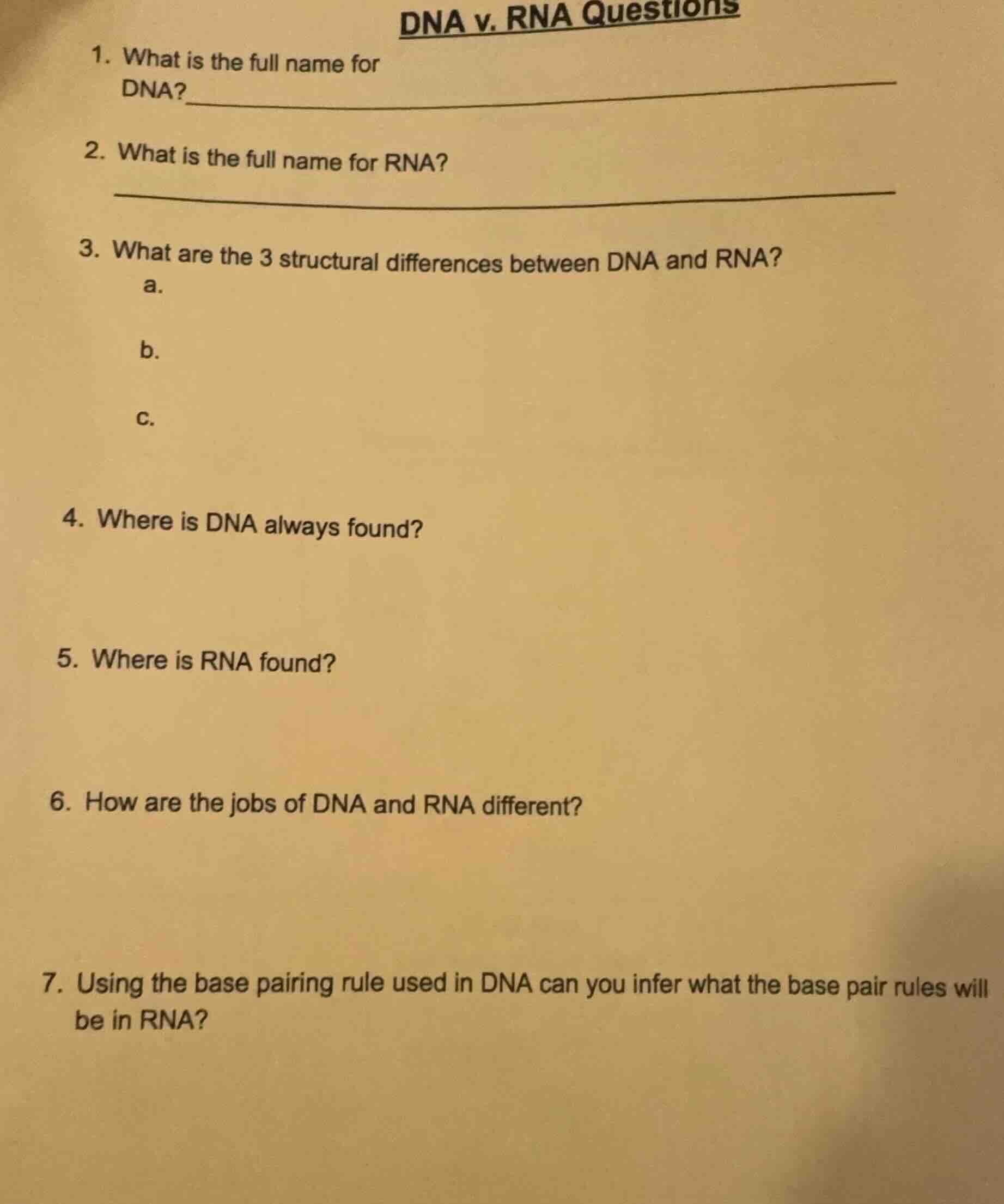
dna v. rna questions
- what is the full name for
dna?
- what is the full name for rna?
- what are the 3 structural differences between dna and rna?
a.
b.
c.
- where is dna always found?
- where is rna found?
- how are the jobs of dna and rna different?
- using the base pairing rule used in dna can you infer what the base pair rules will
b e in rna?
Brief Explanations
- DNA is a nucleic acid that stores genetic information; its full name is a standard biological term.
- RNA is a nucleic acid involved in expressing genetic information; its full name is a standard biological term.
- Structural differences between DNA and RNA relate to sugar, strand structure, and nitrogenous bases.
- DNA's primary location is the nucleus in eukaryotes, with small amounts in mitochondria/chloroplasts.
- RNA is synthesized in the nucleus and functions in the cytoplasm.
- DNA stores genetic code, while RNA executes code for protein synthesis.
- RNA uses uracil instead of thymine, so base pairing adjusts from DNA's rules.

Snap & solve any problem in the app
Get step-by-step solutions on Sovi AI
Photo-based solutions with guided steps
Explore more problems and detailed explanations
- Deoxyribonucleic Acid
- Ribonucleic Acid
- a. DNA has deoxyribose sugar; RNA has ribose sugar
b. DNA is double-stranded; RNA is single-stranded
c. DNA contains thymine; RNA contains uracil
- In eukaryotic cells, DNA is always found primarily in the cell nucleus (small amounts in mitochondria and chloroplasts; in prokaryotes, it is in the nucleoid region).
- RNA is found in the cell nucleus (during synthesis) and the cytoplasm (during function).
- DNA's main job is to store and transmit genetic information long-term, while RNA's main jobs are to carry genetic instructions from DNA to ribosomes, assist in protein synthesis, and perform regulatory roles.
- In RNA, adenine (A) pairs with uracil (U) instead of thymine (T), and cytosine (C) still pairs with guanine (G); when RNA pairs with a DNA template, A (DNA) pairs with U (RNA), T (DNA) pairs with A (RNA), C (DNA) pairs with G (RNA), and G (DNA) pairs with C (RNA).