QUESTION IMAGE
Question
document 1
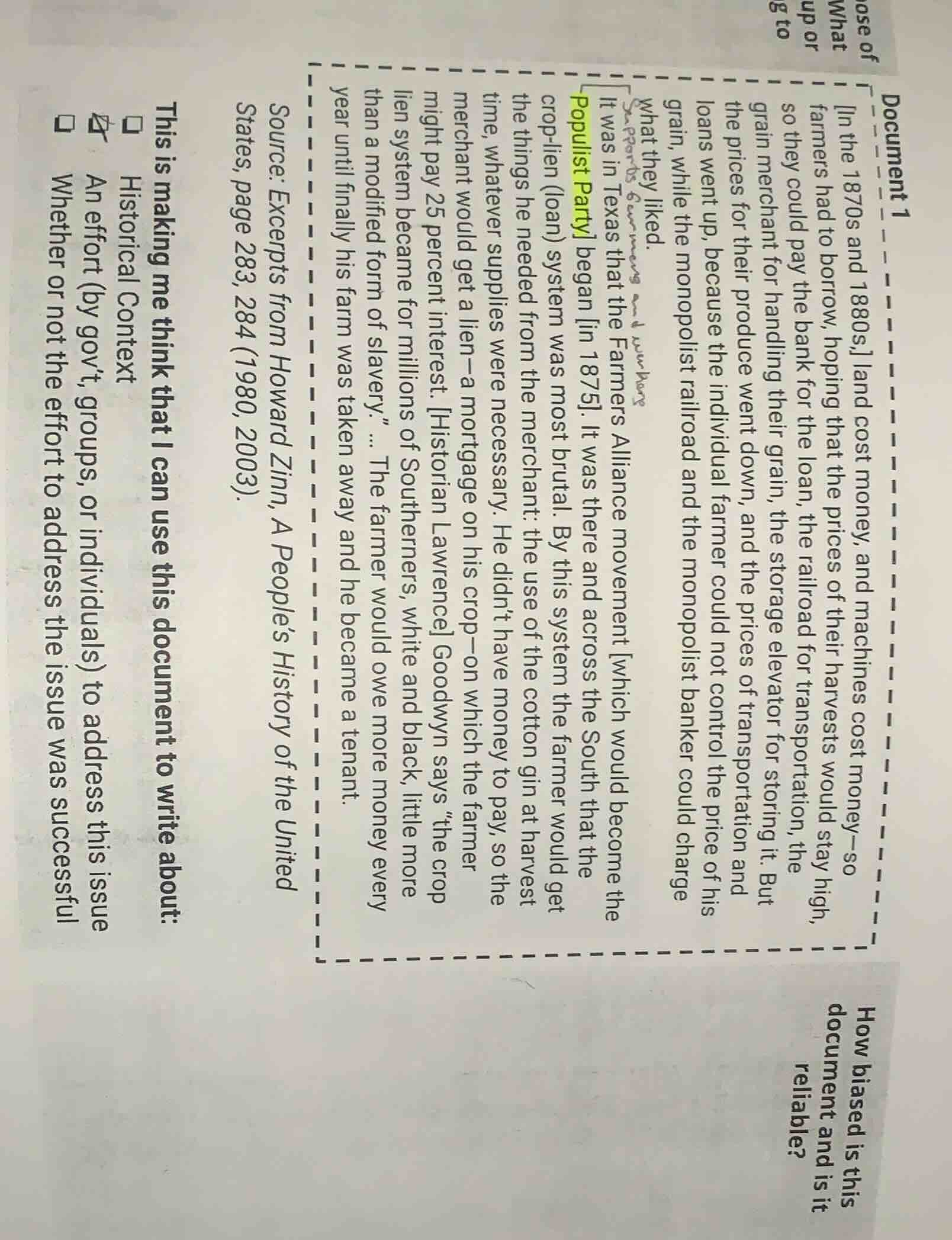
in the 1870s and 1880s, land cost money, and machines cost money—so farmers had to borrow, hoping that the prices of their harvests would stay high, so they could pay the bank for the loan, the railroad for transportation, the grain merchant for handling their grain, the storage elevator for storing it. but the prices for their produce went down, and the prices of transportation and loans went up, because the individual farmer could not control the price of his grain, while the monopolist railroad and the monopolist banker could charge what they liked.
it was in texas that the farmers alliance movement which would become the populist party began in 1875. it was there and across the south that the crop - lien (loan) system was most brutal. by this system the farmer would get the things he needed from the merchant: the use of the cotton gin at harvest time, whatever supplies were necessary. he didnt have money to pay, so the merchant would get a lien—a mortgage on his crop—on which the farmer might pay 25 percent interest. historian lawrence goodwyn says “the crop lien system became for millions of southerners, white and black, little more than a modified form of slavery.”... the farmer would owe more money every year until finally his farm was taken away and he became a tenant.
source: excerpts from howard zinn, a people’s history of the united states, page 283, 284 (1980, 2003).
this is making me think that i can use this document to write about:
historical context
an effort (by gov’t, groups, or individuals) to address this issue
whether or not the effort to address the issue was successful
how biased is this document and is it reliable?
- Bias Analysis: The source is from Howard Zinn, a historian known for a progressive, working-class/farmer-centric perspective. The excerpt frames farmers as exploited by powerful monopolists (railroads, banks, merchants) and frames the crop-lien system as a "modified form of slavery," which is a strongly critical framing that aligns with Zinn's focus on marginalized groups' struggles against elite power. This creates a pro-farmer, anti-corporate/elite bias.
- Reliability Analysis: The document is a secondary source from a well-regarded academic historian, so it is grounded in historical research. However, its strong critical framing means it presents one perspective on the farmer experience and the crop-lien system. It is reliable for understanding the Populist/farmer perspective and the exploitative aspects of the system, but should be paired with other sources to get a full, balanced view of the era's economic dynamics.
- Use for the listed topics:
- Historical Context: It provides clear context for late 19th-century Southern and Western farmer economic struggles, the rise of the Populist Party, and the crop-lien system.
- Efforts to address the issue: It explicitly mentions the Farmers Alliance (which became the Populist Party) as the organized effort by farmers to respond to their exploitation.
- Success of the effort: While it does not directly state the success of the Populist Party, it establishes the harsh conditions that spurred the movement, which can be paired with other sources to analyze success/failure.

Snap & solve any problem in the app
Get step-by-step solutions on Sovi AI
Photo-based solutions with guided steps
Explore more problems and detailed explanations
- Bias and Reliability:
- The document has a pro-farmer, anti-elite/monopolist bias, reflecting Howard Zinn's focus on marginalized groups' struggles against powerful institutions.
- It is academically reliable as a secondary source from a respected historian, useful for understanding farmer exploitation and the origins of the Populist movement, but should be supplemented with other sources for a balanced historical view.
- Use for writing topics:
- It can be used for all three listed topics: it provides key historical context for 1870s-1880s farmer economic struggles, identifies the Populist Party (originating from the Farmers Alliance) as the organized effort to address the issues, and establishes the harsh conditions that allow for analysis of the movement's success or failure.