QUESTION IMAGE
Question
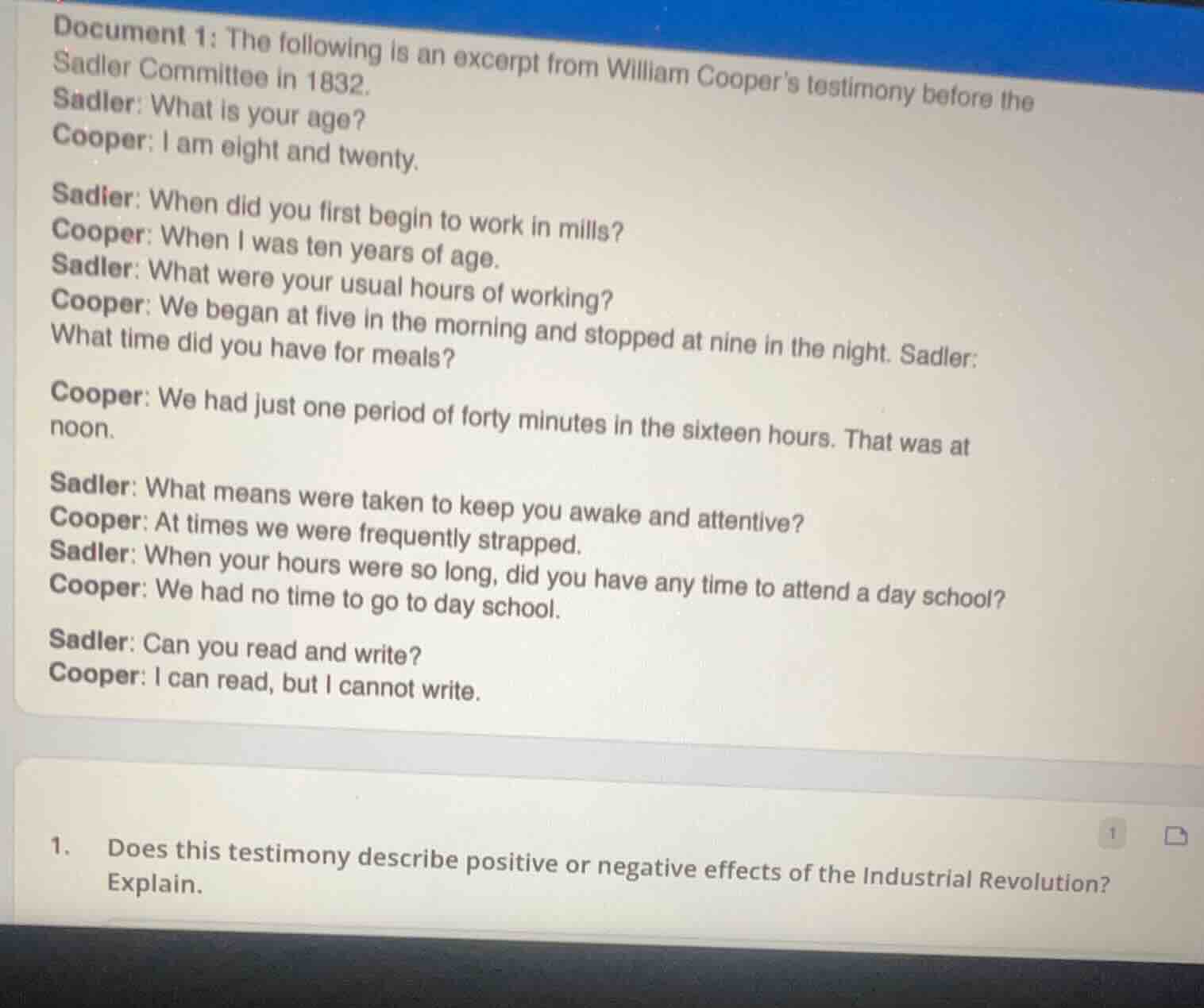
document 1: the following is an excerpt from william coopers testimony before the sadler committee in 1832.
sadler: what is your age?
cooper: i am eight and twenty.
sadler: when did you first begin to work in mills?
cooper: when i was ten years of age.
sadler: what were your usual hours of working?
cooper: we began at five in the morning and stopped at nine in the night. sadler: what time did you have for meals?
cooper: we had just one period of forty minutes in the sixteen hours. that was at noon.
sadler: what means were taken to keep you awake and attentive?
cooper: at times we were frequently strapped.
sadler: when your hours were so long, did you have any time to attend a day school?
cooper: we had no time to go to day school.
sadler: can you read and write?
cooper: i can read, but i cannot write.
- does this testimony describe positive or negative effects of the industrial revolution? explain.
The testimony describes negative effects. Cooper started working at 10, worked 16 - hour days (5 am - 9 pm) with only 40 minutes for meals, was physically disciplined to stay awake, had no time for day school, and couldn't write. These show harsh working conditions, lack of education opportunities, and mistreatment, all negative outcomes of industrialization.
William Cooper began working in mills at age 10, worked extremely long hours (from 5 am to 9 pm, 16 hours total) with only a 40 - minute meal break. He was physically disciplined (strapped) to stay awake, had no time to attend day school, and could not write (despite being able to read). These aspects—child labor, long and harsh working conditions, lack of educational opportunities, and mistreatment—are all negative consequences associated with the Industrial Revolution's impact on workers, especially child workers.

Snap & solve any problem in the app
Get step-by-step solutions on Sovi AI
Photo-based solutions with guided steps
Explore more problems and detailed explanations
This testimony describes negative effects of the Industrial Revolution.