QUESTION IMAGE
Question
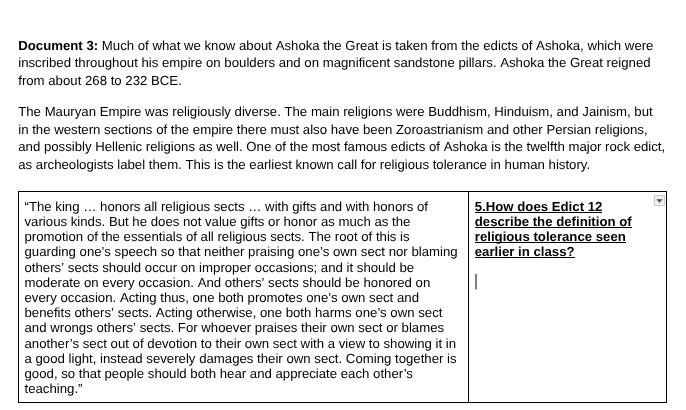
document 3: much of what we know about ashoka the great is taken from the edicts of ashoka, which were inscribed throughout his empire on boulders and on magnificent sandstone pillars. ashoka the great reigned from about 268 to 232 bce.
the mauryan empire was religiously diverse. the main religions were buddhism, hinduism, and jainism, but in the western sections of the empire there must also have been zoroastrianism and other persian religions, and possibly hellenic religions as well. one of the most famous edicts of ashoka is the twelfth major rock edict, as archeologists label them. this is the earliest known call for religious tolerance in human history.
\the king … honors all religious sects … with gifts and with honors of various kinds. but he does not value gifts or honor as much as the promotion of the essentials of all religious sects. the root of this is guarding one’s speech so that neither praising one’s own sect nor blaming others’ sects occur on improper occasions; and it should be moderate on every occasion. and others’ sects should be honored on every occasion. acting thus, one both promotes one’s own sect and benefits others’ sects. acting otherwise, one both harms one’s own sect and wrongs others’ sects. for whoever praises their own sect or blames another’s sect out of devotion to their own sect with a view to showing it in a good light, instead severely damages their own sect. coming together is good, so that people should both hear and appreciate each other’s teaching.\
- how does edict 12 describe the definition of religious tolerance seen earlier in class?
To answer this, we analyze Edict 12 and the concept of religious tolerance:
Step 1: Understand Religious Tolerance
Religious tolerance involves respecting different religious beliefs, allowing their practice, and avoiding discrimination or hostility toward other faiths.
Step 2: Analyze Edict 12’s Content
- The edict states Ashoka “honors all religious sects” with gifts and honors.
- It emphasizes not overvaluing one’s own sect or devaluing others: “one should not be moderate on every occasion. And others’ sects should be honored on every occasion.”
- It warns against harming one’s own sect by praising it excessively or blaming others: “whoever praises their own sect … severely damages their own sect.”
- It promotes mutual respect: “Coming together is good, so that people should both hear and appreciate each other’s teaching.”
Step 3: Connect to “Earlier” Religious Tolerance
In class, religious tolerance (e.g., in ancient contexts) might have been defined as:
- Respecting diverse faiths,
- Avoiding sectarian hostility,
- Encouraging mutual understanding,
- Valuing coexistence over division.
Edict 12 aligns with this by:
- Mandating honor for all sects,
- Discouraging sectarian praise/blame,
- Advocating for shared learning (hearing others’ teachings).

Snap & solve any problem in the app
Get step-by-step solutions on Sovi AI
Photo-based solutions with guided steps
Explore more problems and detailed explanations
Edict 12 defines religious tolerance as honoring all religious sects equally, avoiding excessive praise of one’s own sect or blame of others, and promoting mutual respect/learning (e.g., “coming together to hear and appreciate each other’s teaching”). This matches earlier definitions of religious tolerance (respect for diversity, non - sectarian hostility, and coexistence through shared understanding).