QUESTION IMAGE
Question
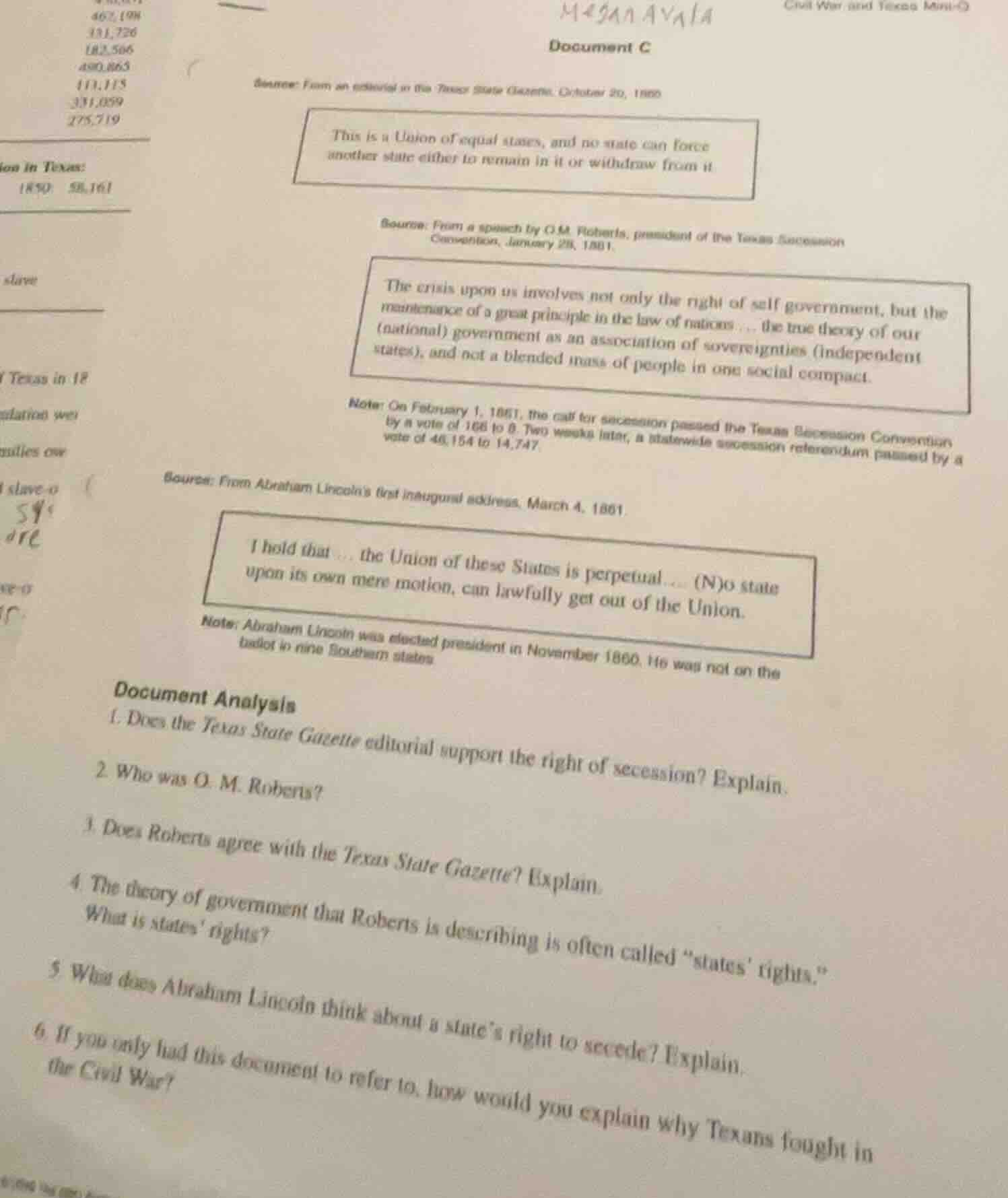
document c
source: from an editorial in the texas state gazette: october 20, 1860
this is a union of equal states, and no state can force another state either to remain in it or withdraw from it
source: from a speech by o.m. roberts, president of the texas secession convention, january 28, 1861
the crisis upon us involves not only the right of self government, but the maintenance of a great principle in the law of nations... the true theory of our (national) government as an association of sovereignties (independent states), and not a blended mass of people in one social compact.
note: on february 1, 1861, the call for secession passed the texas secession convention by a vote of 166 to 8. two weeks later, a statewide secession referendum passed by a vote of 46,154 to 14,747.
source: from abraham lincoln’s first inaugural address, march 4, 1861
i hold that... the union of these states is perpetual... (n)o state upon its own mere motion, can lawfully get out of the union.
note: abraham lincoln was elected president in november 1860. he was not on the ballot in nine southern states
document analysis
- does the texas state gazette editorial support the right of secession? explain.
- who was o. m. roberts?
- does roberts agree with the texas state gazette? explain.
- the theory of government that roberts is describing is often called “states’ rights.” what is states’ rights?
- what does abraham lincoln think about a state’s right to secede? explain.
- if you only had this document to refer to, how would you explain why texans fought in the civil war?
- The Texas State Gazette editorial states the Union is equal states, no state can force another to stay or leave, so it supports the right of a state to secede by affirming states cannot be compelled to remain in the Union.
- O.M. Roberts is identified as the president of the Texas Secession Convention, speaking on January 28, 1861.
- Roberts agrees with the Texas State Gazette: both frame the Union as an association of sovereign states, not a single compact, supporting states' right to self-determination including secession.
- States' rights is the theory that individual states in a union hold sovereign authority, and the national government is an association of these independent states, not a single governing body over a unified people; this means states have the right to govern themselves and make decisions like secession.
- Lincoln argues the Union is perpetual, so no state can lawfully secede on its own; he rejects the right of secession entirely.
- Texans fought in the Civil War because their political leaders (like O.M. Roberts) believed in states' rights and the right to secede from the Union, while the federal government under Lincoln opposed secession, leading to conflict over the sovereignty of Texas and other Southern states.

Snap & solve any problem in the app
Get step-by-step solutions on Sovi AI
Photo-based solutions with guided steps
Explore more problems and detailed explanations
- Yes. It states the Union is equal states, so no state can force another to stay or withdraw, affirming secession as a state's right.
- O.M. Roberts was the president of the Texas Secession Convention (1861).
- Yes. Both view the Union as an association of sovereign states, supporting states' self-determination including secession.
- States' rights is the theory that the national government is an association of sovereign independent states, not a single social compact, giving states the right to self-govern and secede.
- Lincoln rejects secession. He claims the Union is perpetual, so no state can lawfully secede on its own.
- Texans fought because their leaders believed in states' rights and the right to secede, while Lincoln's federal government held the Union was perpetual and secession was illegal, creating a conflict over state sovereignty.