QUESTION IMAGE
Question
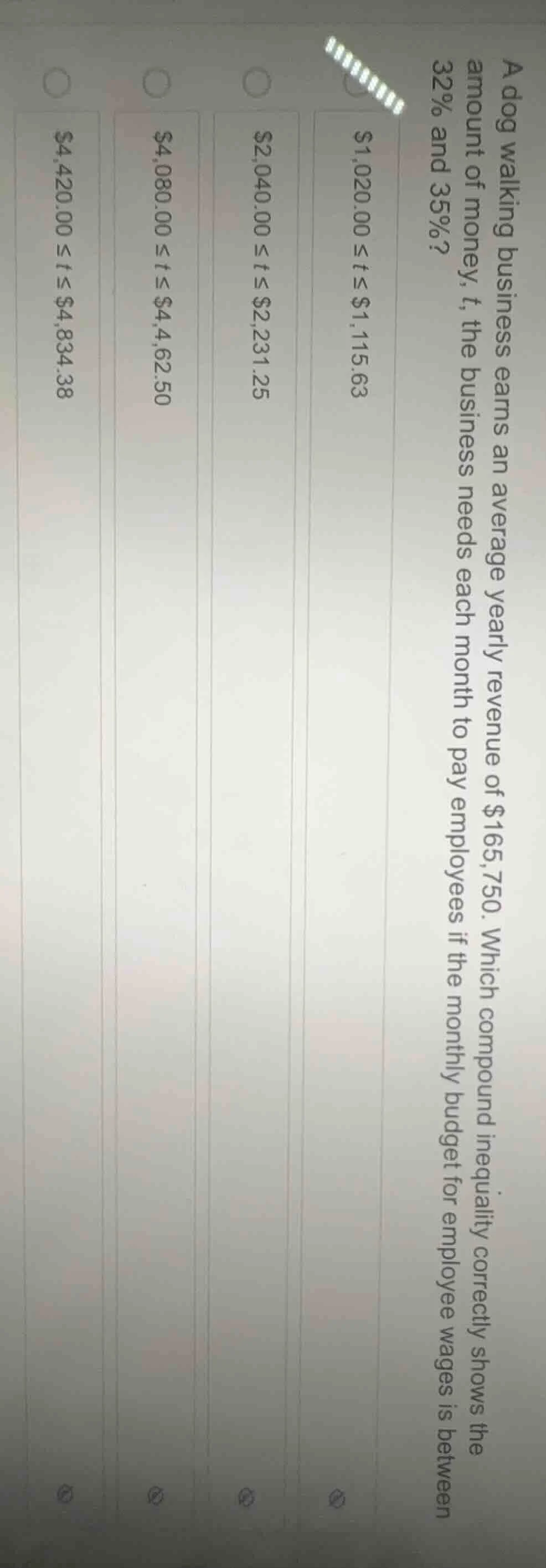
a dog walking business earns an average yearly revenue of $165,750. which compound inequality correctly shows the amount of money, t, the business needs each month to pay employees if the monthly budget for employee wages is between 32% and 35%?
$1,020.00 ≤ t ≤ $1,115.63
$2,040.00 ≤ t ≤ $2,231.25
$4,080.00 ≤ t ≤ $4,462.50
$4,420.00 ≤ t ≤ $4,834.38
Step1: Calculate 32% of yearly revenue
First, find 32% of $165,750. The formula for percentage is $\text{Percentage of a number} = \text{Number} \times \frac{\text{Percentage}}{100}$. So, $165750\times\frac{32}{100}=165750\times0.32 = 53040$. Then, divide by 12 to get the monthly amount: $\frac{53040}{12}=4420$.
Step2: Calculate 35% of yearly revenue
Next, find 35% of $165,750. Using the same percentage formula, $165750\times\frac{35}{100}=165750\times0.35 = 58012.5$. Then, divide by 12 to get the monthly amount: $\frac{58012.5}{12}=4834.375\approx4834.38$.
Step3: Determine the inequality
The monthly budget $t$ is between the two monthly amounts we calculated, so $4420.00\leq t\leq4834.38$.

Snap & solve any problem in the app
Get step-by-step solutions on Sovi AI
Photo-based solutions with guided steps
Explore more problems and detailed explanations
$\$4,420.00 \leq t \leq \$4,834.38$ (the last option)